

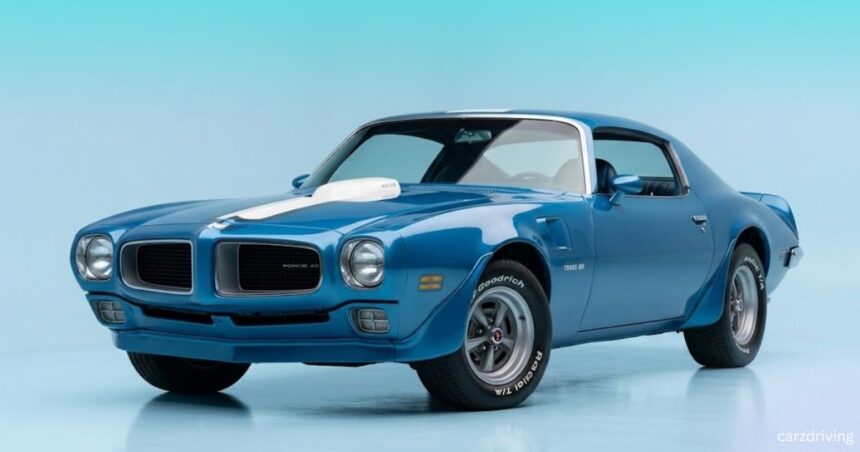
Pontiac Trans Am car carries more history than most people realize, and every chapter of its story deserves a proper look. Let’s walk through how this icon came to life.
Birth of the Firebird
Pontiac worked with its engineers to build something that could outshine the Camaro’s proposed Z/28, and that drive helped Pontiac become a true performance marque within GM.
The new Firebird rode on a shared platform but carried its own design and its own engines, with Coke-bottle styling that gave the sister car integrated front bumpers and a far more streamlined look.
DeLorean loved the Pontiac 3.8-litre, DOHC, inline six cylinder engine, so the team reworked the intake and exhaust systems, and the base car for the 1967 model year carried a one-barrel carb good for 165hp,
while the Sprint option with its four-barrel carb reached 220hp; buyers who wanted more chose from the V8s, including the two-barrel carb 5.3-litres at 250hp, the four-barrel carb version at 285hp, or the 6.6-litre unit borrowed from the Pontiac GTO at 325hp, and by 1968 the Ram Air IV pushed output to 345hp with 430lb ft of torque.
Introducing the Trans Am Car
In March 1969, the first Trans Am arrived quietly as a roughly $1,000 option called the Trans Am performance and appearance package, named after the Trans Am racing series even though the car itself never raced there.
It wore polar white paintwork with twin blue racing stripes, and under the hood sat the 6.6-litre V8 with Ram Air induction, backed by a one-inch front stabiliser bar, a heavy-duty suspension system, variable-ratio power steering, and seven-inch rims.
The hood had functional air inlets the driver could close, rear-facing fibreglass wing scoops vented the engine bay, and a full-width rear spoiler gave the car real sporting appearance; it handled far better than the standard Firebird, even though only 689 hardtops and eight convertibles rolled out in that first year of production.
Firebird Trans Am second generation
The second generation of Firebirds dropped the old ’60s Coke-bottle look for a longer nose and a fast-sloping rear profile when 1970 arrived, and the front end turned more aggressive, swapping twin headlights for large single units around a split grille.
Unlike the first generation, this coupe stayed coupe-only until the convertible returned in 1989, and the Trans Am’s future actually hung in doubt for a while since Pontiac’s Trans-Am racing ambitions were shelved and the marketers worried about losing that competition link.
Thankfully the badge survived, and the ’70 cars came with a functional rear-facing shaker scoop alongside either the 335hp 6.6-litre Ram Air III V8 or the 345hp Ram Air IV, exclusive to the Trans Am, with just 3,196 Trans Ams built out of nearly 49,000 Firebirds.
Huge V8 for 1971 Trans Am
The ’71 Trans Am might have looked like business as usual from the outside, but underneath the hood was a completely different story thanks to the arrival of a powerhouse 7.5-liter V8.
GM’s emissions policies forced lower compression ratios, so engineers built the 455 High Output unit using cylinder heads and a camshaft from the previous Ram Air 400,
paired with the borrowing the aluminum intake manifold straight from the Ram Air IV, the engine saw its compression ratio drop significantly from 10.5:1 down to a milder 8.4:1..
That drop didn’t add raw power, but it made the engine far more reliable, and with 480lb ft of torque arriving at a usable 3600rpm, drivers still felt a serious punch.
Trans Am and the ‘screaming chicken’
Call it the screaming chicken, the firebird, the rising phoenix, or simply the hood bird this outsized bonnet graphic became one of the defining images of ’70s design.
Officially listed as the RPO WW7 Hood Decal, it cost a $55 option on the 1973 Trans Am, and artist Norm Inouye sketched it in 1970 at the request of When GM design guru Bill Mitchell first saw Bill Porter’s giant bird emblem in the paint shop, he absolutely hated its massive size.
Because of his disapproval, early models were restricted to carrying much smaller iterations on the nose..
When John Schinella took over the visuals, he dropped the bonnet stripes, added red and green, and revived the large bird decal, driving a Firebird Formula around town to gauge the reaction and after some pushback from GM management, Shinella won approval, letting the bird grow bigger and more detailed for over a decade.
Facelifts and weight gains
The Firebird gained a new shovel-nose front end for 1974, but mandatory 5mph impact bumpers and other safety measures added real weight to the car.
Emissions regulations chipped away at power output, and 1976 marked the final year for the L75 7.5-litre 455 V8, which simply couldn’t meet the tighter rules anymore.
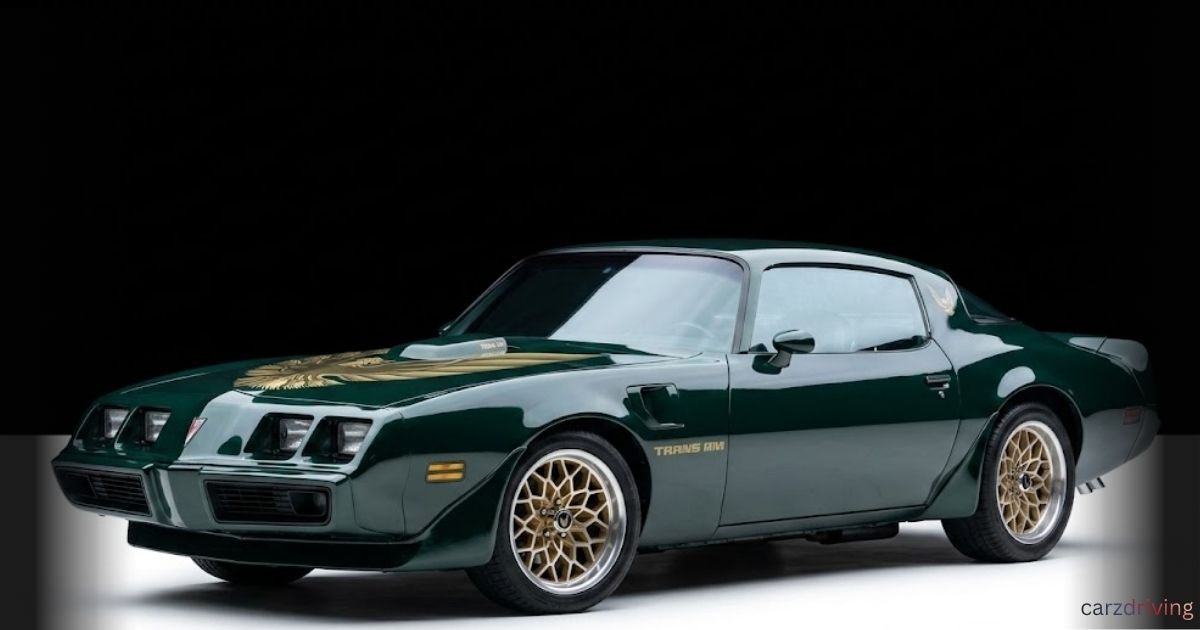
That same year also celebrated Pontiac’s 50th anniversary as a marque, with a special edition black Trans Am wearing gold trim debuting at the ’76 Chicago Auto Show, a colour combination that would soon become utterly iconic.
Trans Am and Smokey and the Bandit
That black and gold colour scheme is exactly what most fans picture when they think of the screaming chicken and Burt Reynolds behind the wheel in the 1977 movie Smokey and the Bandit.
Director Hal Needham, a former Hollywood stuntman, had spotted a Trans Am in a magazine and built his whole film around bootleggers hauling beer across America; GM lent him four cars, and the stunts during filming destroyed three of them, leaving the badly worn fourth to finish the shoot.
Those cars were really 1976 cars wearing the new 1977 facelift, timed for the release date, featuring quad headlamps, a redesigned nose cone, and a lower-profile shaker scoop, with the W72 6.6-litre V8 now making just 200hp and 325lb ft at 2,400 rpm thanks to anti-pollution controls yet the film became a sleeper hit, grossing $300m, second only to Star Wars
and sales jumped from 68,745 units in 1977 to 93,351 in 1978 and 117,108 the next year, overtaking the Camaro and pushing the third generation all the way back to 1982.
Smaller engines and more Bandit fun
By 1980, tougher emissions regulations forced Pontiac to drop its large displacement engines in favor of the 4.9-litre V8, listed as 301 cu in, now the standard unit with no manual transmission offered.
Buyers could choose the Garrett turbo-charged 301 or the Chevy small block 305, a 5-litre good for 200hp, and Needham again borrowed eight turbo 301 Trans Am for Smokey and the Bandit 2, released in August 1980.
Those movie cars carried nitrous oxide tanks for extra performance, and even though the sequel earned less than the original at $66m, it kept the Trans Am firmly in the public eye.
Third Generation Trans Am & Knight Rider
1982 brought the all-new third generation Firebird Trans Am, with an aerodynamic shape and fuel-injected engines that made the car lighter and handled better, with the injected Chevy 5-litre V8 reaching 60mph in under ten seconds and this very generation became famous as KITT, the autonomous car from Knight Rider, running from 1982 to 1986.
The screaming chicken eventually disappeared, and the last Trans Am ran from 1993 to 2002, mostly using Corvette’s 5.7-litre V8 at 325hp, with special editions like the 1994 GT version and 25th anniversary and 30th anniversary editions in ’99; the final collector’s edition came in yellow as a convertible or T-top coupe with black painted alloy wheels and twin black stripes.
This F Body platform, shared with the Chevrolet Camaro, was 230kg lighter than before, promising both performance and economy advantages, and it took its name from the Trans-American Championship, essentially serving as a range-topping options package;
A 1986 example I drove ran the 5-litre Chevrolet V8 with a four-barrel Rochester carburettor making 190bhp and 240lb.ft of torque, sending power to the rear wheels through either a five-speed or, in this case, a four-speed GM box, riding on MacPherson struts and a coil-sprung live axle.
Sized closer to European drivers‘ tastes than its ancestors, it sat near the Capri and Porsche 944 in width, and in white with cross-spoke alloys, pop-up lights, and that signature slit styling at the rear lights, it turned heads everywhere; the V8 sound alone earned approval, the throttle response stayed crisp, and inside, four seats sat beneath gauges that recalled the Rolls-Royce Camargue, shaped like light aircraft instrumentation.
On a short test run, the car proved torque-rich off the line and settled into a relaxed grand tourer ride rather than a stiff sports coupe, and a unit that arrived in 1989, spent ten years in storage, got recommissioned, and stayed with careful UK owners showed just how well the strong parts supply keeps this American classic on the road.
The Trans Am wasn’t yet a thing in 1971
Back in 1969, the base Firebird still dominated the lineup, and by 1971 it still claimed over 23,000 cars of the 53,124 units sold, with the Esprit ranking second and the Formula close behind. That year, Pontiac split the Formula into the Formula 350, Formula 400, and Formula 455, and the top trim could carry the same 455 HO engine found in the real Trans Am, of which only 2,116 Trans Ams left the model year lineup, split between transmission types automatic went to 1,231 units, while manual reached just 885 buyers.
The Screaming Chicken hadn’t arrived yet in 1973, so buyers picked from only two visual configurations, Cameo White with blue stripes or Lucerne Blue with white stripes, and most cars left the factory as V8 engines, with only 2,975 cars running a six-cylinder unit as the standard configuration; the rarest pick by far was the 4-speed, found on just 6% of all Firebirds that year.
This 1971 Trans Am 455 HO for sale
One particular 1971 Trans Am Car I came across sold new at Boomershine Pontiac in Atlanta, Georgia, wearing its original Lucerne Blue setup, confirmed by the PHS documents showing that exact color left the factory.
Interestingly, the buyer ordered air conditioning but cancelled it before delivery, so it got pulled from the invoice, and the dealer, Restore a Muscle car, confirmed through photos that this wasn’t removed later during restoration; the car now sits in tip-top shape with a blue interior, no rust, no rot, and spotless undersides.
Its matching-numbers powertrain still runs the original 455 HO engine paired with a 4-speed transmission, making it one of the rarer Trans Ams from that year, and it sits ready to drive even though nobody knows for certain if the engine was rebuilt;
it still carries power steering, power brakes, the original Delco AM/FM radio, and an odometer reading just 65,496 miles, suggesting it stayed stored most of its life under a careful previous ownership that likely babied it appealing strongly to collectors.
Even at a selling price of $160K, given how rare these early specimens are within Pontiac’s lineup, and buyers who fly in to drive home save real money on shipping costs.
FAQs of Trans Am Car
What made the Pontiac Trans Am so iconic?
Its screaming chicken hood graphic, raw V8 power, and unforgettable role in Smokey and the Bandit turned it into a true American classic.
How much horsepower did the original Trans Am have?
The first Trans Am packed a 6.6-litre V8 with Ram Air induction, delivering serious muscle for its era.
Why is the 1971 Trans Am 455 HO so rare?
Only 885 buyers chose the manual transmission, making this 455 HO matching-numbers beast a true collector’s dream.
What connects the Trans Am to Knight Rider?
The third generation Firebird Trans Am became legendary as KITT, the talking autonomous car from Knight Rider.
When did the Trans Am production finally end?
The beloved Trans Am ran its final lap from 1993 to 2002, closing an unforgettable chapter in Pontiac history.