
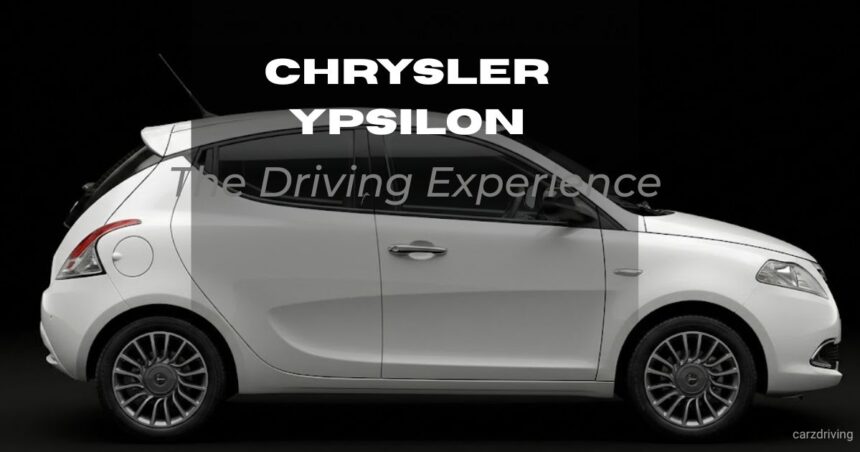
The Chrysler Ypsilon carries an individual design that few cars in the supermini sector can match, and its Fiat TwinAir engine promises drivers close to 60mpg if they drive gently enough.
This badge sits alongside the 300C large saloon and the Grand Voyager MPV in Chrysler’s small line-up, yet the Ypsilon shares far more with the humble Fiat 500 than with its American siblings.
Under the bonnet, buyers can choose the two-cylinder, 875cc, TwinAir turbo petrol engine with 84bhp, a milder 68bhp 1.2-litre four-cylinder, or the 94bhp 1.3-litre M-Jet diesel, and a semi-automatic transmission option exists too.
Chrysler Ypsilon
When the range got revised in 2014, Chrysler added fresh trim levels called Silver, Gold, Platinum, SE, and S-Series, giving shoppers more choice than before.
The car’s size, price, and model positioning echo the MINI in some ways, since both brands bank on premium prices justified by being stylish.
This formula isn’t new though the Italian brand Lancia perfected it long before the modern MINI ever reached European roads, offering city folk comfortable, chic, and responsible city runabouts dressed in cutting edge technology.
That’s exactly what the Ypsilon is underneath its badged Chrysler shell. Back in 2011, the Fiat group chose this branding route for the UK market, even though elsewhere in Europe the same car wore a Lancia badge, a name absent from the British market since 1994.
Rather than reviving Lancia in Britain, the conglomerate decided to re-badge the car and lean on Chrysler’s existing dealer network, since that model line-up badly needed a small car.
Underneath, the underpinnings come from the platform shared with the Fiat Panda, stretched slightly beyond the tiny Fiat 500 city runabout, giving the Ypsilon claimed versatility closer to a
Fiesta-sized supermini while keeping the urban chuckability of a Ford Ka or Toyota iQ bold marketing that aimed to win over buyers eyeing the Audi A1 before the car’s sales reality fell short and Chrysler eventually exited the UK market in 2015.
Design, Engineering & Brand Origin
I’ve always found it funny how confusing the Ypsilon’s badge story gets once you dig in.
The Chrysler Ypsilon isn’t really an American Chrysler at all it’s an Italian Lancia wearing borrowed clothes, and Lancia’s history is full of genuinely interesting cars.
Sadly the brand earned a poor image during the 1980s thanks to the Lancia Delta, which suffered badly from rusting caused by poor quality steel, and that disaster led to the brand being withdrawn from the UK while soldiering on in Italy.
Decades later, the comeback finally arrived, but only under a Chrysler badge, complete with Fiat engines because Lancia has belonged to the Fiat Group since 1969,and Chrysler formed its own global strategic alliance with Fiat back in 2009.
So really, you’re buying a Lancia with a Fiat engine, which explains its unique appearance atop a typical Fiat Group car platform shared with the Fiat 500 and Panda.
Despite technically being a supermini, the engines on offer feel small, especially the two-cylinder turbo petrol TwinAir engine, which is genuinely award-winning and fun to drive, though hitting the claimed fuel economy figures in real life proves tricky.
The exterior and interior both show flashes of design touches worth admiring, yet one quirk spoils things the speedometer sits on the passenger side, forcing your eyes off the road just to check your speed.
Add a driving position hampered by a steering wheel lacking enough adjustment, a genuinely narrow interior, and a frustrating rear-three quarter view, and you start to see why reviewers complain.
The line-up itself stays simple: a 5dr Hatch available with 1.2 petrol, 0.9 TwinAir turbo petrol, or 1.3 MultiJet diesel power.
Interior & Equipment
Sit inside and you’ll notice Chrysler marketed the Lancia-branded car using big words like premium and luxury at the UK launch, language that promised more than the cabin delivers compared with rivals like the Ford Fiesta or Volkswagen Polo.
Still, the interior styled cabin has charm the gearlever on manual models sits neatly on the dashboard within easy reach of the steering wheel, and the instrument binnacle sits centrally mounted, though the speedometer placed on the left annoys anyone in a right-hand drive car.
Four six-foot adults fit comfortably, although claustrophobic rear passengers will dislike the limited glass area back there.
Luggage space measures 245 litres with the rear seats up, beating the Fiat 500 easily but trailing typical supermini and city cars rivals.
Climb high enough up the range and the Ypsilon becomes genuinely well equipped, since the top Platinum trim throws in automatic climate control, air-conditioning, cruise control, part-leather upholstery, the cleverly named Magic Parking system, and electrically operated rear windows found nowhere else in the range.
Chrysler’s designers clearly aimed to sit between the Ford Ka-style Citycar and Ford Fiesta-style Supermini sectors for overall size, passenger accommodation, and bootspace, justifying their pricing through claimed segment-leading luxury and eye-catching design.
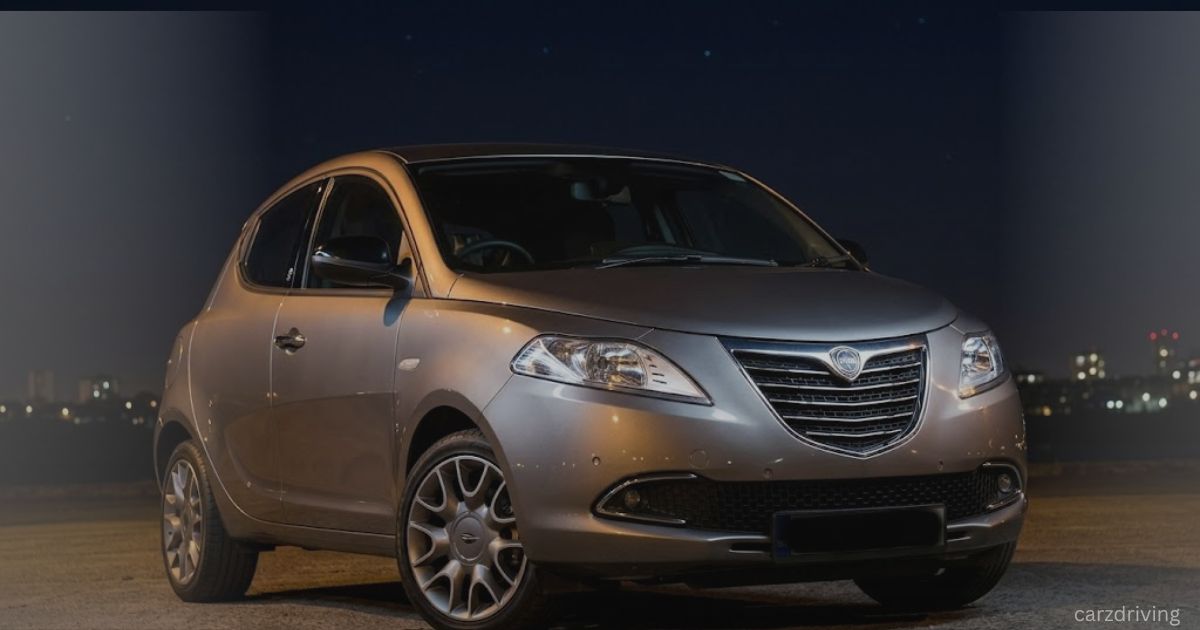
That eye-catching look comes from sharp projector headlamps flanking the shield-like front grille, plus a two curves silhouette borrowed loosely from the Delta hatchback one line tracing the bonnet, waistline, and rear pillar, the other following the A-pillar, roofline, and tailgate window.
The style won over fashion-conscious Italian shoppers more than British streets ever appreciated, and what looks like a sporty three-door actually hides rear door handles inside the C-pillar.
Inside the cabin, headspace stays generous despite tight legroom across the 3.8m body, helped slightly by slim seat technology, while plusher trims even add seat belts for three across the back, and the boot benefits from extra wheelbase length over the Fiat 500 donor design, raising luggage capacity from 185 litres to 245-litres still behind the Fiesta or Corsa, though split-folding rear seats (50/50 or 60/40) help.
The unusual instruments sit atop the centre console rather than ahead of the driver, a layout cheaper to engineer for right hand drive markets, though the dark cabin feels gloomier than the light, airy atmosphere of a Fiat 500, especially with optional piano black trim.
Built in the same Polish factory as the Fiat 500, the cabin feels ergonomically sound once you learn the switch gear, and although rearward visibility could improve, a height-adjustable driver’s seat and a wheel adjustable for rake and reach make finding a comfortable driving position easy enough.
Driving, Performance & Ride
Behind the wheel, the Ypsilon I tested felt defined by a genuinely bouncy ride paired with a revy engine that hits the rev limiter surprisingly often, making it fun to drive around urban areas for short hops.
Long distances on motorways expose the car’s weaknesses though, since its tiny engine struggles up hills at motorway speeds, and cabin noise insulation leaves a lot to be desired.
The soft suspension combined with steering that isn’t the sharpest in class discourages spirited driving on twisting B-roads due to poor body control, and the car still crashes over potholes while its narrow track can’t straddle speed bumps properly.
Our test car came with a five-speed manual gearbox that worked fine, though the semi-automatic five-speed transmission promises better miles per gallon colleagues on our team who tried it gave largely unfavourable reports. Numbers tell their own story: the diesel and TwinAir share similar straightline performance, reaching 0-62mph in 11.4 seconds and 11.9 seconds respectively, while the 1.2, though less economical, costs cheaper and only needs 13.4 seconds for the same sprint, which feels adequate around town.
Few owners ever push toward the max, but the diesel alone tops 110mph, beating the 1.2’s 101mph and the TwinAir’s 109mph.
On the road, comparing it with the Fiat 500 feels unfair, since that car’s road manners get forgiven for being cute, while the Chrysler gets criticised because it isn’t in truth neither car drives badly,
But the Ypsilon’s major controls feel like they’re made from bubblegum, and open road ride and handling stays merely okay, with town driving hampered mainly by poor rear visibility when reversing.
Tucked under the bonnet, the 875cc TwinAir counts among the most advanced engines built for a small car, with its 85bhp petrol unit squeezing sparky performance from just two cylinders, reaching sixty in barely 11 seconds on the way to a top speed near 110mph,
all while keeping CO2 emissions lower than any rival quantity production petrol engine of its era we loved this unit in the Fiat 500, and although its thrum suits the more upmarket Chrysler slightly less well, it still gives the Ypsilon a distinctive-sounding character.
The entry 69bhp 1.2-litre petrol option feels noticeably feeble by comparison, needing 14 seconds to reach sixty and barely scraping past the three-figure mark, while the 95bhp 1.3-litre Multijet diesel rarely justifies its £1,000 price premium given how close its performance and running costs sit to the petrol TwinAir model.
Chasing the headline fuel and CO2 figures means pressing the ECO button on the dashboard below the centrally mounted instrument binnacle, which sadly cuts pulling power by 50% down to roughly 100Nm of torque, similar to the base 1.2-litre petrol model.
Around town, drivers can also flick the City button to lighten the power steering for easier manoeuvring and parking, or skip the effort entirely with the optional Magic Parking system,
which auto-steers into tight spots, while the ride quality soaks up potholed streets, speed-humped streets, and cobbled streets with ease though the five-speed manual gearbox can feel notchy, making the rarely chosen auto gearbox (limited to TwinAir buyers) worth seeking out.
This car clearly suits life on the back streets of Naples more naturally than serving as a long-haul open road companion for British buyers, even though its power steering stays reasonably direct for fast cornering and the car still turns in more willingly than several small car rivals. Refinement at low speeds suffers from the thrumbly rumble of the 0.9-litre engine, though things calm down at speed on major roads thanks to a specially developed roof lining that cuts noise levels by up to 50%.
Economy, Emissions & Cost
Numbers matter most here, and our test car posted an official fuel economy figure of 67.3mpg, with the semi-automatic version edging slightly ahead at 68.9mpg though we’d happily give up that gap and stick with the manual box.
The TwinAir engine impresses on paper, yet matching its official economy figures in real-life driving proves genuinely hard; our test average over a week landed at just 44.5mpg,
roughly 20mpg below the claim, even though disciplined eco-driving techniques can lift results into the mid-50s for patient motorists willing to fight urban traffic with a light right foot at the fuel pumps.
Most drivers, though, will simply enjoy the engine’s revvy, responsive nature and its characterful note (call it noisy if you prefer) rather than chasing economy figures.
Pricing for the range starts at £9,995 for the 1.2-litre petrol engine, which posts the weakest fuel economy and CO2 figures at 55.4mpg and 118g/km (or 54.3mpg and 120g/km without the start/stop system).
Both the TwinAir and diesel sit under 100g/km, earning exemption from Vehicle Excise Duty, with the EU test rating the diesel at 74.3mpg, the TwinAir manual at 67.3mpg, and the automatic at 68.9mpg, though matching these figures in any TwinAir-engined car remains tough.
At the top, the TwinAir Platinum automatic costs £15,095, with every price assuming Clay Red paint as the only standard colour anything else adds £495, and bi-colour or tri-colour options cost even more. For exact figures today, it’s worth filling in a dealer form to get up-to-date information.
Price, Equipment & Model Range
Chrysler offers three engines across the Ypsilon line, starting with the petrol 1.2 Fire EVO II, 69hp, Start&Stop unit don’t let the ‘Fire EVO’ label fool you into thinking rally car engine performance, since 69hp tells the real story.
This engine emits 115g/km CO2 alongside 57.6mpg, making it the cheapest route into Ypsilon ownership at £10,695 for the 1.2 S. Buyers wanting better official economy should look at the diesel 1.3 MultiJet, 95hp, Start&Stop, which manages 74.3mpg and suits longer journeys best.
The TwinAir matches the diesel for emissions at 99g/km (97g/km for the semi-auto), though its 67.3mpg can’t quite reach diesel economy, and both TwinAir versions earn exemption from the London Congestion Charge.
Three trim levels exist S, SE, and Limited with SE adding air conditioning and alloy wheels, though oddly no standard stability control.
Pricing runs from £13,195 for the TwinAir SE manual to £14,395 for the semi-auto TwinAir SE, making the car feel expensive against its competitors, and some buyers still quietly worry about reliability given the car’s Lancia origins.
On the used market, an entry-level 1.2S model typically costs between £4,500 and £5,500, though it’s worth stretching £300 to £400 further for the SE variant, since the base car feels sparsely-equipped.
The pick of the range remains the 0.9-litre turbocharged petrol TwinAir model, which usually commands a premium of around £600 over an equivalent 1.2 SE variant money well spent in my view.
Conclusion
After spending real time with this car, I’d describe the Chrysler Ypsilon as a genuinely unique-looking vehicle, fun to drive around town, with its revolutionary two-cylinder engine producing an interesting noise that matches its interesting design.
Some buyers still carry memories of Lancias from the 1980’s, yet I can’t help feeling the car would carry more appeal wearing its original Lancia badge, since at heart this is a characterful Italian supermini whose spirit sits awkwardly against Chrysler’s brand values.
We’d choose the manual box over the semi-automatic every time, and every TwinAir-engined model deserves a health warning: don’t expect anywhere near the official fuel economy figures without a properly disciplined driving style.
Our own Green Car Guide rating lands at 6 out of 10 we admire the Lancia heritage behind it, but stacked against rival superminis, it feels like a class down offering, which makes sense given its Fiat 500 city car platform, and that holds it back from genuinely competing with the best in class.
You rarely spot Ypsilons on the road, and that rarity, plus its risky styling, leads many shoppers to dismiss it at first glance.
Strip away first impressions, though, and you’ll find a fairly good car not a great one, admittedly but one that lets you genuinely stand out from the crowd rather than blending into traffic like every other supermini.
Had Chrysler’s American engineers built this from scratch instead of borrowing a Lancia design, I doubt they’d have topped it; the distinctive styling and frugal TwinAir petrol engine remain strong draws for anyone shopping used buy, backed by genuinely low running costs.
Stay away from the bottom end of the range, and specification turns reasonable, with plenty of hi-tech options easing the process of downsizing into a car like this true,
it lacks the built solidity of something German, but given its humble underpinnings, Chrysler’s designers still delivered a high quality-feeling product that won’t crowd British roads, leaving its appeal mostly to a select band of loyal UK buyers chasing something genuinely different in the small car class.
What to Look For
Talking to owners reveals real affection for this car research among UK buyers who actually bought a Chrysler Ypsilon turns up mostly happy feedback.
The one recurring complaint involves an electrical issue that randomly switches the headlights off at night, usually fixed by replacing the headlight column switch and running an update on the car’s body computer.
As with any citycar-sized models, check carefully for fabric tears, scratches on the plastics, stains on the upholstery, and the usual wheel scrapes before buying.
Replacement Parts
Budgeting for a used Chrysler Ypsilon stays fairly painless, based loosely on a 0.9 TwinAir, 2013 example priced ex VAT.
Parts pricing runs reasonably brake discs cost between £55 (Mintex) and £68 (Brembo), with brakepads around £30, an air filter near £20, and oil filters ranging from £8 to £15.
A water pump costs roughly £61, while a thermostat falls somewhere between £46 and £70, keeping running costs genuinely manageable for owners.
FAQs of Chysler Ypsilon
Is the Chrysler Ypsilon really a Lancia?
Yes, the Chrysler Ypsilon is built on Lancia origins, wearing a Chrysler badge mainly for the UK market.
What engines does the Chrysler Ypsilon offer?
Buyers can choose the TwinAir engine, a 1.2-litre petrol, or a 1.3 MultiJet diesel, each suited to different driving needs.
Does the Chrysler Ypsilon get good fuel economy in real life?
Official figures claim up to 74.3mpg, but real-life driving often falls well short, especially with the TwinAir engine.
Is the Chrysler Ypsilon reliable?
Most UK buyers report few issues, though the occasional electrical issue affecting the headlights has been noted.
Why did the Chrysler Ypsilon struggle in the UK market?
Despite its bold Italian design and Lancia heritage, it struggled against tougher supermini rivals and quietly left the UK market in 2015.