

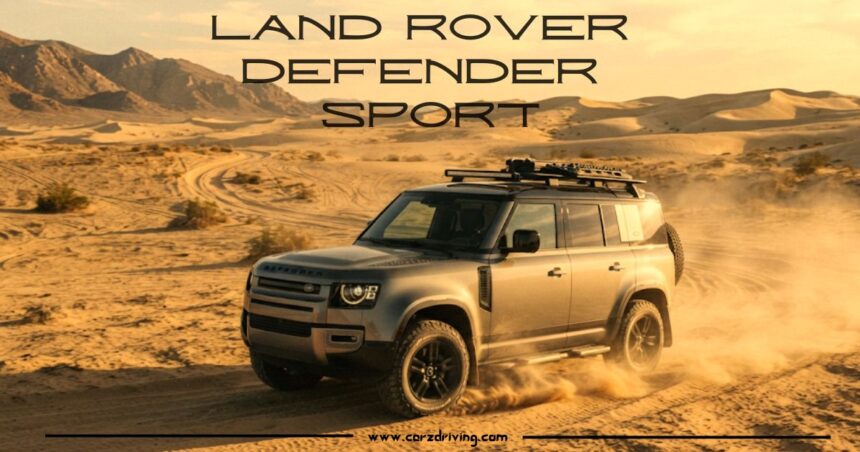
I’ve followed the Land Rover Defender Sport story for years, and this next chapter feels different. JLR is building a second model, and it will sit under the Defender name as a smaller sibling to the current lineup.
Word on the street calls it the Defender Sport, though Mark Cameron, managing director of the brand, hasn’t confirmed the Sport name or given a firm timescale.
What he has confirmed is that the car will run on the EMA platform, and it will offer both HEV and BEV power, unlike a pure electric-only setup.
The Land Rover Defender Sport
This isn’t just a smaller Land Rover Defender squeezed down. Picture something that’s been through the wash and come out shrunk: same tough styling, same off-road prowess, but a smaller shape and hopefully a smaller price tag near £50,000.
Expect squared-off lower quarters, body cladding along the lower edges, and a tall boxy roof that gives occupants good visibility.
It should also carry the outdoors-themed add-ons the brand is known for, like roof racks, room for bikes and kayaks, and even a portable rinse system for washing off after a day in the great outdoors.
Six years on from launch, the Defender brand has grown into a genuine luxury SUV, a global icon that goes toe-to-toe with the Mercedes G-Class and the Toyota Land Cruiser.
It’s no longer the underdog hero it once was as a simple Land Rover model line; it’s become its own brand, part of the House of Brands structure that also holds Range Rover and Discovery.
This entirely new product, spotted testing on UK roads, will carry an expanded range of Defender products and needs to convince die-hard fans it deserves the legendary badge on its bonnet.
From mild-hybrid diesels to the riotous V8, right up to the compact version and the eight-seat Defender 130, the range is broad, class-leading in the traits that matter, refined, cool, and supremely capable off-road ability, though you’ll pay handsomely and need to trust the badge before you buy.
At a Glance
Here’s the short version. The Pros: superb off-road ability, surprisingly agile on tarmac, and characterful styling inside and out.
The Cons: it’s expensive for a working 4×4, it’s weighty and thirsty whatever engine you pick, and there’s a question mark over its reliability reputation.
Defining Defender as a Brand
Cameron says the last three years since the new plan was announced have gone into building out what Defender stands for.
His design and engineering teams drew what he calls the red line, a circle every Defender has to sit inside that’s the DNA. Today the badge covers the 90, 110, and 130 bodystyles, plus the Octa variant and the commercial Hardtop.
The goal, in his words, is turning Defender into a proper luxury lifestyle brand. Right now it’s one model with several variants, but he’s planning seven to 10 years ahead to build out a full brand portfolio.
Everything the team does has to carry that epic built-to-last, go-anywhere capability while developing new products that fit the same mould.
Work ‘Well Advanced’
The Defender Sport isn’t a battery version of the Defender 90 it’s a genuinely entirely new product, shaped by design differences that come from a bespoke electric-first platform.
Tipped at just over 4.5m, it rides on the EMA platform, the same base that will underpin future EVs like the Range Rover Evoque and Velar.
The premium-focused Range Rover and Defender stick with the MLA platform, while Jaguar uses its own bespoke EV architecture called JEA.
Underfloor batteries bring vehicle constraints, and Cameron admits wheel travel and articulation will likely drop compared with today’s truck.
Still, the promise is that it stays class-leading and keeps four-wheel drive, hinting at a dual-motor set-up.
Chasing efficiency for EV design key for range from the battery or fuel economy from a hybrid clashes with the silhouette buyers expect: upright, sharp window angles, a bluff rear end. That capability carries a penalty against range, but Cameron insists keeping Defender’s DNA matters more than becoming just another SUV brand.
Test cars have already been caught by spy photographers, and the project is well advanced, with the firm sticking to its usual test cycles full winter test cycles and hot weather test cycles rather than rushing to match Chinese brands’ speed to market. JLR won’t sacrifice quality and longevity for shorter product development time.
On sourcing, the firm weighs where to partner and where to build in-house, since battery pack and electric drive units have become commodities, but torque characteristics and off-road drivability are harder to buy in.
What’s New?
The current Defender launched in 2020, right into lockdown, and the range has kept growing and expanding since.
First came 90 and 110 bodystyles, then the ultra-long eight-seat 130. After that came the Defender V8 with its old 5.0-litre V8, followed by the Octa running a BMW 4.4-litre V8.
The 2026 model year brings the closest thing to a facelift so far revised front and rear lights, new alloy wheel designs and colours, plus fresh front and rear bumpers that are hard to spot at a glance.
There’s also a bigger 13-inch touchscreen filling more of the dashboard, and optional off-road adaptive cruise control.
The standout change is the special edition Trophy model, a nod to the old Defender Camel Trophy.
It comes in Deep Sandglow Yellow or Keswick Green, with an optional matte protective film, 20-inch black alloys that look like steelies, and all-terrain tyres.
Add the Trophy Edition Accessory Pack for £4,995 and you get a black bonnet, gloss black wheelarch surrounds, an expedition roof rack, side ladders, side carriers, and a raised air intake the full set of Defender accessories.
Brand Building
Cameron won’t share specific product plans past the first EV, but when asked how large the Defender line-up could grow, his answer was simple: huge.
Expect multiple powertrain options, driven by the complexity of EV adoption, where customer demand still lags behind what legislators expect. That matters because of the brand’s global footprint most UK sales stay diesel, while the biggest market is now the US, where electrification sits on the back burner.
The strategy is choice for as long as possible. Given the capabilities, toughness, weight, and geometry of the truck, petrol and diesel with hybridisation will stick around.
Today’s plug-in hybrid powertrain uses a four-cylinder engine with limited electric range because the D7 platform wasn’t built for it that changes with future generations and different architectures.
International focus could shape the vehicle types on offer across different geographies. The red line stays fixed: any new Defender, whether smaller, bigger, longer, or higher, must keep the same characteristics.
It’s not about volume it’s a profitable, margin-led business built around customer needs in fresh segments and markets, the same way JLR, Range Rover, and the Evoque created the rugged SUV segment by finding white spaces rather than chasing numbers, all part of the wider business plan.
Where the Defender Sport Will Differ
The Defender Sport splits from its larger sibling mainly in how it’s powered. It shares underpinnings with the next-generation Range Rover Evoque and Range Rover Velar, both built with an electric version in mind from day one.
That timing makes sense: it lands in 2027, just three years before the proposed ban on new petrol and diesel cars in the UK, and it fits Jaguar Land Rover’s plan for an electric model across every product line by 2030.
The regular Defender can’t go fully electric because of its older underpinnings, so it stays on plug-in hybrid power until roughly 2035.
Production will happen at the Halewood plant in Merseyside, alongside the Evoque and Velar, currently being upgraded to build EVs though PHEV models might join them too, given how well JLR’s plug-in hybrids sell.
Details on battery size stay thin, but expect two motors for four-wheel drive and a range of at least 250 miles between charges. Tata, the parent company, will build the batteries at a new facility in the UK.
On charging, expect access to the fastest charging points, up to 350kW, meaning a 10-80% top-up in about the time it takes to grab a coffee. By launch, rivals will include a new off-road Audi, the Mercedes EQG, an electric 4×4 built in the spirit of the G-Class, plus an electric Toyota Land Cruiser. Today’s Audi Q4 e-tron, BMW iX3, and Skoda Enyaq iV count as rivals too.
Interior & Infotainment
Inside, the Defender Sport should follow the bigger car’s lead with a rugged, modern interior. Materials stay fairly utilitarian think rubberised trim and wipe-clean leather surfaces built for family life.
The infotainment system will likely build on the current 11.4in touchscreen, known for sharp graphics, and a digital instrument panel should come as standard.
Where the regular Defender offers 90, 110, and 130 with seating for up to eight people, the Defender Sport is tipped to stick to one length and five seats. Pricing sits close to £50,000, slotting it neatly between the Discovery Sport and the full-size line-up.
Related: Range Rover EV
Land Rover’s first fully electric model, due later this year, is a battery-powered version of the Range Rover, aimed at the BMW iX and Mercedes EQS SUV.
It shares underpinnings with the petrol, diesel, and hybrid versions already on sale, and promises true Range Rover values off-road ability, usability, and refinement. The Range Rover EV should carry a 110kWh battery with a longer range than the 292 miles claimed by the Jaguar I-Pace.
What Are the Specs?
The current truck sits on what JLR calls Project L663, based on the D7 Premium Lightweight Architecture, or PLA, an aluminium platform developed further into the D7X (Extreme) monocoque, claimed to offer three times the structural rigidity of its rivals.
That means it handles serious loadings well, which shows up in both its off-road ability and its on-road poise.
Off-roading figures are strong: approach angles of 38 degrees at the front and 40 degrees at the rear with air suspension fitted, letting it climb and descend those same angles.
Wading depth reaches 900mm, up from 500mm on the old Defender, and the electrical system meets IP67 standard, meaning it can stay submerged in water for one hour without damage.
The short 90 and longer 110 differ slightly the ramp breakover angle drops from 31 degrees to 28 degrees on the extended wheelbase.
Engines cover petrol, diesel, and hybrid variants, though derv models still sell best. Diesels include the four-cylinder D250 and six-cylinder D350, hitting 62mph in 7.9 seconds and 6.1 seconds, claiming around 33mpg.
On petrol, the basic option is a detuned 5.0-litre V8, called the P425, needed to stay emissions compliant, reaching 62mph in 5.5 seconds at just 20mpg. The P525 V8, offered only on 90 and 110 versions, uses the same unit with a sharper tune for 4.9 seconds.
The plug-in hybrid, originally rated at 395bhp from its 2.0-litre petrol-electric setup, now sits at 296bhp for emissions reasons, with a real-world range of only around 20 miles mostly useful for cutting company car tax.
What’s It Like to Drive?
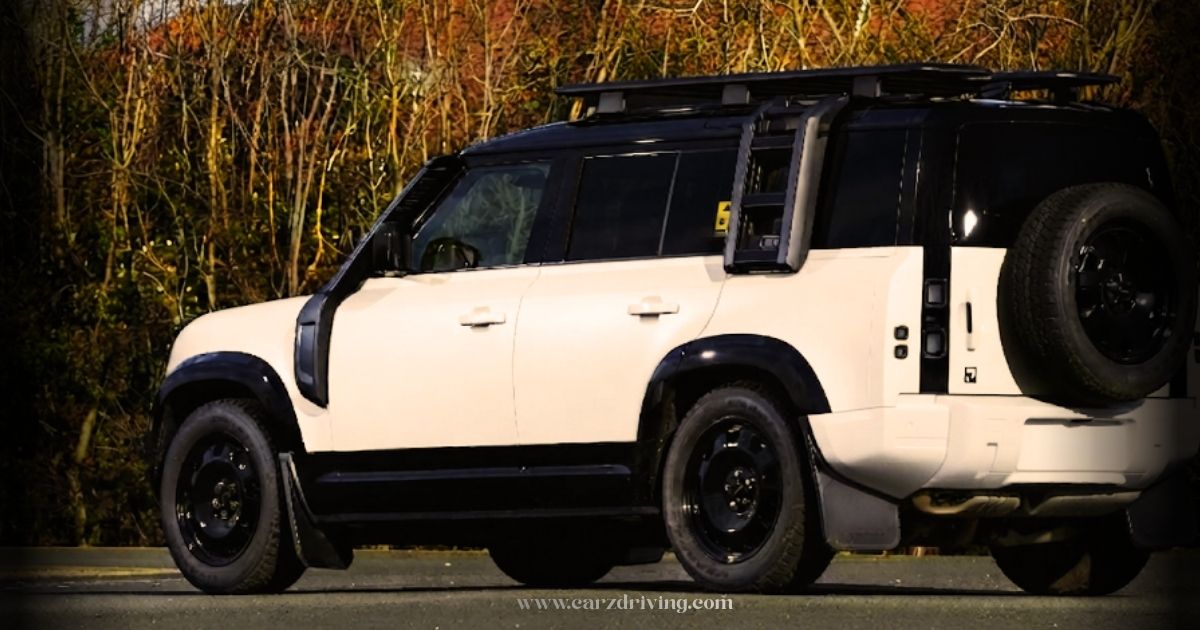
I’ll admit I didn’t expect this level of agility. It’s no sports car, but the direct steering and well-weighted steering build a positive relationship with the road, and with air suspension fitted, the compliant ride and excellent body control genuinely surprise you. It has to compete against car-based SUVs pretending to be off-roaders, and it holds its own.
Through corners, the accuracy stands out easy to place, faithful through bends, an enjoyable steer on the right road.
At speed it stays restful, with barely any wind noise unless you’ve fitted a roof rack (which sounds like a helicopter past 60mph), and it shrugs off crosswinds while the Ingenium diesel stays hushed and responsive.
Off-road testing at Eastnor Castle, a proper off-road development site steeped in Land Rover history, shows its home turf advantage.
Running on all-purpose tyres over courses built by the firm’s engineers, it handled rutted, muddy tracks, steep, slippery inclines, and thick mud with ease, helped by height-adjustable air suspension on the 110, low-range transmission, a locking centre diff, and active rear locking diffs, all working with Terrain Response and Hill Descent.
The steering, throttle, and visibility give real confidence, turning ordinary drivers into capable off-road adventurers even across something as tough as the Darrien Gap.
A drive down a green lane in thick mud proved the point further: switching to mud/ruts mode kept it moving where rivals would get stuck.
The air-sprung arrangement helps most here, though even the 90 on standard coil springs managed two hours of jolting across scarred trail tracks without a winch, limited only by traction, since it lacks the ride height boost to 291mm the air-equipped car gets.
That said, the 90’s nimbleness shows off-road too, weaving around tree stumps, boulders, and earth banks with real ease.
What’s It Like Inside?
The interior blends the original functionality with modern tech and equipment — exposed screw heads and ruggedised surfaces sit next to aluminium panels that look genuinely classy. It’s not quite premium, but there’s a real sense of quality mixed with toughness.
Some un-Defender-like touches show up too, like padded armrests, soft-feel surfaces, and an optional central front seat you can swap for a central storage area with cupholders. Storage areas are everywhere, from deep door pockets to a handy dashboard shelf.
The Pivi Pro infotainment system feels quick and intuitive, boosted by the larger 13-inch screen, and unlike the latest Range Rovers, it keeps physical buttons for temperature, heated seats, and drive modes genuinely a usable interior.
Extra touches include the ClearSight rear-view mirror, handy when the spare wheel blocks your view, and the ClearSight camera set-up, which lets you see through the bonnet during tough off-roading sessions.
It suits expeditions and stays family-friendly, especially in 110-guise, where the ruggedised interior shrugs off whatever the kids throw at it, even if it’s not fully hose-clean. Boot space runs from 231 litres to 2233 litres on the 110, and 397 litres to 1563 litres on the 90.
Step up to the 130 and you get a minivan-rivalling three rows, seating eight seats with genuine adult-sized legroom, though the third row is tight for three adults. Large windows and a standard panoramic roof keep it bright, boot space runs 389 litres to 2,291 litres, and there are five Isofix points for family duty.
Before You Buy
Spec’ing a Defender takes real thought given the extensive choice. Size comes first: the oddly-proportioned 90 with five seats (or six seats with the jump seat), the all-rounder 110 with up to seven seats, and the gigantic 130 with eight seats. Prices start at £57,135, £62,795, and £84,070. Tax-friendly Hard Top van versions come in 90 and 110 too.
Standard equipment covers 19-inch alloys, LED lights, a Meridian sound system, and part electric heated seats.
The X-Dynamic SE grade adds a black roof and 20-inch wheels with upgraded seats, while X-Dynamic HSE brings a panoramic sunroof, electric steering column, full leather upholstery, and Matrix LED lights.
The top-spec X model tops it off with 22-inch diamond-cut alloys and heated and cooled seats for extra luxury. It’s worth speccing air suspension, standard only on V8 versions and the hybrid, otherwise limited to the top-spec X trim or the 130 models.
Verdict
Few icons have been reinvented as well as the Land Rover Defender Sport. It’s a genuinely accomplished vehicle, at home in the countryside and just as capable through towns and cities on everyday roads.
It’s built for adventures, tough enough to back that up, with peerless off-road ability at its price point and for the toughest test of all, working as a family car, it delivers real space, sharp tech, and plenty of cool appeal.
FAQs of Land Rover Defender Sport
When will the Land Rover Defender Sport go on sale?
The Defender Sport is expected to launch in 2027, built on JLR’s new EMA platform.
How much will the Land Rover Defender Sport cost?
Prices are expected to start around £50,000, sitting between the Discovery Sport and the full-size Defender.
Will the Land Rover Defender Sport be electric or hybrid?
It will offer both BEV and HEV power, giving buyers real choice without losing off-road ability.
How many seats will the Land Rover Defender Sport have?
It’s tipped to offer just five seats in one length, unlike the larger 90, 110, and 130 options.
Is the Land Rover Defender Sport still capable off-road?
Yes despite its compact size, Cameron promises it stays class-leading and truly unstoppable off-road.