
I grew up in the 1970s, and the Starsky Hutch car was on my TV screen every week. Television ran my whole week, and TV schedules lived in my head because we had no streaming services, no VCRs, no Tivo, and no internet. Media reached us through audio and visual stimulus on one small screen, and the heroes and icons we met there shaped our dreams.
Every show had a famous ride. Magnum P.I. drove the Ferrari 308, The A-Team rolled in the GMC Vandura, and Knight Rider raced the 1982 Pontiac Firebird Trans Am. Those TV cars looked great on the silver screen, but one muscle car beat them all for me.
Two detectives, David Starsky and Kenneth Hutchinson, whom everyone called Hutch, kept Bay City safe in California. Paul Michael Glaser played Starsky, and David Soul played Hutch.
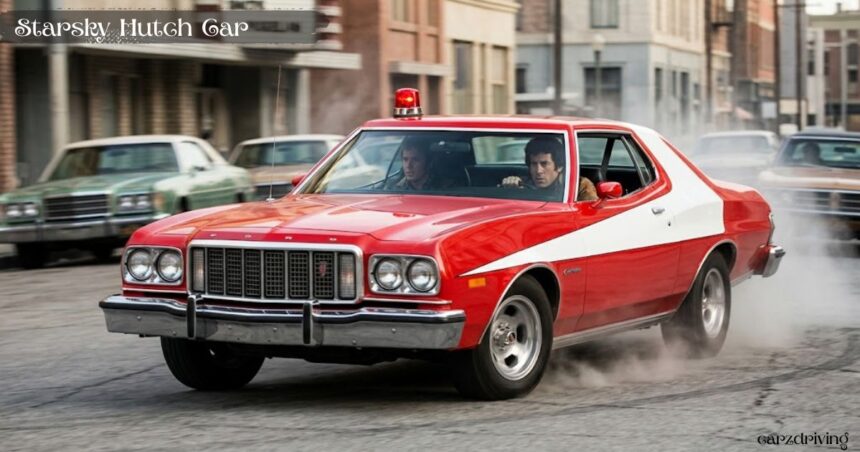
The makers first planned a green and white Camaro, but the TV series ended up with a Ford Gran Torino in Bright Red with a white vector stripe.
Steve Losacco, a Chatham, New Jersey native who arrived in 1972, called the Striped Tomato one of his dream rides. He needed a license first, and then a driveway to park it in. Ford built a special edition in 1976, and 1,305 of them reached buyers, so the car’s history keeps growing, and a screen-used one even sold for $40,000.
Built For the Show
The show used roughly ten Torinos, and the crew split them into stunt cars and Hero cars. Stunt drivers pushed the stunt cars through chases, slides, and turns every week. The Hero cars stayed clean for Paul and David, so nobody wrecked them.
Builders gave the cars many modifications to survive that abuse. They fitted roll cages, racing harnesses, fire suppression systems, chrome exhaust tips, air shocks, and upgraded suspension.
Engines came from Ford’s big family. The V8 Windsor engine in 351ci form (5.8-liter) powered many cars, while the 400-cu.in. V8 and the 460 cu-in V8 powered the tougher ones. The cars made only 148-226 hp, so editors added dubbed sounds from older Ford V8s to the action. Crews changed the rear gearing for better acceleration, and one dashboard warning label even said Do Not Exceed 50 MPH during second-season filming.
All the cars shared a few traits. Painters used code 2B Bright Red, and George Grenier, the transportation coordinator, drew the Vector stripe. The studio used cars from 1974-1976, and every one carried the Ford badge.
Ford’s Special Edition & Influence on Sales
ABC launched the show in April 1975, and fans wanted their own Zebra 3. A sales spike hit the Ford dealerships soon after, even before the limited edition appeared. In spring 1976, the Chicago assembly plant built the special edition, and reports say roughly 1,300 or 1,305 cars, while others claim 1,000 to 1,300+.
Ford painted these 1976 Gran Torinos in Ford Bright Red, and it added Wimbledon White vector stripes in the last year for the model. Buyers could pick the 351-2V, the 400-2V, or the 460-4V big block, and every car came with automatics only. Each car also had air conditioning and disc brakes.
Collectors love the paper trail. The buck tag shows PS 122, the build sheet repeats it, and the VINs 6G30 start every serial number. The DSO numbers are 0022 (US) for American cars and 8000 (Canada) for Canadian ones.
These replica editions differ from the TV show cars. Ford left off the black outline, skipped the air shocks, and never offered an aluminum slotted wheel, so owners hit the aftermarket for aftermarket suspension parts and that famous rake. No police equipment came in the box either, so fans built that part themselves.
Today, finding an authentic example takes serious research, because so many copies exist. Only documented histories and strong provenance prove a car’s story. An auction in 2014 sold a screen car for $40,000, and many private collectors and every serious collector still call that price low.
Where Are the Original Cars Now?
Nobody knows where every one of the original TV series cars ended up. You can see one in Las Vegas, where The Auto Collections runs a garage with 800 unique cars inside the Imperial Palace. Another sits in the Hollywood Car Museum, and the rest belong to the general public and car collectors.
Proving authenticity takes real proof. At Leake’s Tulsa sale, a restored 1976 Ford Gran Torino arrived as one of seven cars used in filming. It wore red and white livery, a 351-cu.in. Windsor V-8, and five-slot mag wheels, so buyers treated it as a television series car.
The firewall plaque read 20th Century Fox Film Studios and showed a nine-digit identification number. The passenger sun visor carried signatures from the Starsky and Hutch stars. The Leake representative called that signed sun visor the best proof, while the consignor added magazine articles as extra documentation, and the auction still raised debate about provenance.
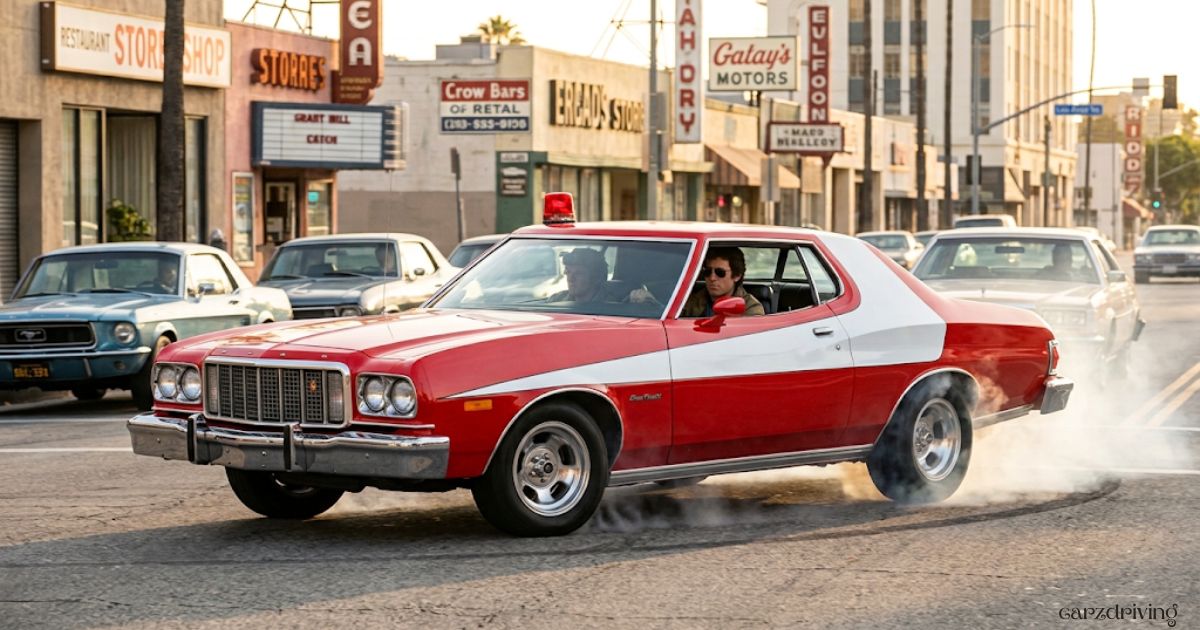
Starsky Hutch Car
William Blinn and Spelling Goldberg Productions picked starky hutch car because the Ford brand and its sporty design matched the 1970s. A plain four-door sedan looked dull as a patrol car, but the Torino had a fastback roofline and a muscular appearance. It was durable too, so it handled stunts well.
The 4-season TV series led to a 2004 movie 25 years later. Ben Stiller and Owen Wilson told the origin story of David Starsky and Kenneth Hutch Hutchinson, and Paul Michael Glaser and David Soul dropped in for cameos. The picture coordinator could not find an original, so he bought a limited edition Gran Torino and sent it back to Bay City.
Steve loved the show, and a neighbor named Sean sold a ’76 Gran Torino with a wing and a spoiler on the hood for $3,000. Steve could not afford it, but his parents surprised him with a balloon on the car as a graduation present. Friends gave him the Starsky nickname, and he used the car as his daily driver for four years before he sold it.
Later, Steve wanted a factory-produced one from the Striped Tomatoes family. He found a numbers-matching 1976 Ford Gran Torino in Florida and bought it sight unseen. He shipped it to his shop in New Jersey and chose a full-blown restoration to restore every part.
The car needed plenty of metal work, so Steve sandblasted the parts and worked as a self-taught welder. He shaped the compound curved parts with a body hammer and a sandbag. That hands-on effort gave the car a strong base.
For paint work, body work, and panel fitment, he picked Blue Sky Performance and Restoration in Budd Lake. Jesse Barratt and Jeff Manzella run the place, and they also took over the final assembly. Steve says that choice saved him years.
He swapped the weak 351 Windsor and automatic transmission for a stronger drivetrain. The new 427-cu.in. Windsor makes 539 hp and connects to a Pro Street 4STB with a trans brake and a reverse-pattern manual valve body. A custom driveshaft feeds the Ford 9-inch rear, and Currie Enterprises rebuilt it with 4.11 gears and new axles.
Steve boxed the rear control arms with steel plates and added Wilwood disc brakes for stopping power. He also cleaned up the seams near the quarter panels and rockers. The interior stays mostly stock, with a Hurst shifter and a new steering wheel, while air conditioning works through factory controls to keep the stock look. A RetroSound unit now replaces the original radio and adds Bluetooth.
The car’s legacy still grows 50 years on. It appears in music videos, and a video game even paid homage to it. Cop shows, American television, automotive history, and pop culture all remember it, and car enthusiasts and fans still love it.
FAQs
Who chose the Ford Gran Torino for the show?
William Blinn and Spelling Goldberg Productions picked it for its sporty design and 1970s spirit.
Who designed the white vector stripe?
George Grenier, the transportation coordinator, designed the vector stripe.
How do the factory cars differ from the TV show cars?
Ford left off the black outline, the air shocks, and the aluminum slotted wheel on the replica editions.
Did the Gran Torino appear in the 2004 movie?
Yes, the 2004 movie with Ben Stiller and Owen Wilson used a limited edition Gran Torino.
How much did a screen-used Starsky Hutch car sell for?
One sold for $40,000 at auction in 2014, which many collectors call low.