
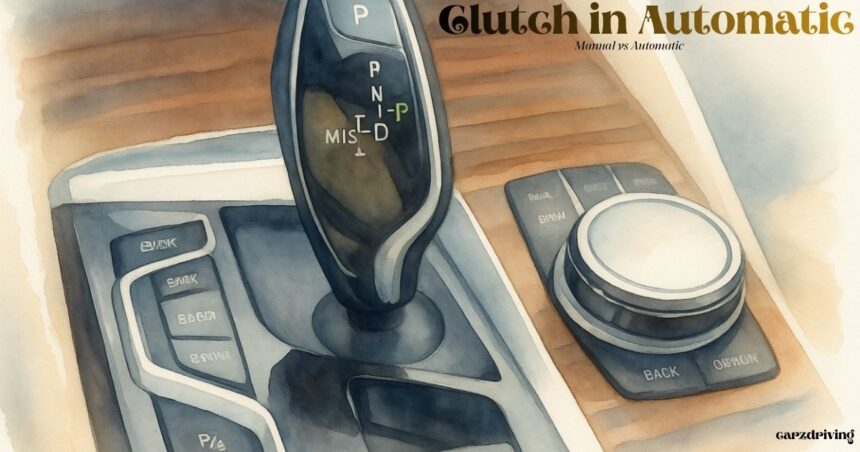
There is clutch in automatic cars, but you never see it. There is no clutch pedal and no gearstick, only a gear shifter with park, reverse, neutral and drive. The transmission handles every clutch operation itself, using hydraulics, hydraulic pressure and electronic signals from sensors, the transmission control module and other electronic control units, or ECU for short.
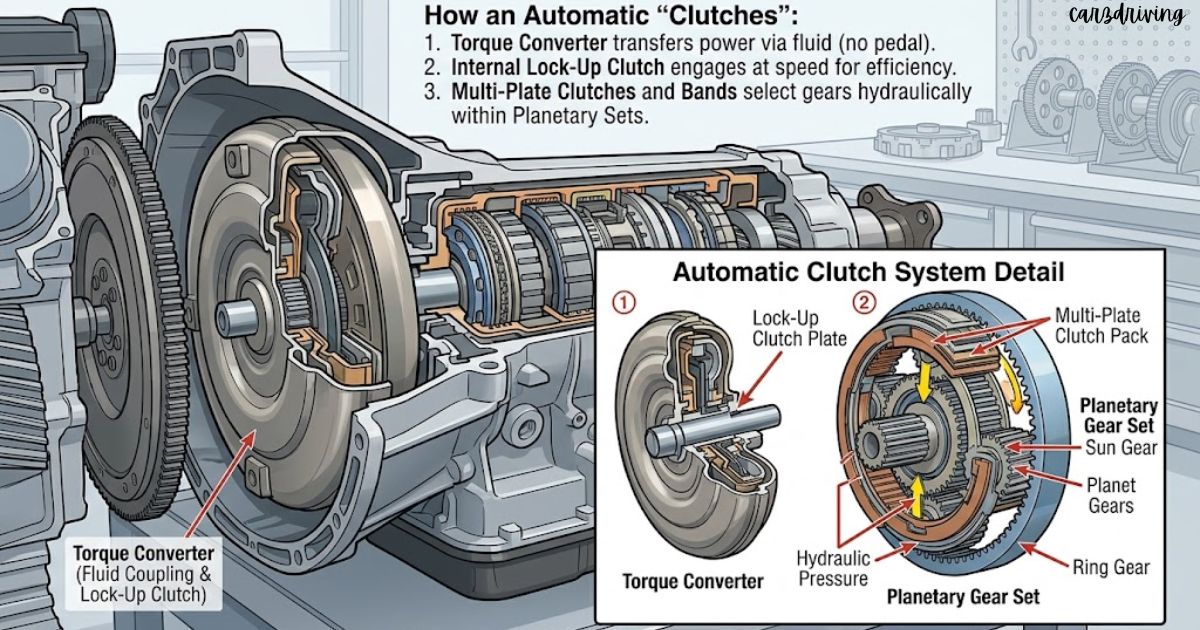
The torque converter is a hydraulic device that uses fluid dynamics for torque transfer. The impeller takes power from the engine, the turbine passes it on, and the stator steers the oil between them, so you find no clutch disc and no mechanical connection.
At specific speeds, the lock-up clutch makes a direct physical connection to stop slippage and improve fuel efficiency. A dual clutch transmission, or DCT, which some call twin-clutch automatics, uses two separate clutches: one takes gears 1, 3 and 5 (the odd gears), and the other takes 2, 4 and 6 (the even gears).
A CVT, or continually variable transmission, swaps gears for belts and pulleys, and some semi-automatic setups use clutch packs. In every case, engagement and disengagement happen with no manual input, so power flow and power delivery stay steady.
You get smooth gear changes and a smooth driving experience that manual transmissions can’t match without effort. Each electronically controlled clutch system and each set of hydraulic or electronic control systems handles the gear changes, and the driver just steers.
Difference Between Manual Transmission and Automatic Transmission
I learned on a manual transmission, so I remember the hands-on driving experience well: you press the clutch pedal, handle gear shifting yourself, and time each clutch engagement.
An automatic transmission uses one planetary gearset for all ratios and picks them by speed and engine load. Your feet only touch the accelerator and the brake, and a gear selector set to Drive does the rest. Driver involvement drops, and you get a relaxed experience in congested traffic.
The clutch system in an automatic uses multiple clutches that work with a torque converter or a dual-clutch system, like the Porsche PDK gearbox with its fast gear shifts. Transmission fluid matters more here because it acts as hydraulic fluid, the hydraulic aspect that manual boxes lack.
Manuals use lubricants only for gear and bearing lubrication, while automatic fluid lubricates moving parts and powers the shifts. Manuals have fewer components, so complexity, vehicle maintenance and repair costs stay lower, while the electronic systems in automatics push maintenance higher.
How Does an Automatic Transmission Work?
An automatic transmission gives you real convenience because it does the hard work for you. Inside the gearbox, two planetary gearsets fold into one unit about the size of a melon. Each of the planetary gearsets holds a sun gear, a ring gear and planet gears, and each part can act as input, act as output, or stay held stationary.
Those roles set the gear ratio, which compares the driver gear with the driven gear, and a lower ratio gives a higher top speed. When you put the car in drive and press the accelerator, the crankshaft turns the linear force of the pistons into rotational force, spins faster, and raises pressure in the torque converter.
The torque converter links the prime mover to the automatic gear train. It replaces the manual clutch with hydraulic pressure, so the car needs no physical connection. By sensing vehicle speed against engine speed, plus throttle position, load and engine load, the system picks the right gear ratios.
Older automatic systems relied on hydraulics alone, while modern transmissions add electronics, and hydraulic pressure still does the heavy lifting. Transmission fluid helps cool the gear train and prevents slipping, and it matches power demands from engine power to the wheels.
Compared with manual counterparts, twin-clutch automatic systems can even win on fuel efficiency. Electric cars with electric motors skip traditional transmissions because torque arrives across a wide range of speed.
Different Types of Automatic Transmissions
The torque converter automatic is the classic type: a fluid coupling plus planetary gears. It feels refined, though it can use more fuel than a manual car, and these conventional automatic transmissions fill most driveways. CVT units, or continuously variable transmissions, also known as shiftless transmissions, skip traditional gears.
A belt and pulley system with two cone-shaped pulleys and a V-shaped drive belt joins the engine to the wheels. As the engine revs, one cone moves and the other holds tension, so you get a seamless range of gear ratios, a smoother drive, and a single-gear ratio feel.
Makers put them in hybrid cars because they are compact and more fuel-efficient, but slow acceleration is the price, and you find no clutch or pedal. Dual-clutch transmissions, or DCT, also called twin-clutch automatic units, use two independent clutches.
One handles odd-numbered gears and the other handles even-numbered gears, which means odd and even gear sets, and the onboard computer uses gear prediction to keep the next gear ready. They bring improved fuel efficiency, more horsepower, faster gear shifts and fast gear changes, yet they feel jerky at times and stay expensive to repair and expensive to replace.
The direct-shift gearboxes, or DSG, from the Volkswagen Group (Audi, Skoda and SEAT) work this way, and owners book servicing about every 40,000 miles. Both are electronically controlled, with electronically controlled clutches that engage and release on their own. Automated manual gearboxes simply mimic manual shifting.
Advantages of Automatic Gearboxes
When I helped a friend with learning to drive, an automatic gearbox let her watch her road position and speed instead of fighting the clutch pedal. That is the big plus: ease of use, convenience, and a car that feels accessible and simpler to drive.
The automatic clutch setup relies on a torque converter, a fluid coupling that lets the engine spin apart from the transmission. That cuts engine strain and gives a smoother ride, smoother acceleration and seamless gear transitions.
Performance cars and high-performance vehicles gain more power, faster shifting and quick gear shifts, and Porsche PDK, short for Porsche Doppelkupplung, changes gear with no power interruption. Automated manual transmissions in some luxury cars and hybrid cars blend a manual gearbox feel with automatic efficiency.
Better fuel efficiency and reducing emissions support greener driving, meet environmental standards and answer consumer demands. The result is an untroubled driving experience with real comfort, even when traffic turns ugly.
Preventive Maintenance Tips for Clutch in Automatic
You do the engaging and disengaging yourself, and constant gear changing wears you down in heavy traffic. Automatics remove that chore and bring ease of driving, a pleasant driving experience and a seamless driving experience with little driver interaction. They do have downsides: they are more expensive, they feel boring to some drivers, they give less control, and they need frequent maintenance and expensive maintenance.
The intricacies and internal operation of the clutch mechanism and the gears make a fault costly and complex to fix. Look after the transmission by checking the transmission fluid and fluid levels. The fluid should show a bright red colour with no burnt smell.
Catch slipping and unusual sounds through early detection, because clutch wear and transmission damage follow quickly. Avoid overheating by skipping towing heavy loads beyond your vehicle’s capacity, since heat adds stress and strains torque handling across all gear ratios. Have a mechanic service the car by the manufacturer’s recommendations, and you will enjoy reliability and a high degree of reliability for years.
What does the Mechanics Call the Clutch in an Automatic?
Mechanics call it the torque converter. In an automatic transmission, it does the function of the clutch in a manual transmission, but it needs no conventional clutch pedal. It is a fluid coupling device that takes the engine’s output and moves it to the transmission, so you can reach a complete stop without stalling.
Compare the component type: a manual clutch is a mechanical linkage, manually operated, that disengages engine from transmission. The converter is a hydraulic fluid coupling that transfers engine power hydraulically through hydraulic fluid.
The car keeps it automatically managed, with no presence of pedal, which gives seamless operation with no driver input. A dual-clutch system adds faster gear shifts and improved efficiency by using odd gear sets and even gear sets, both controlled electronically, and there is still no clutch pedal to press.
How Many Clutches Does an Automatic Have?
The number of clutches depends on your automatic transmission system. A traditional automatic transmission has 0, because a torque converter links the engine’s power to the drive shaft. A dual-clutch transmission, or DCT, also called twin-clutch automatic, has 2.
Those two separate clutches split the work, with odd-numbered gears on one and even-numbered gears on the other, which brings faster gear changes, smoother gear changes and a manual feel.
A CVT, short for continuously variable transmission, also shows 0 because it has no traditional clutches, so the box says not applicable. It uses a belt and pulley system for a seamless range of gear ratios.
Do Automatic Cars Have Clutch Fluid?
People often ask about clutch fluid, but that name is a misnomer for automatics. A manual’s clutch pedal works with a hydraulic clutch system and its own fluid. In an automatic transmission, transmission fluid builds the hydraulic pressure and pressure that drive gear shifting and changing gears, while the torque converter moves power from the engine.
In a semi-automatic or automated manual transmission, you might find a slave cylinder that uses the same transmission fluid. That fluid does three jobs: lubrication to cut wear on gears, cooling to carry away heat, and hydraulic functions that move the parts. Unlike manual transmissions, an automatic needs regular checks of fluid level and fluid condition.
How to Drive an Automatic Car without a Clutch Pedal?
Move to Drive (D), ease off the brake, and press the accelerator for gentle accelerating. Use Neutral (N) for short stationary moments and return to Park for prolonged stops. Your right foot handles braking and accelerating, while your left foot rests on the footrest.
These driving tips help anyone learning to drive and make safe driving feel confident. Watch the vehicle’s responses in different drive modes, and let the automatic gearbox manage the gear changes while the engine does its part.
How Much Does It Cost to Replace a Clutch in an Automatic Transmission?
Many drivers think only manual cars need clutch replacement, but automatics need it too, and the cost depends on the complexities. Expect several hours of labour at about £50 per hour, plus parts like a flywheel. Your make and model and vehicle model matter, and luxury models and exotic models cost more. The price range often runs from £320 to £1,350, and average costs can reach £2,000.
How Long Does an Automatic Clutch Last?
Lifespan varies from car to car. Automatics last because manual gear changes disappear, which cuts driver-related wear and driver input, and the torque converter or dual-clutch system works alone. There is no clutch pedal to ride, yet friction materials and transmission fluid still face wear and tear. Vehicle type and usage patterns shape durability and reliability. Use smooth acceleration and deceleration instead of rough handling of the gears.
Can a Clutch Go Bad in an Automatic Transmission?
Yes, a failing clutch can happen in an automatic transmission, as with any moving parts, because clutch components wear. Slipping shows first: engine revs climb without a rise in vehicle speed, delayed gear shifts and erratic gear shifts appear, and whining or grinding, both unusual noises, join in. These symptoms and early signs point to loss of power and erratic vehicle performance.
Excessive heat speeds up wear, so transmission damage and a costly breakdown follow. Unlike a manual gearbox, you can’t reach the parts easily, so expensive repair is common. Do regular fluid checks, get a professional assessment from a mechanic, and keep breakdown cover so transmission failure won’t leave you stranded. Good care also extends the lifespan.
What Are Semi-Automatic Cars?
A semi-automatic car blends manual transmissions with an automatic gearbox. Actuators and a hydraulic motor replace the gear lever and clutch pedal, while a control unit manages engine torque and speed. You choose manual mode with a lever on the gearstick or steering wheel paddles, or you leave it in automatic mode, so you get the best of both worlds.
Weigh the pros and cons: these cars are often fuel efficient and cheaper to maintain and repair than fully automatic ones. They are expensive to buy compared with a manual gearbox car, they bring a learning curve and jerky gear shifts, and availability stays limited. The clutch is still there, hidden from view, and it changes the gears for you.
Are All Electric Cars Automatic?
Yes, electric cars count as automatic, and there is no clutch in automatic EVs because an electric motor gives steady power and speed, so gears matter far less. EVs have no automatic gearbox like a combustion engine car with its forward gear ratios. Instead, one or two motors run on electricity.
The motor spins fast, so a reduction gear, a single-speed unit, cuts the rotational force before it reaches the wheels. Some high-performance EVs, like the Porsche Taycan, use a two-speed reduction gearbox to optimise motor efficiency and battery efficiency.
FAQs
How does the clutch in an automatic car work?
The torque converter uses hydraulic fluid to pass engine power to the transmission, so you never press a clutch pedal.
What is a lock-up clutch in an automatic transmission?
It is a direct mechanical link inside the torque converter that stops slippage and improves fuel efficiency.
Does a dual-clutch transmission have a clutch pedal?
No, a DCT uses two electronically controlled clutches that change gears on their own, with fast, smooth shifts.
How much does it cost to replace a clutch in an automatic?
Most repairs cost between £320 and £1,350, though luxury models and complex labour can push it toward £2,000.
How can I make my automatic clutch last longer?
Check your transmission fluid, avoid overheating and heavy towing, and service the car on time to protect your drive.
Do electric cars have a clutch?
No, an electric motor delivers steady torque, so a single-speed reduction gear replaces the need for a clutch and gearbox.