

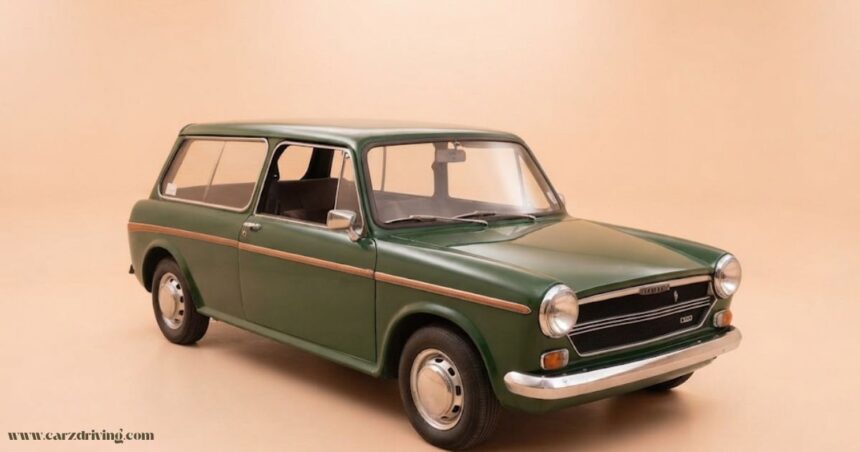
The little Austin 1300 carved its own path through the 1960s as one of Britain’s best-selling cars.
It felt delightful from the very first mile, and though it wasn’t perfectly healthy nor free from rotten metal underneath, the A-Series engine’s gear whine and the gentle rise of the Hydrolastic suspension told me this car had a soul worth saving. Getting Historic registration for it felt like a small victory in itself.
The story of this car stretches back to BMC, the British Motor Corporation, and later to British Leyland, who built it not just in England but also in Spain through Authi, in Italy through Innocenti, and at a plant in Belgium, with related models reaching Australia and South Africa too.
Austin 1300
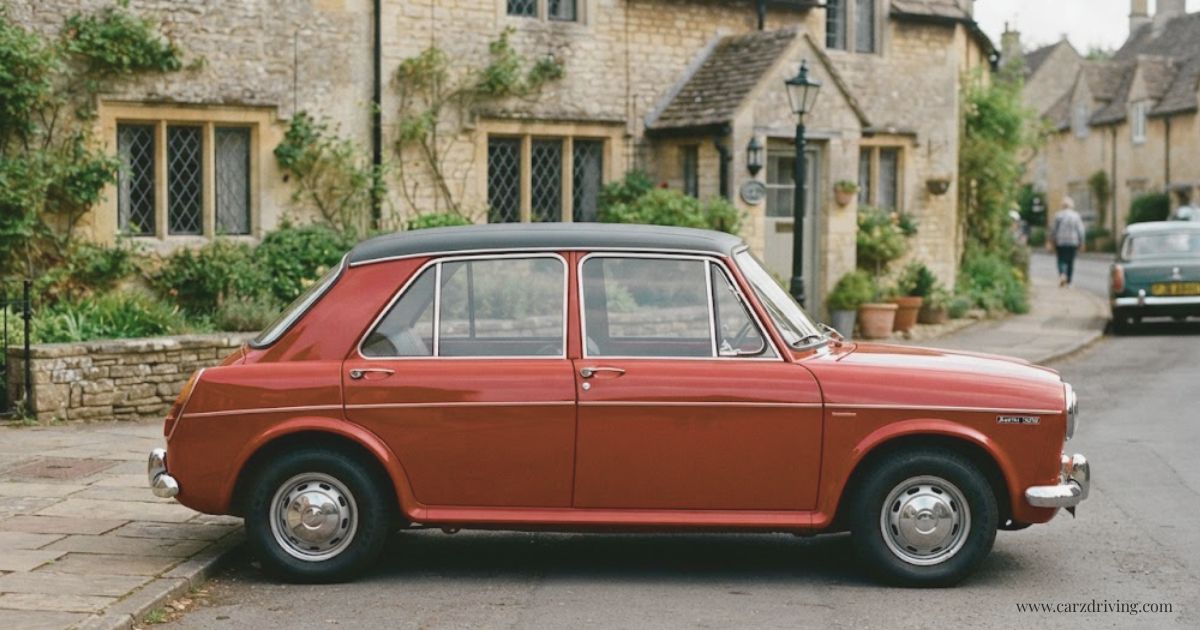
The Morris 1100 badge came first, but by 1969 the Austin 1300 GT and Morris 1300 GT arrived as the hot(ish) version of the range, dressed up in shades like orange, bronze yellow, deep purple, aconite, and a strange limeflower that some called a sludge green.
It wore a vinyl roof, faux alloy wheel covers, and matt black trim strips that gave it a sporty look borrowed from names like BMW, Triumph, and Citroën, even though this was really a
humble four-door saloon more often seen doing the school run, parked outside Budgens, or resting on a grassy verge near a picnicking family than chasing any Gran Turismo badge.
It always surprised people that such an ordinary car could wear letters usually saved for a semi-exotic marque, the kind of coupé poster that earns adolescent wall space and a chunk of BluTack, rather than sitting beside the Vauxhall Viva GTs of its era.
Origins /Design & Engineering
Fresh from his success with the Mini, he wanted something bigger, so he kept the same BMC A-Series engine, transversely mounted and driving the front wheels, but added features rarely seen on cars this size, such as single piston swinging caliper disc brakes and the clever Hydrolastic interconnected fluid system built by Alex Moulton.
That system actually traced back to the Citroen 2CV suspension, studied by both men in the 1950s, a detail Moulton only confirmed in a CAR magazine interview during the 1990s.
Their goal was ride comfort and body levelling while keeping the roadwheel planted and the tyre in firm tyre contact with the road, plus far better roll stiffness than the old 2CV ever managed.
Styling came from Pininfarina, the same house that shaped the Austin A40 Farina, and their sense of packaging gave the little car interior space rivalling the much bigger Ford Cortina.
The Mark I cars leaned hard on this in their marketing material, boasting a spacious cabin that, by 1964, easily beat rivals like the Ford Anglia, the Vauxhall Viva HA, and BMC’s own aging Morris Minor.
People often called it a big Mini, and that’s fair, since the same chief engineer used similar design magic, with the BMC technical director simply stretching his 1962 formula rather than starting fresh.
The rubber-sprung suspension and its clever fluid damping felt worlds ahead of the crude setups in a Hillman Minx or an Austin A40.
Prime Minister Harold Wilson later borrowed the phrase “white heat of technology” to describe cars exactly like this one, which shared parts with the Mini Cooper yet reached a much wider public.
Sadly, the same monocoque seam designs that made it clever also invited corrosion, something engineers at the Cowley plant near Oxford warned about early on.
Years later, I spoke with a retired engineer who still remembered colleagues joking that “Arrigonis’s” seams would rust through, and history proved them completely right.
Model Launch
The Morris 1100 name officially arrived on August 15 1962, and BMC wasted no time expanding the family with the twin-carburettor MG 1100, followed by the Vanden Plas Princess in October 1962, then the Austin 1100 in August 1963, and finally the Wolseley 1100 and Riley Kestrel both landing in 1965.
The Morris badge stepped aside for the Morris Marina in 1971, though Vanden Plas versions soldiered on until June 1974. Estate buyers got their own options too, the Countryman and Traveller, both part of the same estate version launched in 1966.
Engine & Transmission Development
Under the bonnet, BMC added an Automotive Products built AP transmission as a four speed automatic option back in November 1965, tuning the carburettor and raising the compression ratio to fight power loss, a known weakness of the standard manual gearbox paired with a transversely mounted gearbox layout.
By 1967, a new 1275cc engine shared with the Mini Cooper and the Austin-Healey Sprite arrived, keeping the same gearing but altering the final-drive gearing for extra pull, and this bigger unit turned the car into the Austin 1300 and Morris 1300 launched in October 1967.
Sales
Demand shot up so fast that waiting lists stretched for months, blamed partly on the devaluation of the British Pound in autumn 1967, which pushed BMC to prioritise the export market over the home market.
Riley, Wolseley, MG, and Vanden Plas variants trickled in first, with regular buyers waiting until March 1968. Visually, the Mark II wore a new front grille, extending under the headlights, plus a smoother tail light fitting later reused on the FX4 London taxi.
Gearboxes gained synchromesh across the top three ratios, later fitted to the smaller 1098cc cars too.
More Mark II trims followed in October 1968, though the Riley Kestrel name dropped that year, and the Riley 1300 Mark II was cancelled entirely by July 1969 cancelled production, closing the badge for good.
The London Motor Show in October 1969 brought the car I love most, the 1300 GT, sharing its twin carburetter engine with the MG version but standing out with a black full width grille, black vinyl roof, and a bold black stripe, built to answer the Ford Escort GT and its Vauxhall counterpart.
Engineers even dropped the ride height slightly by lowering the Hydrolastic fluid pressure from 225 psi down to 205 psi. Sales stayed strong into 1970, when 132,965 vehicles beat the rival 123,025 Cortina registrations, even as that car entered its third incarnation Cortina generation, and BMC celebrated the two millionth ADO16 rolling off the line by June 1971.
That year marked its final spell as the top selling car in Britain. New Mark III models followed in September 1971, honouring BMC’s original ten-year production plan, though the range slowly thinned, with the MG 1300 dropped that same year and the Wolseley 1300 dropped 1973.
The very last one, a Vanden Plas Princess 1300, left the factory on 19 June 1974, handing over to the Austin Allegro and its own Vanden Plas 1500 cousin, right as Ford Cortina growth pushed that rival out of the small class car bracket entirely.
Sadly, checking the How Many Left website today tells a sobering story. Out of 2,250,757 ADO16s built across every badge, only around 42,000 UK market 1300 GTs left the factory, and just 137 GTs remaining survive now, with 48 off the road entirely.
That kind of survival rate is grim, and plenty of undiscovered cars are likely still hiding in old sheds. The reason is simple chemistry: unprotected steel, water, and oxygen trigger a chemical reaction that eats these cars alive, and even the factory’s electrophoretic dipping and thin primer stood little chance against typical British weather.
Poorly clinched panels and welded panels left seams wide open to rust, especially around the sills and rear subframes, the classic MoT failure points, while the front subframe usually survived thanks to corrosion-arresting oil leaks.
A whole railway arches repair industry grew up just to patch these cars, tackling rust traps in the double-skinned front bulkhead, the inner wings, and the door bottoms, turning many a proud saloon into a rolling tramp ship within a few short years.
My own connection to these cars runs through family. My grandfather caught the Mini inspiration bug early and moved on to a Tartan red 1100, buying a fresh one every year from his local Wadhams Southampton dealer, working through eight or nine 1100s and 1300s before finishing with an Austin Allegro 1300.
Only one ever let him down badly, with a gearbox failure fixed under warranty repair. My father told a different story with his second-hand 1300 GT, a car I pushed him to buy because I loved the twin SU carbs, the faux alloys, and that unfamiliar rev counter.
Over five years it chewed through exhaust manifolds cracked three times, needed a full gearbox rebuild, and ate through countless minor components.
That teal blue 1300 GT even gave me my first oversteer moment, sliding through the Reading area’s tricky double roundabouts, my vaulting heart rate proof of how close I came to spinning off.
Years later, nostalgia sent me hunting for my own bronze yellow 1300 GT, which I eventually found advertised in Ireland. It carried its original 1970 registration, had lived as a collector’s car, and showed a believable 40,000 miles.
The seller, Paudge seller, admitted to some rust, and I still went ahead with a sight unseen purchase rather than book an inspection flight. Once it reached my storage shed, the inspection found doors rust around the bumpers, plus sills rust and floors rust, though nothing worse than expected.
I needed fresh rubber subframe bushes, various service items, replacement badges, and even a pair of seat belts, alongside several body panels including a front wing, new front floors, and a lower rear wing.
Hunting on eBay and through the 1100 Club turned up new front wings, though rarer bits like the hat-like hubcaps and correct trim strips took far longer to track down. Adam Redding Classic Cars, better known as E-Types restoration specialists, handled the bodywork, returning a clean shell with the powertrain and subframe kept apart.
The engine itself was a Gold Seal exchange engine, which we treated to a gold repaint and a matching green BMC gearbox paint job before blasting the subframe and coating it in Hammerite. We even ran it briefly from a remote fuel supply just to hear it fire, then finished the job with generous Bilt Hamber wax worked into every panel.
Driving Impressions
Driving Austin 1300 today reminds me why these front-drive family cars mattered so much, even if their fluid suspension sophistication feels ordinary next to modern machines.
Its small overall size and slim roof pillars still give a wonderful view out, and the SU carburettor setup gives sharp throttle response from just 70bhp, hauling 864kg with 74lb ft torque at 3250rpm. Fourth gear gears out at 16.8mph per 1000rpm, so even a leisurely 15.6sec 0-60mph time feels brisker than the number suggests.
What really impresses is the steering immediacy, the near-total lack of bodyroll, and how eagerly it changes direction. The famous Float on Fluid ride softens slightly here, since the GT’s rear anti-roll bar and lower stance bring some vertical bouncing over rough roads, earning it the cheeky shirt-lifter nickname among BMC test drivers, aimed at anyone with a loose Terylene top.
Even so, the rear space thanks to clever Issigonis packaging, sharp brakes, and genuine steering precision still shine through. It’s no 205 GTI, but you can feel where that kind of car came from.
Unlike the Mini’s direct-mounted setup, this car uses rubber mounts instead of the Mini subframes direct connection, giving noticeably better refinement.
All told, it delivers real charm and real entertainment, and reminds me why this remains such an advanced car and once such a popular car, even though its survival rarity today makes every surviving example feel special.
FAQs of Austin 1300
What is the Austin 1300?
The Austin 1300 is a small British family saloon built by BMC, part of the beloved ADO16 range designed by Alec Issigonis.
What makes the Austin 1300’s suspension special?
It uses the innovative Hydrolastic suspension, a fluid-based system that gives it a smooth, almost floating ride.
What is the Austin 1300 GT?
The 1300 GT is the sportier version launched in 1969, known for its twin carburetter engine, vinyl roof, and black stripe styling.
Why are so few Austin 1300s left today?
Sadly, most succumbed to corrosion, leaving only a handful of survivors and making each remaining car feel truly special.
Is the Austin 1300 a good classic car to own?
Yes, it offers genuine charm, sharp steering precision, and a rewarding slice of British motoring history for any enthusiast.