
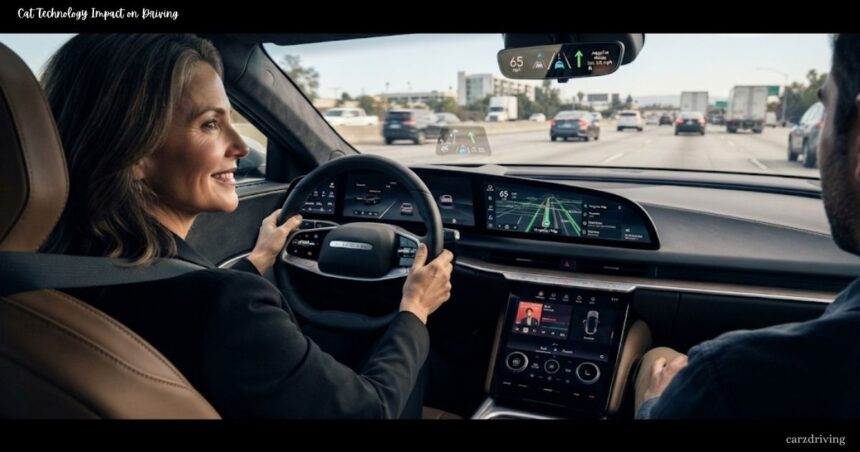
Car technology impact on driving has become one of the most talked-about topics for anyone who spends time behind the wheel.
Many people once believed that excessive speed or driving under the influence caused most car accidents, but the real picture is far more complicated, and causing an accident often starts with something as small as looking down, reaching for an item, or getting lost in thought while picking something up from the seat.
Car Technology Impact on Driving
This is why we built this guide, so drivers can stay focused, avoid becoming distracted, and understand which features actually protect them on the road, whether they drive an everyday car or dream about flying vehicles and robot-assisted automobiles someday.
Brands like AMT and Toyota have spent decades studying human error as the biggest contributory factor behind traffic casualties, and their work has shaped how car technology and vehicle features are designed today.
Toyota, in particular, has pushed active safety research since the 1990s and built the Mobility Teammate Concept around the idea that mobility should stay fun, convenient, and full of choices, not something that removes human engagement from the experience.
That is why automated driving systems such as Chauffeur and Guardian exist to add automated driving capabilities without taking away the joy of driving for people who still want to hold the wheel themselves.
These updates aim to boost human capability instead of replacing it, since crashes often happen simply because someone was not looking properly at the road ahead.
By 2022, innovative contributions in car safety technology were already changing what an accident looks like, because sensors and smart systems could react faster than a mobile phone call or a distracting phone notification ever could.
Looking ahead, the future holds even more efficient and accessible systems that keep vehicles and people safer, eliminating many of the risks that once made dangerous situations unavoidable, while giving drivers real freedom and genuine safety at the same time, all thanks to a steady advance in how cars think and respond.
Lane Departure Warning
A Lane Departure Warning system watches your lane position on a motorway or single carriageway road, and it will warn you the moment you start drifting out of lane without indicating to indicating other drivers around you.
This standard safety feature uses visual and aural signals, plus a vibrating seat or steering wheel, to pull your attention back before a drift turns into a real swerve.
Newer cars go a step further with the LKA system, known as Lane Keeping Assist, which does not just alert you but can adjust steering and apply brakes to keep you on a correct course.
This kind of autonomous technology can actively take control of the car when a driver seems distracted, and it has become one of the smartest pieces of technology on modern roads.
Unlike some safety kits, this system usually cannot be retrofit onto an older vehicle, since it needs built-in sensors from the factory, but the goal stays the same the car is prevented from drifting into another lane before anything goes wrong.
Automatic Braking
The story of auto-braking goes back more than sixty years, when Cadillac first tried a radar-based technology to spot oncoming obstacles on the road, but it took until 1997 for Toyota to bring this idea into the mainstream by pairing it with cruise control, and Mercedes soon followed with a similar system in its S-Class.
Today, this early idea has grown into full collision avoidance systems built around sensors and cameras that constantly watch the road ahead.
A modern AEB system, short for autonomous emergency braking, checks for a potential accident or an imminent crash and warns the driver with a flashing alarm or a flashing icon on the dashboard.
If a distracted driver misses that warning, the car can automatically emergency stop itself at a lower speed, which lowers the chance of a dangerous impact for motorway drivers and anyone using slower routes.
Groups like the EU and US, through tests such as Euro NCAP and NHTSA, now treat this as a core part of any safety rating, so most automated driving brands install it even though it can be expensive. Some buyers still see it as more than a valuable safety accessory, since it protects concentration during heavy traffic, works alongside sensors near the car’s grille, and adds to the overall vehicle price without asking too much from a normal cruise control setup.
Why Is It Important to Keep Focused While Driving?
In the UK, failure to look shows up as the primary contributory factor in a quarter of all fatal accidents, and that single fact explains why staying focused on the road ahead matters so much for every driver.
US studies also found that one in five crashes involving a teen driver trace back to using a mobile phone or a phone while behind the wheel, and this problem hits younger drivers the hardest.
At any moment, roughly one in six drivers are doing something that pulls their eyes away, such as smoking, eating, chatting, or glancing at the centre console, and about 70% of people admit to juggling multiple things instead of concentrating fully on the road.
This kind of distraction is not rare it is closer to a normal habit of daily driving in the 2020s.
Because this problem is so common, organisations, safety advisers, and car manufacturers have spent years building technological solutions and new options to fight distracted driving. Their work shows just how seriously the industry takes this issue, and it gives drivers real tools instead of just warnings.
Bluetooth
Phones have long been a serious hazard on the road, and in the UK, using a hand-held phone while driving has been illegal since 2003. Bluetooth arrived early as a solution, letting drivers keep their eyes on the road ahead while using buttons on the dashboard or steering wheel instead of picking the phone up.
Today, Bluetooth counts as a standard part of car tech and comes fitted in most new cars, though retrofit options exist for older models too. Even so, a conversation with a passenger or through the speaker can still cause distraction, so keeping any chat to a minimum helps protect the safest driving experience possible for everyone in the car.
Voice control
Mercedes-Benz introduced voice control back in the 1990s, and back then it felt more like a luxurious technological marvel than a real safety measure. Early systems could only understand a few hundred words, but the goal was always the same as Bluetooth cutting down on distracted driving since an accident can happen within a few seconds of looking away.
The old worry was drivers glancing at the centre console or dashboard just to adjust audio or climate control, and voice control solved that without needing any screen time at all. Now, tools like Android Auto and Apple Carplay add phone voice recognition to control in-car entertainment, and their functionality covers far more than music alone.
Head-up displays
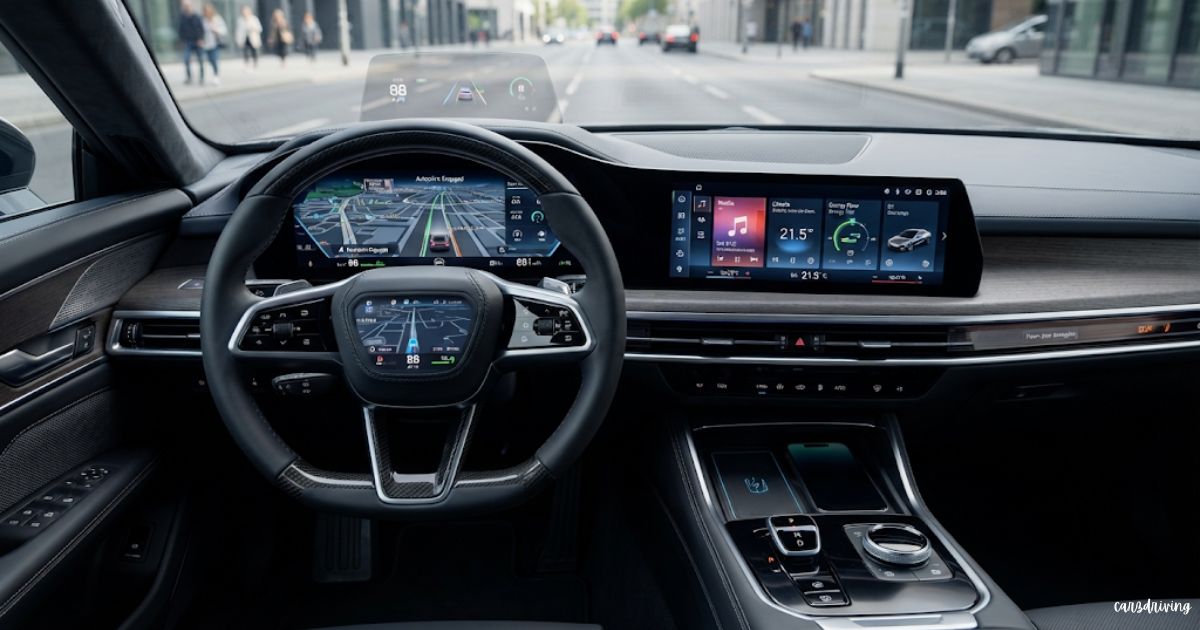
A HUD, short for head-up display, first came from military aircraft before it landed in high-end cars during the 1980s, and it remains one of the more futuristic developments built to fight distraction. There are different types of this system, some that reflect light off the windscreen and others that use a small piece of glass in front of it.
Either way, the information things like speed and sat nav directions sits at the same road level as any obstacles ahead, so drivers can look straight ahead instead of glancing down.
This tech does not have to come pre-installed; buyers can purchase it as an additional safety tech and retrofit it onto an existing car, which is why it stays popular on premium cars and beyond.
Driver monitoring
Driver monitoring systems stand out as one of the newest tools on this list, since the technology is barely ten years old, yet it could prove truly lifesaving. Toyota built the first version for its premium brand, Lexus, using a mix of inputs to judge driver attention on the road ahead.
The main trick relies on infrared LED cameras that track where the eyes are pointed, and if focus drifts too long, beeps and buzzers kick in to help drivers regain attention fast.
Adaptive Cruise Control
Adaptive cruise control builds on ordinary cruise control by adding sensors and cameras that watch for potential vehicles ahead and cause the car to automatically slow down on its own. It stands out as a smart safety feature for anyone worried about speeding on a long road trip.
Users simply pick their selected options, and the system will adapt speeds to match traffic on the motorway, sometimes even reading speed limit road signs to adjust the car’s speed without any extra input.
Blind Spot Monitoring
Blind spots cause a large share of road traffic accidents, mainly because vehicles, pedestrians, and cyclists can slip out of a driver’s sight without warning. Blind spot monitoring fixes this gap using sensors built into the side mirrors or the rear bumper.
Most systems flash small flashing light indicators in the mirrors to tell drivers it is not safe to switch lanes yet, giving everyone on the road one more layer of protection.
Lane Keeping Assist
Lane keeping assist warns drivers the moment they leave lane by accident, and depending on the manufacturer, the vehicle might beep, show a dashboard warning, or vibrate steering wheel to grab attention. If the driver still does not react, the system can control steering wheel movement and brakes together to bring the car back to correct positioning within its correct perimeters.
Automatic High Beams
Every drivers knows the hassle of switching between high beams and dipped headlights at night to avoid blinding oncoming vehicles. An automatic high beam system removes that chore by itself, since it senses the rear lights of a car in front or any nearby traffic and adjusts the beams instantly.
Night Vision
Luxury car manufacturers such as BMW and Audi now build night vision assistance using an infrared camera to catch objects that sit far out of sight during the night. These state of the art features can spot pedestrians, animals, or cyclists up to 200 metres ahead and show them clearly on the digital display.
Rear and Front Cross Alert
Rear and front cross alert counts as an older car safety technology system, yet it still shows up in most new cars today, and many drivers say it makes parking and reversing ten times easier and safer.
A front cross alert works best for anyone pulling out of side roads where visibility restricted view makes it hard to see. This cross alert technology helps drivers handle blind spots and unknown obstructions without any guesswork.
What’s Behind Teammate?
A car means more than plain transportation; the bond people feel with “my car” grows deeper as it fits their mobility needs and matches their unique tastes. That bond does not fade just because some driving becomes automated, since driving ability shifts with experience, knowledge, age, medical conditions, or plain fatigue.
Some days a driver wants a sporty driving style, and other days only a smooth ride will do, and automated driving technologies are built to meet these shifting needs while still protecting safety no matter the driver’s condition.
Chauffeur and Guardian
Vehicle automation aims to make mobility safe, accessible, and convenient for everyone, and this goal splits into two clear roles. Chauffeur technology lets a car drive on its own for anyone who cannot or does not wish to be the driver.
Toyota Guardian takes a different path, pairing the driver with an AI system so each side uses its individual skills, since Guardian constantly monitors environment conditions and steps in the moment a collision or other safety risk turns imminent. Rather than relying only on braking, Guardian uses the full range of driving actions to amplify driver’s capabilities when it matters most.
Why Guardian?
Chauffeur could bring a meaningful impact to people who cannot drive themselves, but it still faces steep technical challenges and social challenges that take real time to solve. Because of this, most Level 4-equivalent systems only run their test cars under limited conditions, such as low-speed streets, light traffic, fewer pedestrians, fewer cyclists, or fair weather.
Toyota built Guardian to skip past many of those constraints, which lets the brand add stronger driver assistance into production vehicles and study the safety benefits of automated driving much sooner. This approach also helps build public trust and acceptance around highly automated technology.
Automated or Autonomous?
New technologies that handle some or all driving tasks have brought a flood of terms into everyday use, including self-driving, driverless, highly automated, semi-autonomous, and partially autonomous.
Toyota believes it matters to describe functions based on real performance, since loose language can confuse customers’ expectations and understanding of what a car can truly do.
The word automated covers any tech that adds to or takes over human control for a set period of time, while autonomous means the system is fully replacing driver input, whether that lasts a short while or indefinitely.
Automation beyond safety
Car technology impact on driving goes beyond their core safety benefits, automated driving systems can make traffic run smoother and more efficient for everyone on the road. This shift promises real gains, from better air quality through reduced emissions to a better quality of life for drivers thanks to shorter travel times and predictable travel times.
More people stand to enjoy the joy of mobility, and Toyota believes this technology carries sweeping benefits and mobility solutions that reach well past ordinary cars and trucks. The brand’s research into enhanced perception, reasoning, and manipulation is already shaping robots that offer expanded freedom of movement, especially for people with limited mobility.
FAQs
How does car technology impact driving safety?
Car technology like lane departure warnings and automatic braking helps prevent accidents by catching distracted driving before it turns dangerous.
What is the difference between automated and autonomous driving?
Automated technology assists or takes over specific driving tasks, while autonomous systems fully replace driver input.
Can lane keeping assist really prevent accidents?
Yes, lane keeping assist actively adjusts steering and brakes to stop a driver from drifting into another lane before it’s too late.
Why is driver monitoring considered a lifesaving feature?
Driver monitoring uses infrared cameras to track eye focus, gently alerting drivers the moment their attention drifts from the road.
What are Toyota’s Chauffeur and Guardian systems?
Chauffeur drives the car fully on its own, while Guardian pairs AI assistance with the driver to protect against sudden, imminent risks.