

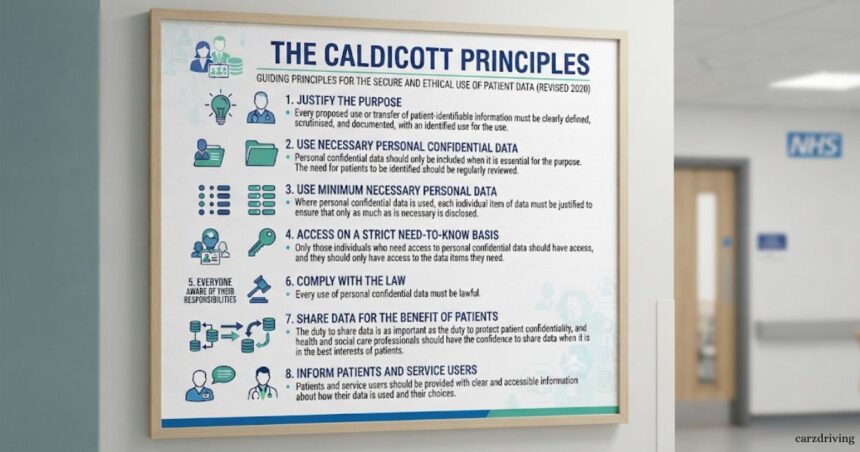
Anyone working in the healthcare sector understands that the Caldicott Principles shape far more than paperwork patient confidentiality plays a crucial role in keeping trust alive between patients and the people who care for them.
The National Data Guardian, often shortened to NDG, exists for exactly this reason: to protect how personal health details are used across the NHS. At the heart of this system sit the eight principles, a set of rules built to guide the handling of patient information with care and respect.
Every organisation carrying a Caldicott guardian role is expected to support the upholding of these standards, and interestingly, this responsibility doesn’t stop at death confidentiality continues to apply even for the deceased, which surprises a lot of people the first time they hear it. This ongoing preservation of trust is really what the whole system is designed to protect.
I’ve noticed that many staff members only really grasp this once they’ve sat through proper training, which is why understanding the principles matters so much for anyone touching patient-identifiable data.
Most NHS organisations now point new starters toward an expert team of subject leaders who have built a comprehensive catalogue of online healthcare training courses, giving staff a practical route into healthcare training rather than just handing them a policy document.
Caldicott guardians, meanwhile, act as the people on the ground who translate all this purpose-driven guidance into everyday decisions about how health and social care services actually use the information in front of them.
National Data Guardian Role
The National Data Guardian holds a statutory role in England, working almost like an independent champion for patients and the wider public whenever their health and care information is involved.
Its core mission is simple to state but hard to deliver: preserve trust by making sure confidential information is kept safe and used properly across every corner of the adult social care system. It works hand in hand with the Department of Health and Social Care to keep this whole framework moving forward.
To make that happen, the NDG carries genuine statutory power, which means Public bodies such as GPs and NHS trusts have to sit up and take notice whenever fresh official guidance lands on their desk.
Back in 2021, that statutory power was put to direct use through formal guidance covering the appointment, roles, and responsibilities of Caldicott guardians across the country.
The guidance sets out how processing of adult health and social care data should work in practice, reinforcing confidentiality at every stage and making clear that health and social care services carry real duties whenever they touch a patient’s record.
Caldicott Principles What Are They
Back in 1997, following a review chaired by Dame Fiona Caldicott, the original C.P were developed as a set of good practice guidelines for organisations handling health and care data.
Since then, the framework has expanded, and a wider range of bodies is now expected to appoint a Caldicott guardian to support the upholding of these standards at organisational level. Every one of the NHS organisations must have one in place, and the key principles apply wherever patients and service users can be identified and where they’d reasonably expect their patient information to be kept private.
In my own experience reading through NHS policy documents, the Principles work almost like a decision-making framework a guardian doesn’t just tick boxes but actively supports the provision of health and social care services while keeping a firm duty toward maintain patient confidentiality.
This sits alongside wider legal duties under the Data Protection Act and GDPR, giving healthcare providers and healthcare professionals clear guidance on proper handling of patient-identifying data, sharing data responsibly, and following data protection laws whenever Caldicott guardians get involved in day-to-day patient care.
What Is Patient-Identifiable Information?
When people talk about identifying information, they usually mean anything that reveals the identity of an individual patient think full name, date of birth, home address, or NHS number.
It can also stretch further than most people expect, covering visual material and audio material like photos, videos, and recordings captured during appointments or consultations. Even test results or details about health conditions count as patient data if they could lead to identification of the person behind them.
If any of this patient data is mishandled, it puts patient confidentiality at real risk and can seriously compromise the trust a patient places in the service caring for them.
Why Were They Introduced?
The principles were introduced largely because of growing concern over how the NHS handled patient information during the shift toward computer systems and electronic record keeping.
As information sharing for research or administration became more common, people started asking harder questions about whether patient data was being used ethically and appropriately, especially for non-clinical purposes far removed from direct treatment.
To settle those worries, the rules set out clear standards for sharing information responsibly, balancing protecting patient confidentiality with the need to deliver quality care across the health system.
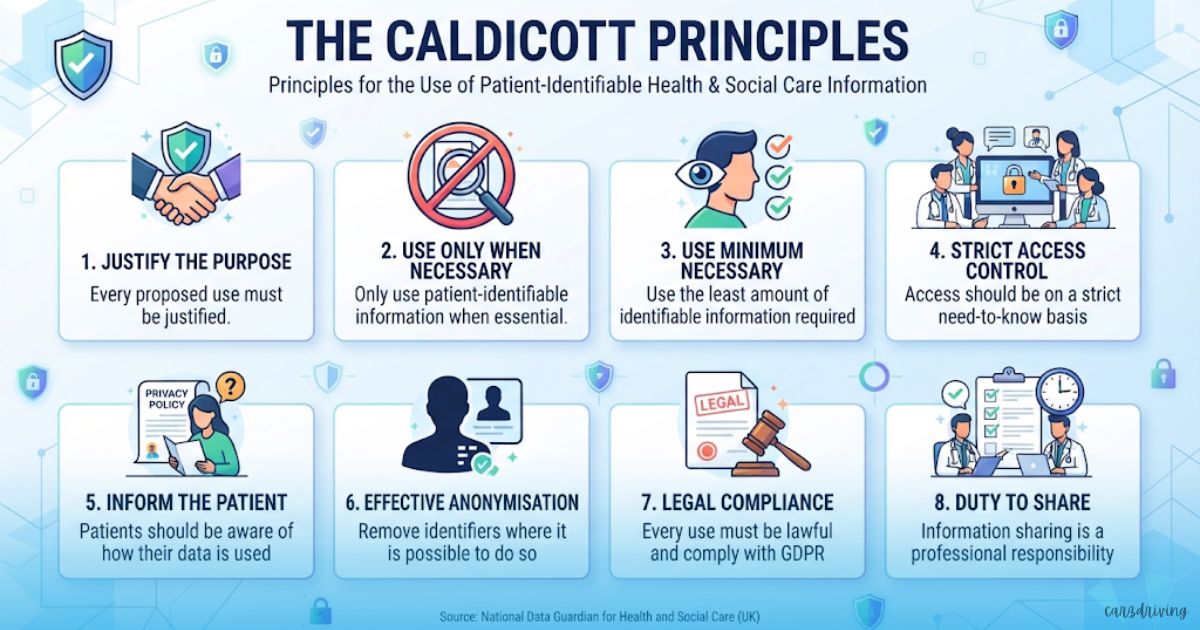
The 8 Principles
Behind every principle sits one overarching purpose: protecting confidentiality while keeping data sharing practical rather than paralysing.
The 8 Principles ask staff to justify every use of confidential information with a documented purpose, and to only use it when truly necessary rather than just because it’s available.
Where information is needed, teams should stick to minimum information using the minimum necessary amount to complete a task and access should sit on a strict need-to-know basis, so only relevant staff can see it. Everyone handling patient-identifiable data needs to understand their information governance duties, and the whole system must comply with the law, following both NHS governance frameworks and wider data protection legislation.
What I find genuinely useful about this list is Principle 7, which treats the duty to share information for individual care as being just as important as protect patient confidentiality itself data sharing isn’t the enemy of good patient care, it’s often essential to it.
The final rule pushes transparency further still, asking teams to inform patients with no surprises about their choice and their patient data rights. This recent principle, added in December 2020, rounds out a framework built on clear justification, shared responsibilities, and a genuine sense that service users deserve to know exactly how their sharing data works.
Principles Explained with Examples
Seeing the principles play out in real situations makes them click. Take a nurse referring a patient to a consultant that’s justify the purpose in action, because the referral serves a specific purpose and a valid reason stands behind it, delivering genuine necessary treatment rather than sharing records for no reason.
Compare that with monthly departmental reports, where anonymised statistics replace individual patient details and appointment attendance rates don’t need a single name attached that’s how sharing information stays proportionate.
A podiatrist handling a referral only needs foot-related health issues and relevant medications, not someone’s full mental health history or unrelated conditions a neat example of minimum necessary in practice.
Meanwhile, a physiotherapist working in outpatients can pull up a medical record for their own caseload but has no business looking at other departments’ files, which is exactly what access to patient information on a need-to-know basis is meant to prevent.
Healthcare staff, including any administrator typing up clinic letters, carry real information governance responsibilities that means never discussing confidential patient details in corridors, the canteen, or other public areas.
It also means following cyber security policies properly, sticking to encrypted secure NHS systems rather than a personal email account, all in line with data protection legislation and NHS governance frameworks.
Protecting confidentiality doesn’t mean information never moves in genuine safeguarding situations, staff carry a legal duty to raise concerns even without patient consent, because authorised duties around direct care sometimes outweigh strict secrecy, though transparency with the patient should follow wherever it’s safe.
None of this slows down genuine patient care if anything, it protects it. And when someone is registering for NHS services, staff should always run through the person’s sharing preferences and be open about how data sharing works, because protecting confidentiality is essential, but so is being open under the organisation’s policies about identifiable information and share patient information practices that keep everyone informed.
Caldicott Guardians
Caldicott Principles every NHS organisation has been required to appoint a Caldicott Guardian since 1998, and this senior person carries real weight often described as the conscience of the organisation when it comes to information.
Their role oversees how health and care information moves through the building, working closely with legal colleagues to keep everything handled legally and ethically.
Bodies covering the health service, adult social care, and adult carer support all carry a statutory duty to appoint one, and the same goes for organisations that are publicly funded even if they aren’t technically a public body think GP practices or care homes.
This matters across the board because public bodies carry the same expectations as smaller providers. Small organisations are allowed to share a staff member across sites rather than hiring separately for the job.
Caldicott guardians lean on real competencies and knowledge to make each decision, and the 2021 guidance from the NDG spells out exactly what NDG guidance organisations should follow when it comes to appropriately protecting patient information.
Groups must have regard to this guidance as a matter of legal obligations, showing genuine responsibilities toward patients and service users alike.
For anyone looking for support, the UK Caldicott Guardian Council, known as the UKCGC, acts as the main point of contact for advice, and every Caldicott guardian across England is supported in upholding the 8 principles at organisational level.
In short, the C.P depending how you write it exist to keep confidential information and patient confidentiality protected everywhere NHS organisations operate.
FAQs
What are the Caldicott Principles?
The Caldicott Principles are 8 trusted rules that protect patient confidentiality across NHS organisations.
Who is a Caldicott Guardian?
A Caldicott Guardian is a senior person who oversees patient information and safeguards confidential information.
Why do the Caldicott Principles matter?
They matter because they protect patient confidentiality while still allowing essential data sharing for genuine patient care.
How many Caldicott Principles are there?
There are currently 8 Caldicott Principles, with the most recent principle added in December 2020.
Do the Caldicott Principles apply after death?
Yes, confidentiality continues even for the deceased, showing just how deeply patient trust is respected.