

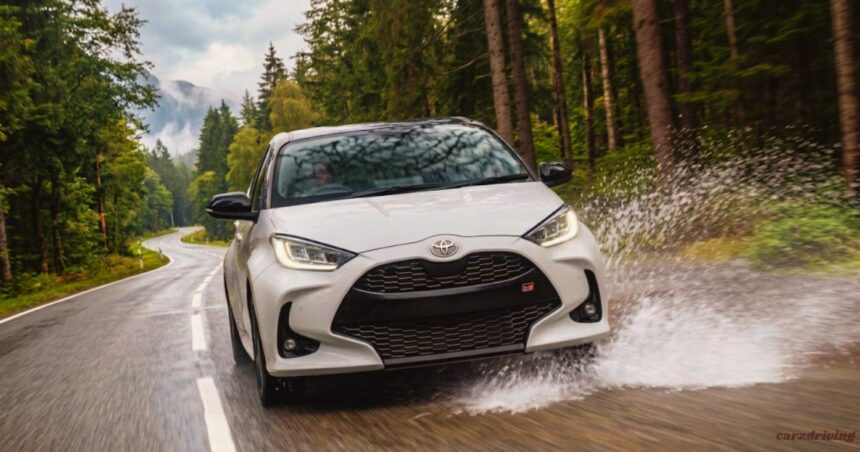
The Yaris GR Sport Hybrid sold only as a 5-door hatchback variant, this model should never get mixed up with the turbocharged 257 bhp GR Yaris 3-door, which behaves more like a rally replica model built for track days than daily commutes.
Of course, times change, and a brand can no longer lean on performance per pound alone to win over the punters; today’s buyer wants something genuinely different.
That’s exactly where the extra shove from the more potent hybrid powertrain comes in. Around town, the car finally feels nippy rather than just smooth and efficient, and on longer runs it stays comfortable during rapid cross-country travel.
Strangely enough, it even manages to be more economical at the same time, though this upgrade sits only on the top two trim levels, so you’ll pay a hefty price premium for it.
Most of the tech upgrades carry over to the mid-spec Excel trim anyway, which still runs the standard 114bhp set-up.
Plenty of brands are quietly leaving the small-car market behind, but Toyota still treats its baby models as a smart way to bring younger customers through the doors of its dealerships.
Toyota Yaris GR Sport
The Yaris sits right at the center of that strategy, with combined sales topping 10 million vehicles since the Mk1 first appeared in 1999.
The current generation has now had a mid-life nip and tuck, and this isn’t your typical facelift of new bumpers and headlights; instead, Toyota went heavy on revised cabin tech without touching major external changes, added a range-topping trim level, and gave us this more powerful petrol-electric hybrid powertrain.
The setup still runs a 1.5-litre, three-cylinder petrol motor producing 91bhp, but the electric motor now adds much more to the overall system output, boosting total power from 114bhp to 129bhp, with electric-motor torque climbing from 141Nm to 185Nm.
Compared with the full GRMN’s hot hatch magic, though, this version still leaves a lot to be desired for anyone chasing real thrills.
Model History & Pricing
The Yaris nameplate has come a long way since those first models rolled out in 1999, and this is now its fourth generation.
Prices for the standard range run from £22,110 to £25,070 across Icon, Design, GR Sport and Excel spec levels, all sharing the same 1.5-litre petrol/hybrid 114 bhp power unit paired with e-CVT automatic transmission.
Stepping up to the hard core GR Yaris pushes the figure to between £32,110 and £35,610, depending on which option pack levels you choose.
Within the wider range, Icon opens the door with 16-inch alloy wheels, air-con, electric windows, auto wipers, and heated side mirrors.
Design brings its own alloys, a seven-inch instrument panel, LED front and rear lights, plus rear privacy glass, while Excel moves up to 17-inch wheels, keyless entry, keyless start, dual-zone air-con, a bigger digital instrument panel, the 10.5-inch infotainment system, part-leather upholstery, auto folding side mirrors, and a wireless smartphone charger.
These three grades stick with the original hybrid powertrain, while the GR Sport spec brings 18-inch wheels, ambient cabin lighting, sportier seats, extra styling add-ons, and a couple of bonus extra speakers on the audio system.
The Premiere Edition sits at the very top, throwing in two-tone paint, a head-up display, and premium JBL speakers. All this extra power and kit, though, comes at a cost.
The GR Sport itself starts from £28,805, which feels steep for a small car with only modest practicality, and the finance numbers don’t make it easier; put down £3,000 on a three-year, 30,000-mile deal, and you’re looking at £432 per month, which is closer to family SUV money.
That price puts it well above electrified rivals like the Renault Clio, and likely above the all-new MG3 once that car lands too.
Exterior & GR Sport Design Details
Visually, the GR Sport earns its badge through a handful of thoughtful touches rather than a full redesign. Toyota fitted retuned suspension for more enthusiastic engagement, bespoke 18-inch wheels with sporty decals, and a unique Dynamic Grey paint finish that sets the car apart on the road.
Step inside and you’ll find red stitched cloth seats, a matching wheel and gear knob, along with optional seat heaters for colder mornings.
That harder edge never comes at the cost of everyday comfort, either. Toyota still packs in smartphone integration, integrated music, full multi-media through an eight-inch screen, a generous spread of safety features including multiple airbags, and LED lights running front and back.
My test car even wore the £915 optional two-tone paint, pairing a black roof section with grey painted bodywork for a sharper look on the driveway.
It’s worth noting that the facelift hasn’t added a single millimetre to the car’s overall dimensions, so the GR Sport remains one of the smaller cars in its class, sitting just under the four-metre mark. That compact footprint shapes nearly everything else about how this car drives and lives day to day.
Engine & Performance
Under the skin, the Yaris GR Sport‘s 1.5 litre petrol/hybrid engine would have embarrassed most hot hatchback rivals from the 1970s and 1980s, not on pace, but on economy, low emissions, and general refinement that those older cars never came close to matching.
The triple-cylinder motor runs so refined and smooth that you’d swear it was a four-cylinder unit, right up until you ask for real flexibility and try to avoid minimum gear-changing.
Total output sits at 114 bhp once you count the hybrid assist, and the whole package stays enjoyable, quiet until you push into high revs, and consistently unbelievably economical; I checked consumption more than once and it kept landing around the low 60 mpg mark.
Like every other Toyota hybrid, this engine runs the Atkinson cycle design, holding the intake valves open longer to delay the compression stroke, which boosts both efficiency and fuel economy. The petrol side alone manages a maximum output of 90 bhp, or 68 kW, with peak 120 Nm (89 lb.ft) of torque arriving at lower revs around 3,600 rpm.
Add the electric motors through the e-CVT automatic, an electric continuously variable transmission, and the hybrid system’s two motor/generators, MG1 and MG2, work together cleverly: MG2 drives the front wheels directly as a power source, while MG1 handles starting the engine and helping generate power for both the hybrid lithium-ion and 12V battery.
The newer, punchier version swaps in a three-cylinder petrol motor rated at 91bhp, with the electric motor lifting system output to 129bhp and electric-motor torque up to 185Nm from 141Nm.
On the road, that translates into better response when nipping through traffic or pulling out of junctions, and the petrol engine doesn’t even fire up more often to do it; CO2 figures actually come in lower CO2 than the standard car. The sprint to 0-62mph drops by half a second, and those performance gains feel even clearer out of town, where the CVT gearbox no longer sends revs into orbit, giving genuinely useful electrical assistance.
The earlier, milder four-cylinder naturally-aspirated petrol engine and electric motor combination made do with 98bhp and 125Nm of torque sent to the front wheels through a standard CVT, reaching 0-60mph in 11.6 seconds and a top speed of 103mph, while returning 56-60.1mpg on the combined cycle and emitting 89g/km of CO2.
Set against the full GRMN’s Lotus-sourced, supercharged 1.8-litre engine, this hybrid setup simply can’t match that fizz or fun, leaving a clear mismatch with the sportier chassis underneath.
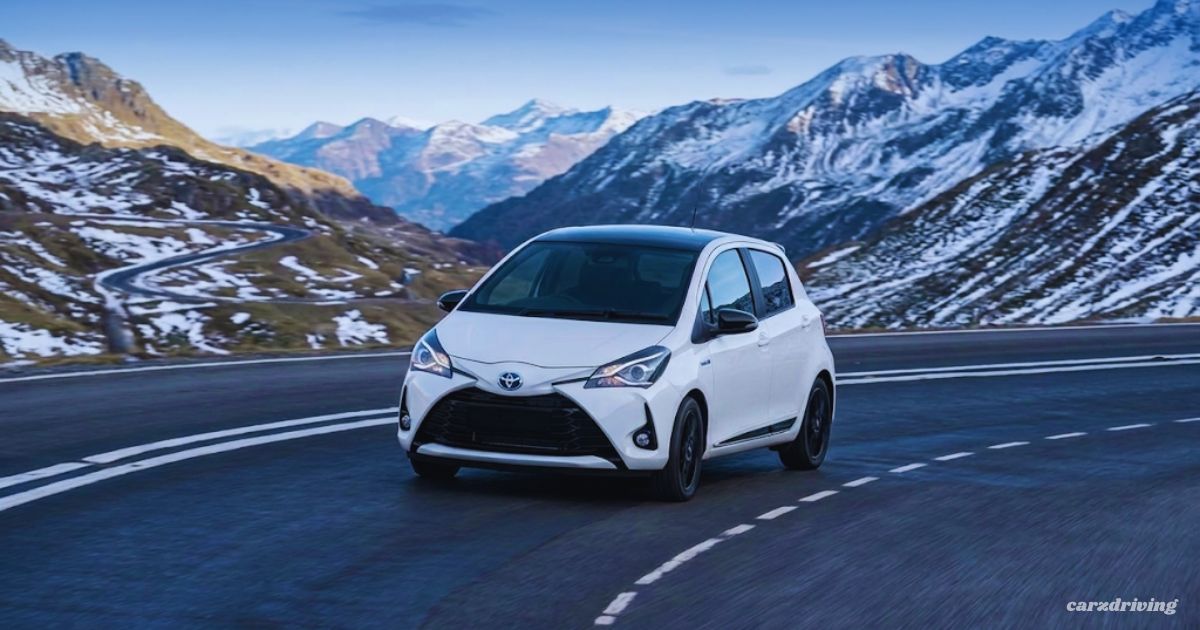
Interior & Practicality
Inside, the GR Sport’s hatchback’s refinement shows up the moment you start exploring the sound system, connectivity, and controls. The secondary controls click with a satisfying squeeze action, the gear lever feels short and direct, the brakes stay powerful and balanced, and the steering delivers genuine input and feedback through corners.
Up front, room infront suits most drivers comfortably, though anyone over six feet tall might find the adjustment range a bit tight.
Climbing into the back seats takes a small wiggle through the small opening of the rear doors, and once you’re in, the legroom struggles for anyone past average height, leaving the rear bench best suited to children.
The seats themselves carry typical Toyota quality, deep and supporting through corners, though they don’t fully absorb bad bumps thanks to the stiffer sports suspension.
Elsewhere, the cabin upgrades borrow heavily from the Toyota Corolla, dropping the old analogue dials from every trim above entry-level Icon trim in favour of a digital instrument panel running either seven inches or 12.3 inches, depending on trim level.
Even the base car now gets a nine-inch infotainment system, while the top three grades step up to the same 10.5-inch display found in the Corolla, complete with wireless Android and Apple connectivity as standard.
Extra safety kit includes a clever warning that flashes if you’re about to open a door into the path of a passing cyclist or pedestrian.
Space in the rear cabin still suits only small adults comfortably, and the boot, at 286 litres, falls short of the Renault Clio’s 301 litres in full hybrid guise, confirming this stays a true supermini rather than a small family car. Interior quality holds up well too; you’ll spot a few harder plastics here and there, but the cabin feels neatly finished, with soft padded fabrics in the right places and sensible controls like physical dials and switches for heating and ventilation, giving it one of the more mature offerings and sophisticated cabin ambience in the class, backed by a crisp, responsive infotainment system with quick screen prods.
The GR Sport trim layers on its own flair, too, with Ultrasuede-upholstered semi-bucket seats that add real comfort, a steering wheel borrowed from the GT86, and GRMN-style detailing minus the red 12 o’clock stripe seen on the full-whack car.
Fire up the ignition and the TFT display in the gauge cluster throws up a small GR animation, but beyond that, it stays close to the standard Yaris Hybrid, with seating for five, although adults in the back won’t thank you for it, alongside that same generous boot of 286 litre, and the same scattering of hard plastics throughout.
Ride, Handling & Driving Dynamics
On the move, roadholding impresses thanks to tight control over wheel-lift and body roll, keeping the driver firmly planted through twisting turns without a single one of the bad habits you sometimes find in small hot hatches.
Poorer surfaces do generate some noise through the 18-inch tyres, and the extended engine note adds to that, though mechanical noises and wind noises both stay impressively low.
The TNGA platform underneath continues to punch above its weight by class standards, arguably offering more body control than it strictly needs; it’s genuinely fun to lean on that capable chassis through corners, though I’d happily trade a touch of that composure for more compliance over sharper urban bumps and potholes, which still find their way into the cabin, especially in the rear.
The GR Sport’s 18-inch wheels likely don’t help that ride quality either. Toyota went further still on the sportier mechanical side, fitting Sachs Performance suspension and an anti-roll bar for increased stiffness, alongside 17-inch alloy wheels wrapped in sticky Bridgestone Potenza RE50 tyres.
The effect is obvious from the first corner: the car builds real confidence when driven harder, with far more grip than most drivers will ever need, which only highlights the underlying powertrain-chassis mismatch.
A more potent and characterful engine would have turned this into a genuinely exceptionally fun car, or alternatively, keeping the GR appearance without the racy mechanical upgrades would have made for a perfectly nice-looking, comfortable firm car. Instead, it lands in a slightly weird middle ground that’s hard to fully love.
Verdict
There’s something genuinely exciting about the idea of a baby Yaris GRMN, a car that sounds astonishing on paper, and a cheaper version that could bottle some of that hot-hatch spirit while staying properly useable day to day really is an appealing prospect. The GR Sport, though, isn’t quite that car.
While the chassis clearly has the potential to deliver real fun, it gets let down by a powertrain that never feels at home when pushed hard, and switching to driving for efficiency instead just lets those racier enhancements eat into everyday comfort too much.
Toyota has built something with real promise here, but there’s still a lot left to be desired before the GR Sport lives up to its badge.
Key Specifications
Across the lineup, the Model badge reads Toyota Yaris GR Sport, with a Price of £28,805 for the newer car, built around a 1.5-litre, 4cyl, petrol hybrid Engine producing System power of 129bhp through a CVT auto, front-wheel drive Transmission.
That combination reaches 0-62mph in 9.2 seconds, hits a Top speed of 109mph, and returns Fuel economy of 65.4-67.3mpg alongside CO2 emissions of 96-98g/km, with overall Size (L/W/H) measuring 3,940/1,745/1,500mm.
The earlier Model as tested carried a Price on-road of £20,735, running a petrol-electric hybrid through a Gearbox described as continuously-variable automatic transmission, or CVT, with Power rated at 100hp and Torque of 125Nm. That version reached 103 mph at the top end, completed 0-60mph in 11.6 seconds, and achieved 56-60.1 mpg while emitting just 89 g/km of CO2.