
Booking your first practical test feels like staring down a mystery clock. I remember sitting in the waiting room years ago, wondering how long is a driving test? exactly how the minutes would be spent once my examiner called my name. This guide walks through every part of the appointment in plain language, so you know precisely what to expect before you even turn the key.
How Long Is a Driving Test?
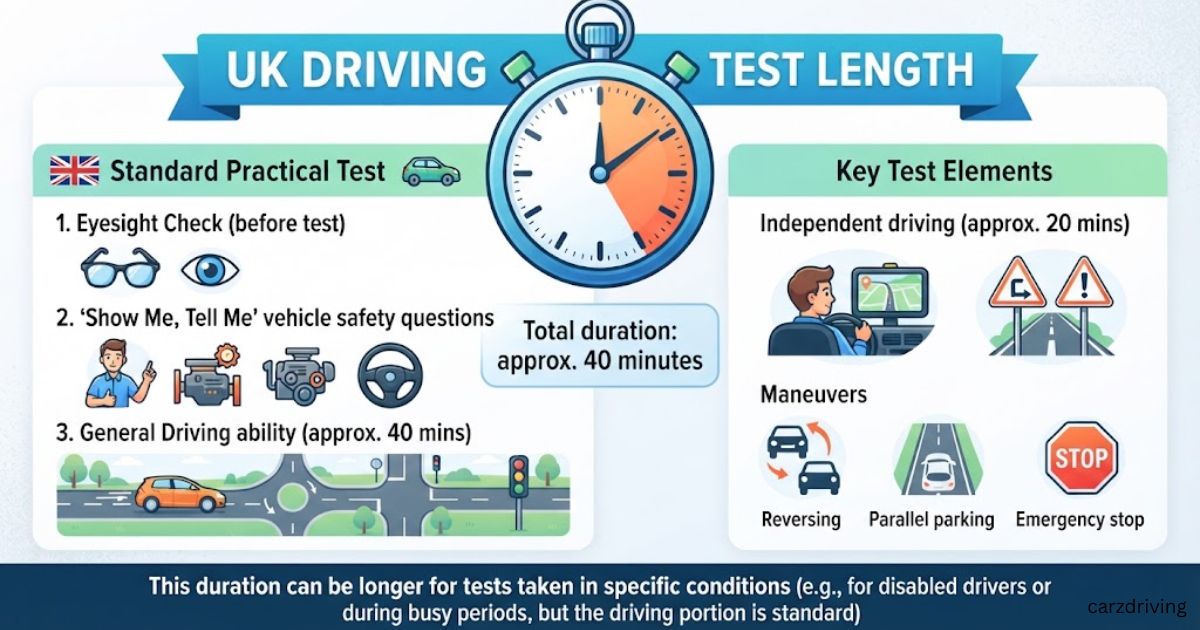
Most learners in the UK ask the same question before test day, and the honest answer is that a standard practical driving test runs for about 40 minutes, though some appointments settle closer to 35 minutes depending on the route.
You should still block out a full 1 hour for the whole visit, because arrival, document checks, and feedback all add extra driving time around that hour at the test centre.
If you fall into the category needing an extended driving test, plan for 65 minutes to 70 minutes in total, and use any spare moment beforehand as quiet prep so the feedback time at the end doesn’t catch you off guard.
Driving Test Time Breakdown
Walking into the appointment, your arrival and pre-test briefing happen first, usually around 10 minutes before your start time, followed swiftly by an eyesight check that examiners treat as a firm gateway into the rest of the driving.
From there, expect 1-2 minutes of document checks, a couple of 2-3 minutes worth of questions one Tell Me and one Show Me before the car even moves, then roughly 15-20 minutes of general driving guided by spoken directions from the examiner, blending into 20 minutes of independent driving using sat nav or traffic signs.
The whole driving stretch typically lands around 35-40 minutes, and once you park up, post-test feedback takes about 5 minutes, giving you the result and calming any lingering nerves so you leave the zone knowing where you stand; treat this like a driving lesson in itself and jot down the minutes and totals so future practice sessions feel less like guesswork.
What Happens During the Driving Test?
The opening eyesight check asks you to read a number plate from 20 metres away, or 20.5 metres for an older-style plate, and failing this leads straight to an immediate test cancellation, so glasses-wearers should double check their vision beforehand.
Next come the safety questions: a Tell Me question about something like brakes, spoken before you start, and a Show Me question perhaps washing the windscreen asked once you’re already driving through roundabouts, junctions, and residential areas while the examiner watches your directions, use of mirrors, lane discipline, speed control, and safe decision-making during general driving.
You’ll also complete one reversing manoeuvre, chosen from pull up on the right and reverse two car lengths, a parallel park, or a reverse bay park, then handle 20 minutes of independent driving by sat nav or road signs, where taking a wrong way turn stays safe and isn’t penalised,
and finally there’s a random chance never guaranteed of an emergency stop, which only adds a few seconds to the driving element, lasting around 3 minutes to 5 minutes total for manoeuvres.
Can My Driving Test Be Longer or Shorter?
Your total time on the road isn’t always fixed, because heavy congestion on the day can stretch things out, while dangerous faults or major faults trigger an early termination that cuts the appointment short for safety reasons rather than convenience.
On the other end, medical conditions or disabilities sometimes qualify learners for a longer driving test, part of the official extended tests category that runs up to 70 minutes, or closer to 65 minutes in most cases.
This same extended driving test applies to anyone who must retake their licence after a disqualification, and examiners follow the same structure regardless of why you’re sitting it.
Can We Use Our Own Car for the Driving Test?
Bringing your own vehicle is allowed, but it must be taxed and insured specifically for driving test use, so it’s worth confirming this with your provider well before the day arrives.
The car also needs to be roadworthy with a valid MOT if it’s over 3 years old, free from dashboard warning lights, and fitted with tyres that meet the legal tyre tread depth of 1.6mm, showing no tyre damage and no space-saver tyres anywhere on board.
On top of that, it must stay smoke-free before and during the test, reach 62mph using a working mph speedometer, and weigh no more than 3,500kg as max weight, with the full list confirmed on the GOV.UK car requirements page.
What Matters Most on the Day?
Two documents matter most on the day: your signed UK provisional driving licence and your theory test pass certificate, which stays valid within 2 years of the date you passed.
If you’ve misplaced your lost theory test certificate, contact the DVSA directly and request a letter of proof, since turning up without one risks the whole appointment. Following the official guidance on this closely saves a lot of last-minute stress.
What If I Fail Mid-Test?
A dangerous fault or serious fault brings the assessment to a close for safety reasons, and your examiner will simply drive you, or guide you, back to the test centre to explain calmly what happened.
There’s no shame in a test end early, and the process for how to book another test is straightforward once 10 working days have passed. Many learners actually improve fastest right after this kind of setback, because the feedback is fresh in their mind.
Can I Drive Straight After Passing?
The moment you pass, you’re free to drive solo, provided your car insured status is active, since learner insurance stops covering you the second you hold a full licence, and your car taxed status must also be current.
Behind the scenes, your examiner usually sends the paperwork to upgrade your provisional licence through the DVLA, and your full licence then arrives by post within about 3 weeks. Until it lands, keep your pass certificate somewhere safe as proof.
Do I Need a Driving Instructor to Take the Test?
Technically no, because any suitable car works as long as you’ve completed your theory test and it meets DVSA requirements, so learners are allowed to turn up without ever booking a lesson.
In reality, most people pass with support from a qualified driving instructor, who already knows local routes, understands the rules, and preps you properly for success. Their experience often shortens the whole learning curve considerably.
Driving Test Day Tips
Arrive with 10-15 minutes to spare, because rushing in flustered rarely helps your concentration once the examiner greets you.
A short pre-test lesson beforehand works wonders to calm nerves, and something as simple as comfortable clothes and sensible shoes genuinely changes how relaxed you feel behind the wheel. Double-check you have every one of your necessary documents tucked safely in a bag the night before.
UK Driving Theory Test
The UK driving theory test runs for 80 minutes in total, split into two parts taken during one single appointment.
First comes multiple-choice questions, allowed up to 57 minutes, then hazard perception, taking around 20 minutes, with an optional break of up to 3 minutes available between the two sections. Once you add check-in and instructions at the test centre, most people are finished within 90 minutes from start to finish.
How Long Is the Multiple-Choice Theory Test?
This multiple-choice section asks 50 questions and lasts up to 57 minutes, giving plenty of time to read carefully rather than rush. You need 43 out of 50 correct to pass, which leaves a reasonable margin for a few uncertain answers. Reading each question twice tends to help more than racing through the clock.
How Long Is the Hazard Perception Test?
The hazard perception section takes roughly 20 minutes and shows 14 video clips, each containing at least one developing hazard for you to spot. Scoring 44 out of 75 is required to pass, so clicking too early or too late on developing hazards can cost valuable points. Staying relaxed and watching the whole screen, not just the centre, genuinely improves accuracy.
How Long Does the Theory Test Take at the Test Centre?
Once you factor everything in, expect 90-95 minutes at the test centre for the full theory test experience. That figure includes the 80 minutes for the exam itself, plus another 10-15 minutes for check-in, ID checks, and general instructions from staff. Arriving a little early avoids any unnecessary rush before the screen even starts.
Driving Test in Manchester
A driving test in Manchester follows the exact same timing as anywhere else in the UK, sitting at around 40 minutes regardless of the postcode. The DVSA sets this duration nationally, so London, Birmingham, and Manchester all share identical rules on paper. What genuinely differs is the local road environment, which brings its own flavour of challenge.
Does Manchester Traffic Affect Test Length?
Manchester traffic doesn’t shorten or stretch the clock, since the test still runs for 35-40 minutes of driving no matter how busy the roads feel. Learners here often face busier roundabouts, multi-lane junctions, thick city centre traffic, variable speed limits, and heavier rush-hour conditions, all within the same fixed window. The examiner simply watches how you respond to real road conditions, rather than adjusting the timer because of congestion.
Independent Driving in Manchester
For about 20 minutes of your test in Manchester, you’ll handle independent driving entirely on your own judgement.
This usually means following a sat nav through busy routes, working through complex junctions, keeping tidy lane discipline on dual carriageways, and reading road signs clearly even under pressure. Practising these specific conditions beforehand builds real confidence rather than blind luck.
Ready to Pass Your Driving Test in Manchester?
How long is a driving test? building genuine confidence takes more than luck, and structured lessons built around real Manchester routes make a noticeable difference to how prepared you feel.
Good driving lessons focus on real test route preparation, realistic mock tests under realistic conditions, and calm patient instruction paired with clear feedback after every session.
If that sounds like what you need, confidence-focused lessons through driving lessons in Manchester, including options like Impulse Driving School, can turn nervous energy into steady, reliable practical test results.
FAQs
How long is a driving test in the UK?
A standard practical driving test lasts about 40 minutes, with the full appointment taking around 1 hour at the test centre.
How long is the driving theory test?
The UK driving theory test runs for 80 minutes total, covering both the multiple-choice section and the hazard perception test.
How long is the independent driving section?
The independent driving part lasts around 20 minutes, guided by either a sat nav or road signs.
How long is the extended driving test?
An extended driving test runs longer, usually between 65 minutes and 70 minutes, often after a disqualification.
How long does it take to pass a driving test in the UK?
Most learners need around 45 hours of professional lessons so don’t worry if it takes a little patience to get there.