
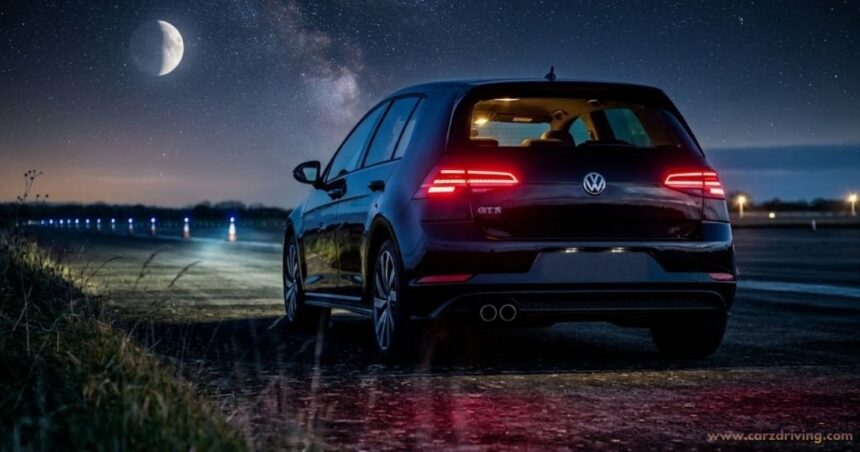
The Volkswagen Golf GTE sits in a sweet spot that very few cars manage to hit it gives you the soul of a GTI wrapped in a plug-in hybrid package that actually makes sense in the real world.
I remember the first time I drove one and thought, “this doesn’t feel like a compromise at all.” Volkswagen built this car on the MQB (Modular Transverse Matrix) platform, which gives engineers the freedom to drop in different powertrains without redesigning the whole car, and that flexibility is exactly why the GTE and e-Golf roll off the same factory line as the standard Golf.
The Volkswagen Golf GTE
When the Golf GTE plug-in hybrid made its debut at the Geneva Motor Show in 2014, it landed alongside a Golf range that already offered five power sources petrol, diesel, CNG, pure electric, and now plug-in hybrid.
The name itself tells you where it sits: GT stands for Gran Turismo, I for Injection, D for Diesel, and E for Electricity, placing it right next to the iconic GTI and the GTD in the lineup.
Volkswagen had already racked up over 30 million sales across seven generations, won European Car of the Year and World Car of the Year, and celebrated its 40th anniversary the GTE simply added another chapter to that story by cutting tailpipe emissions drastically without losing any of the practicality, refinement, and advanced technology the Golf family is known for.
Under the hood, the earlier GTE paired a 1.4-litre TSI engine producing 150 PS with a 102 PS electric motor for a combined 204 PS output, while the updated model steps things up with a 272hp total system output drawing from a larger 19.7kWh hybrid battery that delivers an EV-only range of over 70 miles on the WLTP cycle.
That bigger battery also unlocks a DC charging rate of up to 40kW, which is seriously impressive for a PHEV.
The earlier spec returned a theoretical range of 580 miles, 166 mpg, and CO2 emissions of just 39 g/km, while the updated GTE pulls hard with 0-62mph in 7.6 seconds, a top end of 138 mph, and a chunky 350 Nm (258 lbs ft) of torque all while keeping BIK at just 5%, making it one of the most compelling company car tax choices for fleet buyers today.
The kerbweight sits at 1,599 kg, with the 120 kg battery tucked under the floor, and the whole thing is built at Volkswagen’s Wolfsburg, Germany plant a detail that tells you something about the quality expectations baked into every car.
Performance and Drive
The updated GTE punches hard with a 1.5-litre petrol engine working alongside a 110hp electric motor for a total system output of 272hp that’s a jump of 27hp over the pre-facelift car
And you feel every bit of it the moment you put your foot down. 0-62mph arrives in just 6.6 seconds, which puts it firmly in hot hatch territory, and the whole powertrain update makes this feel like a genuinely fast car rather than an eco box wearing a performance badge.
The acceleration is smooth, immediate, and confidence-inspiring, which is exactly what you want when you’re pulling onto a busy dual carriageway.
The chassis handles direction changes flatly and responsively, the steering is direct without feeling nervous, and the electronic differential does a brilliant job of pulling the car through longer corners in a way that feels planted and controlled.
I did notice that the hybrid setup causes the petrol engine shut-off mid-cornering the engine cuts when you tip into a bend and then wakes back up when you accelerate out, which is the one area where the dynamic experience loses a tiny edge compared to a pure GTI.
That said, the brakes are genuinely impressive and give you real handling confidence, and if you spec the optional adaptive chassis control with variable suspension settings like the test car I drove had fitted, the ride quality never tips into bone-shaking territory even in its firmest setting it keeps things firm but always composed.
The drive overall rewards you for using the car the way it was designed to be used lean on the battery around town, let the plug-in hybrid system do its thing on longer runs, and save the Sport PHEV SUVs comparison for someone else, because the GTE genuinely handles like a proper driver’s car.
The plug-in hybrid setup that disappointed in early PHEVs actually works here because Volkswagen engineered the transition between power sources to feel responsively seamless.
On an interesting road, the only thing missing is the rawness of being 200kg lighter, which the pure petrol GTI still has over it but for what the GTE is trying to do, the performance delivered is remarkably convincing.
Design and Interior
The GTE wears the same sharp suit as the GTI with a body kit that includes uniquely shaped bumpers and side sills, and while the badges on the doors split opinion, the overall visual package is cohesive and purposeful.
Step inside and the MIB4 infotainment system running on a 12.9in screen immediately grabs your attention it sits beside a 10.2in Digital Cockpit Pro screen and together they create a cabin that feels genuinely modern.
The climate controls are handled through the infotainment system screen, which means the old sliders are gone, though they are now at least illuminated in the updated car.
This is still very much a family car at heart rear seat passengers get their own dedicated climate controls, USB ports, solid headroom, and decent legroom, which matters when you’re doing real family miles rather than track days.
The sport seats up front come with lumbar support in proper GTI style, trimmed in blue Clark tartan with Checkered Black decorative inlays running through the dashboard and door panels.
The leather-trimmed, three-spoke multifunction steering wheel with aluminium accents, paddle shift, and GTE logo feels premium in the hand, while the gear knob in aluminium look, chrome accents on the rotary light switch, mirror adjustment, and window lift switches add layers of quality throughout the cabin.
The one genuine compromise you live with is the boot at 273 litres, it’s frankly poor for a lower-medium hatch and sits over 100 litres down on ICE-powered Golfs including the GTI, because the plug-in hybrid battery takes up that space.
The Composition Media 5.8-inch touchscreen display handles mobile online services, traffic information, and connects to the Car-Net e-Remote smartphone app, while the optional Discover Pro navigation adds the range monitor, energy flow indicator, zero-emission statistics, e-manager, and the brilliant 360 degree range feature that shows your electric driving range as a zone on the map.
The Car-Net e-Remote app included free with a three-year subscription in the UK lets you programme departure time, manage charging times, control interior cooling and heating via stationary air conditioning, monitor auxiliary consumers, check vehicle status, confirm
whether doors are locked, and track the location of the car; the energy flow indicator uses animated graphics with blue arrows for accelerating and green arrows for regenerative braking, making the whole e-mobility story visible in real time.
The power meter supplements the tachometer on the left side of the instrument cluster, the speedometer stays on the right, and a colour display in the centre continuously shows the electric driving range and the current operating mode.
A separate LED field in the lower segment of the multifunction display shows the READY message once the e-motor fires up a small touch, but one that reminds you this is no ordinary Golf.
Driving Modes
The GTE launches every journey in fully electric mode, pulling silently from rest with a real-world 40 miles range on a full charge enough to cover most commutes without ever touching the petrol engine.
Switching into Hybrid mode tells the car to intelligently blend both power sources, optimising your electric range, cutting fuel consumption, and lifting performance wherever the system sees an opportunity, and you can also tell it to preserve a specific level of battery charge for later useful if you know you’re heading into a city center after a motorway run.
The sat nav integration takes this further by reading the route ahead and deciding which power source suits each section, and the transition between the two is so smooth it’s genuinely hard to notice when it happens.
Eco mode dials back throttle responsiveness and reduces the load on the air conditioning, and it throws up eco tips on screen to coach you toward better fuel efficiency not the most exciting mode, but remarkably effective if you want to stretch every mile from the battery.
Comfort mode sits in the middle, giving you a balanced, relaxed drive that works well for mixed roads, while Sport mode brings both motors together, adds weight to the steering, cranks up responsiveness, and pipes fake engine sounds into the cabin for a more dynamic experience it’s theatrical, but it works.
For the gearbox, flicking the lever back once drops you into the sport gearbox setting instantly, giving you sharper shifts and the confidence to overtake cleanly or pull out of junctions without hesitation.
The touch sensitive button that cycles through modes sits right where you need it, and the full selection is confirmed through the touchscreen the whole system feels logical and well thought out once you’ve spent a few miles getting familiar with it.
What strikes me most after living with these modes is how naturally the car flows between them: you’re never fighting the system, you’re working with it.
The E mode button and the GTE mode buttonwhich live just to the left of the gear knob become second nature within a day, and that ease of use is part of what makes the GTE genuinely liveable rather than just impressive on paper.
Five Operating Modes
The GTE gives you five modes to play with e-mode, GTE mode, Battery Hold, Battery Charge, and Hybrid Auto and whichever one is active shows clearly on the multifunction display in the instrument cluster so you always know where you stand.
The car starts by default in zero-emission e-mode, running purely on the electric motor up to 81 mph with a maximum range of 31 miles from a fully charged pack, though outdoor temperature and driving style both affect that figure; the TSI engine only wakes up automatically if battery charge drops below a predefined low battery threshold or at very low outdoor temperatures.
The vehicle management system handles this switch seamlessly, and you can also hit the e-mode button to the left of the gear knob at any time to force the car back into zero-emission running whenever you want.
Pressing the GTE button also just left of the gear knob transforms the car’s character entirely: the accelerator pedal sharpens up, the gearbox characteristics shift toward faster, more urgent responses, steering characteristics stiffen and communicate more, and a sound actuator fires up to deliver a sporty sound that matches the performance oriented tuning of the TSI.
In this mode automatic headlight control and adaptive cruise control behaviour also adjust, and if you’ve opted for dynamic chassis control, the electronically controlled dampers move from their Normal setting into Sport mode everything tightens up at once.
Most importantly, GTE mode triggers boosting, which means the TSI and electric motor work together to deliver the full system power of 204 PS and the maximum 350 Nm (258 lbs ft) of torque simultaneously this is the mode you use when you want the car to feel properly, unambiguously fast.
Battery Hold keeps the high voltage battery at a constant average charge state so you can save electric range for later useful if you want to arrive at a zero-emissions zone with enough charge to drive through it without burning fuel consumption.
Hybrid Auto uses the stored energy to support the TSI wherever it can, minimising fuel consumption automatically, while Battery Charge actively tops up the pack on the move.
You can switch between Battery Charge, Battery Hold, Hybrid Auto, and e-mode from the Car menu in the infotainment system, and pulling the DSG gear shift grip back from D to B increases the intensity of battery regeneration letting the car slow itself through engine braking without touching the brakes at all, which is genuinely useful in the mountains or in slow urban traffic.
This style of deceleration without brakes feels natural very quickly, and it’s one of those features usually reserved for pure electric vehicles like the e-Golf that makes the GTE feel intuitive to live with rather than complicated.
Charging Process
Do I have to fully charge the car?
You do not have to fully charge the GTE every time in fact, the quickest charging window sits between 20% and 80%, so frequent top ups within that band are both more convenient and better for long-term battery health.
Going to fully charged gives you the maximum range and gets the most from the electric motor, which is the whole point of running a PHEV in the first place, but the battery is engineered to last the lifetime of the car even if you regularly charge outside that 20%–80% window.
The reassurance that frequent charges outside that range won’t cause lasting damage is one of the things that makes everyday charging feel low-stress.
How do I charge it?
Charging the GTE is straightforward the charging port sits on the passenger side of the car and looks almost identical to a fuel cap; you open it, plug in either the supplied charging cable or the charging station cable, then follow the payment instructions and wait for the confirmation that the session has started.
The status light around the port lights up green when everything is running correctly, and the dashboard immediately gives you a live battery prediction showing when it will be full.
On the older model, the socket sits behind the VW emblem on the radiator grille, where the car draws alternating current AC from a standard 230 volt mains electrical socket at 2.3 kW, or from a wall box, carport, or public charging station at 3.6 kW.
When you want to lock the car and leave it, the cable stays secured in the port until you return, unlock the car, and press the unlock button beside the charging port to release it then the cable goes back in the boot.
The charging process can also be triggered immediately via a button on the charging socket behind the VW badge, or you can set time-delayed charging through the infotainment system or the Car-Net app a three-year subscription is included free for UK buyers.
That Car-Net app also lets you activate remote control charging, schedule interior cooling or heating before you set off, and manage the whole process from your phone. Many public chargers now pair with a dedicated app that lets you verify the session and monitor charging status remotely a genuinely useful feature when you’re out and about.
How long does it take to charge?
Charging between 20% and 80% is where the rapid charging happens outside those points the rate slows deliberately to manage battery protection.
Several factors influence real-world charge times: cold temperatures slow things down noticeably, and the charging rate of the source and the battery size both play a role.
Starting from 0%, the approximate times break down like this: a standard 3-pin plug at home takes around 6 hours for a full charge; a home wallbox brings that down to 3.5 hours; a 7kW public charger also delivers the same 3.5 hours; and even a 22kW public charger won’t go faster than 3.5 hours because the GTE’s maximum AC charging capacity is capped at 3.6kW so faster public chargers won’t make a difference here.
The dashboard prediction appears the moment you plug in, telling you exactly when to expect a full pack, which takes any guesswork out of planning your day.
What connector does the GTE use?
The GTE charges through a Type 2 Connector, which works at home, at work, or at any public charging station across the network.
The car’s maximum AC charging rate is 3.6kW, so whether you’re topping up overnight at home or grabbing a charge at a public charging station during the day, the same AC standard applies cleanly across all those settings.
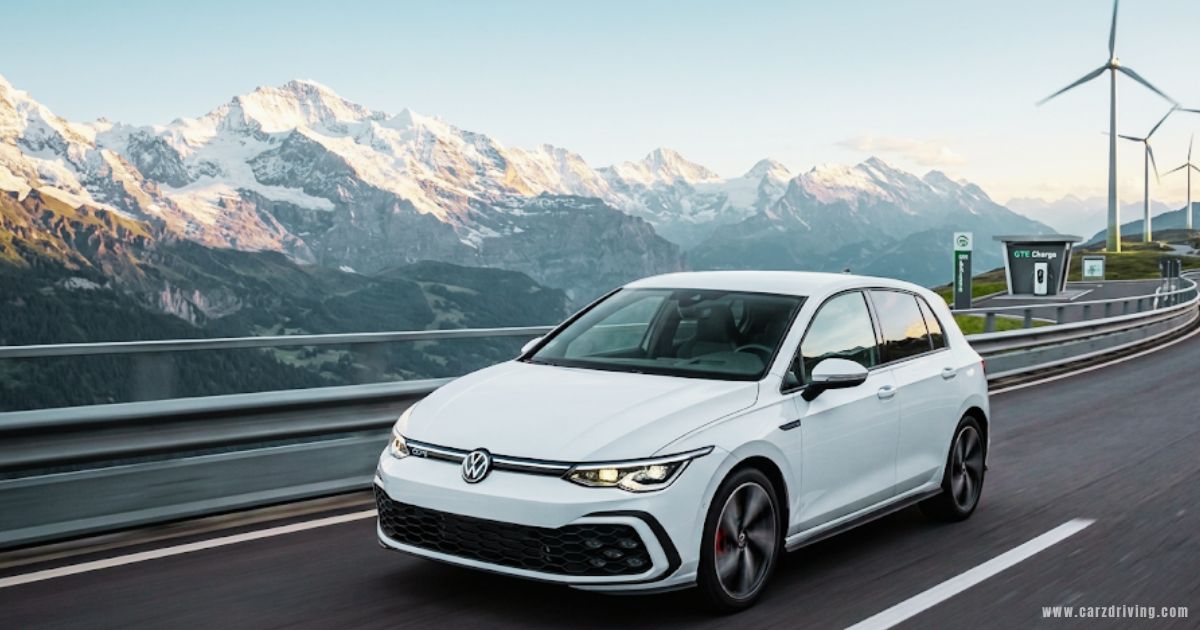
Hybrid Drive System
The GTE’s hybrid drive system is built around two core units: the 1.4-litre TSI turbocharged petrol direct injection engine producing 150 PS and the 102 PS electric motor, which combine for a system output of 204 PS.
The electric motor draws its energy from a high voltage 8.7 kWh lithium-ion battery with a liquid cooling system, charged through a socket behind the VW logo on the radiator grille, while the six-speed DSG with its three clutches a dual clutch plus a disengagement clutch was purpose-built for hybrid use and handles the handoff between power sources so naturally you barely notice it.
During coasting, the disengagement clutch separates the TSI from the front axle and shuts it off, letting the car use its own kinetic energy without any added propulsive power this is where the system earns its efficiency numbers.
All of the compact powertrain elements sit tightly packaged: the TSI weighs 102.8 kg, the electric motor comes in at 34 kg, the DSG at 98.5 kg, and the power electronics at just 12 kg the engineers shifted the petrol engine 57.5 mm to the left (when viewed from the front) specifically to integrate the electric motor into the gearbox housing cleanly.
The battery (120 kg) lives under the vehicle floor in front of the rear bench seat, keeping the interior space intact and the total unladen weight at 1,599 kg.
The power electronics convert DC power from the battery to AC power for the electric motor via high-power transistors, linking the traction circuit, the 3-phase connection to the e-motor, the DC/DC converter to the 12V electrical system, and the high-voltage power distributor essentially acting as the brain of the energy flow between the electric motor and the lithium-ion battery.
The 1.4-litre TSI develops its 150 PS peak at a relatively low 5,000 rpm, with maximum torque of 250 Nm available from 1,600 rpm to 3,500 rpm thanks to its 16-valve EA211 series architecture and ultra-rigid diecast aluminium crankcase.
Because the GTE can run on electricity for weeks at a stretch, Volkswagen applied a polymer coating to the connecting rod bearings, used special hard material coatings on the piston rings, and reworked the bearing shells and piston play to handle long dormant periods without wear.
The exhaust manifold integrates directly into the cylinder head so the engine reaches optimal operating temperature quickly, while thermal management runs through a two-loop cooling system a low-temperature loop serves the intercooler and turbocharger housing via an electric pump, and the passenger compartment is heated through the cylinder head circulation loop for fast warm-up.
Choosing a single-scroll compressor in the turbocharger reduced weight in the cylinder head and turbocharger unit, and the intake camshaft uses variable valve timing to sharpen drive-away torque in the lower rev range, while the exhaust camshaft adjuster gives more spontaneous response from low revs and lifts torque at high engine speeds.
The maximum injection pressure of 200 bar feeds five-hole injection nozzles that can deliver up to three individual injections per cylinder through a stainless steel distributor bar precision engineering that goes well beyond what you’d expect in a family hatch.
The 102 PS electric motor produces 330 Nm of peak torque from a standstill with 170 Nm available as continuous torque spins to 7,000 rpm, and operates as a three-phase permanent magnet synchronous motor mounted on the input shaft between the dual-mass flywheel of the disengagement clutch and the DSG components.
Power electronics regulate the motor’s torque and speed in real time, and the whole DSG and electric motor module is produced at Volkswagen’s component plant in Kassel Baunatal.
The DSG distributes power through a coaxially split driveshaft with upstream driving clutch to two gear-train halves, executing shifts in fractions of a second without any interruption in drive the two drive clutches K1 and K2 handle input torques of 400 Nm each, while the disengagement clutch K0 manages up to 350 Nm from the TSI.
The lithium-ion battery under the floor is built from eight modules, each containing 12 cells with their own cell electronics, and the cell voltage ranges from 250 volts to 400 volts depending on charge status.
The Battery Management Controller (BMC) handles all safety functions, diagnostic functions, and monitoring functions, manages the battery junction box (BJB), controls the liquid cooling system by reading temperature distribution across the pack, and reports cooling needs to the broader thermal management system and if the car is in a crash or non-operating state, it automatically enters a de-energised state for safety.
Volkswagen backs the high-voltage battery with an eight years warranty covering 160,000 km (100,000 miles), which gives real-world confidence in the system’s longevity.
The cooling system serves a far more complex job than in a conventional car it has to keep the combustion engine, gearbox, car interior, and all hybrid system electrical components within their ideal temperature window simultaneously.
The solution is three separate cooling loops that ensure each component reaches its individual operating temperatures quickly while never exceeding maximum temperatures, with optimal volumetric flow of coolant maintained across all five operating states of the car.
The electro-mechanical brake servo (e-BKV) adds another layer of efficiency through brake blending at low deceleration levels, the e-motor braking torque handles everything and recovers energy into the battery through regenerative braking, while harder stops bring in the full hydraulic brake system alongside the motor braking, converting kinetic energy into electricity throughout.
Standard Equipment
Every GTE leaves the factory with 17in alloy wheels, automatic matrix LED headlights, LED tail lights, front fog lights with cornering light function, and electrically foldable door mirrors as standard the visual package is complete without opening the options list.
Inside, three-zone climate control, heated front sports seats, a 12.9in infotainment display, sat-nav, four USB-C ports, wireless smartphone charging, Digital Cockpit Pro, and wireless App-Connect cover the technology bases thoroughly.
Adaptive cruise control, front and rear parking sensors, a reversing camera, an advanced driver attention monitor, a drowsiness monitor, autonomous emergency braking with pedestrian monitoring and cyclist monitoring, and lane assist round out the safety suite all standard, all on a 272hp plug-in hybrid with a six-speed automatic gearbox.
Pros and Cons
The GTE keeps minimal BIK payments at just 5%, delivers genuinely impressive performance and razor-sharp handling, and makes the case for plug-in hybrid motoring more convincingly than most rivals.
The small boot is the real-world sting in the tail 273 litres simply isn’t much for a family hatch and the hybrid engine shut-downs mid-corner will occasionally remind you this isn’t quite a pure driver’s car. Both are liveable trade-offs, but they’re worth knowing before you sign.
Summary
The GTE earns its place in the lineup by genuinely delivering on every promise the name makes GT (Gran Turismo) comfort, I (Injection) performance, and E (Electricity) efficiency, sitting confidently alongside the GTI and GTD as a complete, coherent package.
At its core it runs a 1.4-litre TSI producing 150 PS and a 102 PS electric motor for a combined 204 PS, backed by a six-speed DSG gearbox purpose-built for hybrid vehicles, with the electric motor integrated directly into the gearbox housing alongside the power electronics and charger the electro-mechanical brake servo and electric air conditioning compressor then handle braking and air conditioning with maximum efficiency.
The five operating modes E-mode, GTE mode, Battery Hold, Battery Charge, and Hybrid Auto give you genuine control over how the car uses its resources, with E-mode covering up to 31 miles at speeds to 81 mph before the system automatically engages the TSI engine, and GTE mode calling up the full 204 PS and 350 Nm (258 lbs ft) for serious 0-62mph performance in 7.6 seconds on the way to 138 mph.
The efficiency credentials are equally strong 166 mpg on the combined cycle, CO2 emissions of 39 g/km, and expected exemption from VED and the Congestion Charge while the 8.7 kWh lithium-ion battery charges in 3 hours 45 minutes from a domestic mains outlet or 2 hours 15 minutes from a domestic wallbox, and the pack’s 120 kg weight contributes to a total kerbweight of 1,599 kg. The GTE is available in five-door bodystyle only and comes in a single UK specification that covers the serious bases 18-inch Serron alloy wheels, C-shaped LED daytime running lights echoing the e-Golf, aerodynamic fins nodding to the GTI, and blue accents running through the radiator grille and headlights where the GTI would wear red.
Inside, blue stitching on the steering wheel, gear lever gaiter, and seats plus that distinctive blue stripe in the tartan pattern on the sports seats carry the design language through the cabin, and the touchscreen with DAB radio and Bluetooth is standard, with the e-manager and full Car-Net e-remote app access available on a three-year subscription built into the UK price.
The power meter beside the tachometer keeps you connected to the battery status and regeneration activity at a glance, the speedometer holds its traditional position, and the central display keeps the current operating mode visible at all times.
As the first Volkswagen EV sold through the entire UK Retailer network unlike the e-up! and earlier e-Golf which used a restricted 25-dealer network the GTE was always meant to be a car for everyone, and it was built in Wolfsburg, Germany to prove it.
Safety Features
The Automatic Post-Collision Braking System addresses a real-world problem studies show around a quarter of all injury accidents involve multiple collision events where a second impact follows the first by automatically applying the brakes the moment the airbag sensors detect a primary collision.
The ESC control unit limits braking to a maximum 0.6 g deceleration, which matches the Front Assist threshold and keeps the car controllable so the driver can take over at any point; if the system senses the driver accelerating, it disables itself, and stronger hard braking by the driver overrides it too.
The system holds the car down to 10 km/h and no further, leaving just enough residual vehicle speed to steer to a safe spot it’s a thoughtful piece of engineering that costs nothing in normal driving and could easily prevent the worst outcomes in an accident.
PreCrash preventive occupant protection pre-tensions the seatbelts of the driver and front passenger the moment a brake assistant detects a potential crash situation, so the airbag and belt system work at full effectiveness from the first instant of impact.
When severe oversteer or understeer triggers ESC intervention, the system also closes the side windows (leaving a small gap) and shuts the sunroof, because head airbags and side airbags deploy most effectively when the windows are almost fully closed a detail that reflects the depth of engineering behind Golf safety systems.
Adaptive Cruise Control uses a radar sensor built into the front of the car to maintain a preselected speed and distance from the car ahead, operating across a range from 30 km/h to 160 km/h (18 mph to 99 mph) it handles automatic braking and automatic acceleration in traffic smoothly, which makes motorway driving noticeably less tiring.
Front Assist operates independently of ACC, continuously monitoring the distance to traffic ahead and preconditioning the brake system while issuing visual warnings and audible warnings if the driver fails to react; if the driver doesn’t intervene at all, Front Assist automatically reduces speed to minimise the impact in critical situations.
City Emergency Braking a Front Assist extension introduced on the up! and standard on the GTE kicks in below 30 km/h (18 mph), scanning for stationary or moving vehicles ahead via the same radar sensor and triggering hard braking and maximum braking power automatically if the driver fails to respond.
The Driver Alert System takes a different approach to the problem of driver tiredness instead of tracking eye movement monitoring like some rival systems, it spends the first 15 minutes of every journey building a baseline of the driver’s own steering behaviour and driving behaviour.
After that, it continuously reads steering angle, pedals input, and transverse acceleration, and when the pattern drifts from the baseline a sign of waning concentration it issues a five-second acoustic signal and a visual message in the instrument cluster recommending a break.
If no break is taken within the next 15 minutes, the warning repeats; the system targets the early stages of concentration lapses rather than microsleep, which means it works equally well when the driver wears sunglasses or when driving in complete darkness no cameras needed, just data.
The Electronic Parking Brake replaces the old pull-up handle with a switch between the front seats, and the built-in auto hold function activated via a button near the gear lever holds the car on the brakes automatically whenever it stops in heavy traffic, releasing the moment the accelerator is pressed.
Operating across all four wheels, the electronic parking brake doubles as an emergency brake when needed.
Insurance
The GTE’s extensive security and safety features earn it a place in insurance group 26E according to the ABI (Association of British Insurers) a rating that reflects the depth of technology built into every car.
Servicing
The GTE follows Volkswagen’s Fixed service regime, which means an oil change every 10,000 miles or 12 months, followed by a full inspection service at two years or 20,000 miles, then annual checks every year or 20,000 miles thereafter a straightforward schedule that makes ownership costs predictable.
Equipment and Trim
The GOLF GTE’s specification builds on the Golf GT base, then layers in unique styling, technology, e-mobility, and hybrid features that make it a genuinely distinctive package.
On the safety and security side, the list covers ABS (Anti-lock Braking System) with HBA (Hydraulic Brake Assist), ESC (Electronic Stability Control) with EDL (Electronic Differential Lock) and ASR (Traction Control), plus XDS+ for enhanced traction and handling through corners.
Curtain airbag protection runs front and rear, joined by front airbags with a passenger deactivation switch, a driver knee airbag, and front seat side impact airbags, while active head restraints, immobiliser, remote locking, and alarm complete the passive and active security layer.
Active safety continues with ACC (Adaptive Cruise Control), Front Assist, radar sensor-based distance monitoring, city emergency braking, and cruise control all standard, alongside the Driver Alert System, PreCrash occupant protection, post-collision braking, tyre pressure loss indicator, and Isofix child seat anchors.
Comfort and convenience equipment runs deep: Driver Profile Selection with GTE mode, battery regeneration (recuperation energy recovery during braking),
Stop/Start, a multifunction computer with gear change recommendation for fuel consumption optimisation, 2Zone automatic air conditioning with dust filter, pollen filter, and air recirculation, heated door mirrors with puddle lights and indicators, a front center armrest with storage, rear vents, and cup holders, LED reading lights front and rear, sports seats with height adjustment, lumbar adjustment.
And under seat drawers, automatic lighting with dusk sensor, rain sensor, automatic dimming rear-view mirror, electric windows all round, full steering wheel adjustment, progressive steering, front and rear parking sensors, and split folding rear seat 60:40 with load-through provision.
The Composition Media 5.8-inch colour touchscreen comes with DAB radio, CD player, eight speakers, MDI (Multi Device Interface), SD card reader, playback from MP3, WMA, and AAC files, and an aux-in socket, while Car-Net e-remote with its three-year subscription covers remote battery charging management, pre-trip climatisation, vehicle status monitoring, and trip statistics.
Bluetooth hands-free and two charging cables a 16 amp AC cable for wallbox and chargepoints and a 10 amp mains charge cable plus an AC type 2 socket round out the standard tech list.
Wheels are 7½J x 18 Serron on 225/40 R18 tyres with anti-theft wheel bolts and a steel space-saver spare wheel in reserve, while the car rides on sports suspension lowered approximately 15 mm from standard.
The exterior GTE styling pack delivers the uniquely shaped front bumper, rear bumper, and side sills, along with LED headlights with their distinctive blue stripe, LED rear light clusters, a rear diffuser in black with a chrome twin exhaust tailpipe, the unique C-shaped LED daytime running lights, the GTE radiator grille with its blue stripe, full GTE badging, and the rear roof spoiler with its black glass underside.
Inside, blue stitching covers the leather multifunction steering wheel with paddle shift and GTE logo, the gear knob gaiter, and the seat trim, while Chequered Flag decorative inserts run through the dash and door panels, stainless steel pedals serve the brake and accelerator, the unique GTE instrument cluster ties it all together, and the standard upholstery is Jacara Blue cloth with blue ambient lighting throughout.
The options list adds Vienna leather with heated front sports seats and manually adjustable lumbar support, the Winter Pack covering headlight washers, heated windscreen washer jets, and low washer fluid warning, and advanced telephone connection with a dedicated USB socket and inductive link to the external aerial for better reception.
The Discover Navigation Pro system brings voice activation, an eight-inch screen, a 64 GB SD hard drive, full European navigation data, 3D map view, three calculated routes, dynamic navigation via TMC+, traffic sign display, and photo display on a 2x SD card reader.
Keyless entry with a start/stop button on the center console, a panoramic sunroof, Dynamic Chassis Control, High Beam Assist, Lane Assist with Side Scan and Dynamic Light Assist, park assist, rear view camera, and an optional heat pump complete the options menu meaning almost every conceivable ownership need is covered either in standard specification or just one tick-box away.