
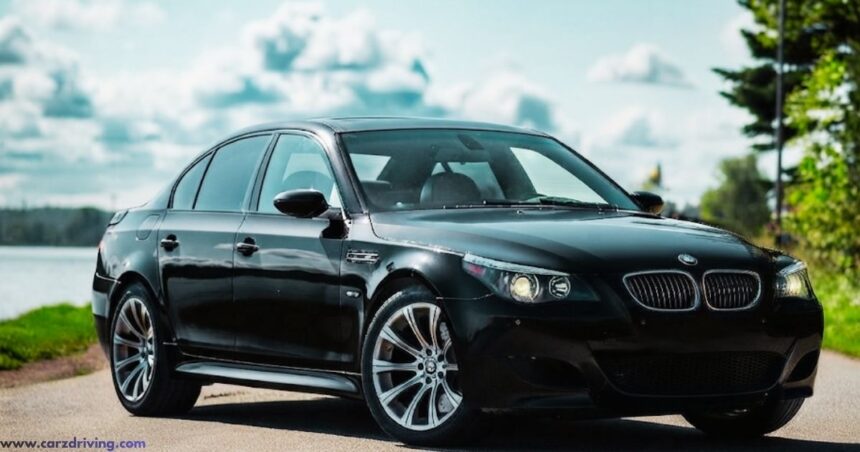
As the fifth-generation entry in the 5-Series lineup, the E60 arrived in 2003 carrying a futuristic approach that broke away from the regular production engine thinking of older models. Fitting a V10 into an executive saloon sounds mad on paper, but BMW pulled it off, and by 2010, when production ended, the car had already carved out its own legend.
I still remember reading about the Williams Formula One team connection and how it pushed BMW’s M division to build something new instead of leaning on the usual Magic formula from before, and that’s how the V10-powered E60 came about, a genuine clean sheet design engine made for a supersaloon rather than a track toy.
Out of the six generations of M5, people often compare this one to the E34 with its straight-six engine, but this car stands apart thanks to its high-revving V10 and its list of technological firsts.
The car brought a three-box silhouette with sweeping body lines and sharp edges, a shape that still turns heads today.
Underneath the skin, BMW fitted a balanced chassis with a communicative chassis feel that lets you push right up to the limits of adhesion without feeling nervous, while the engine spins toward a peak torque point near 6100rpm that genuinely surprises anyone driving it for the first time.
Owning one of these isn’t all sunshine, though. Running costs climb fast, spare parts get harder to source every year, and the electronic complexity built into the first-generation iDrive system, the adaptive headlights, and the active steering hasn’t aged perfectly, which raises real questions about long-term reliability.
Even so, the M5 heritage this car carries, sitting proudly among earlier M5s while offering less outright performance than newer versions, makes it one of the most interesting chapters in Motorsport history for anyone who truly loves driving.
Common Problems
I’ll be honest, this car drinks fuel like nothing I’ve owned before. On a bad day you get a 9mpg average, and I’ve watched 50 miles range disappear across just 10 miles distance, which is not something you forget quickly.
The reliability picture isn’t perfect either, and if you spend any time reading internet forums, you’ll find endless threads about running concerns with this 200mph V10 saloon. It’s built around a motorsport derived engine, so you need a healthy savings account before you commit to ownership.
People talk about reliability woes constantly, though to be fair, similar issues show up across many performance car engines, not just this one. Oil Leaks are common too, with Valve cover gaskets and oil filter housing gaskets wearing out as mileage climbs, especially on the inline-6 models. Cooling System Failures also creep in, as Water pumps and thermostats tend to give up somewhere between 80K–100K miles, risking overheating if you ignore the warning signs.
On the 535i, the N54 engine suffers from Turbo Carbon Buildup, where carbon deposits on intake valves cause misfires and rough idling.
The good news is that when properly maintained, most trims hold up well: N52 models like the 525i, 528i, and 530i stay dependable with fewer major flaws, while N54 engines just need routine carbon cleanings and fuel system checks. N62 V8s demand more attention due to oil-related wear and sensor issues, and M5 variants genuinely need expert care because of their high-revving engines and complex transmissions.
Whatever trim you pick, skipping service on the aging electronic systems and sensor controls is asking for trouble, so strict maintenance really is the only way to avoid costly repairs.
Gearbox (SMG)
The SMG setup confuses a lot of people the first time they drive it. It’s basically a single clutch controlled by a robot that handles the tricky parts of driving a manual, though it can feel like it’s operated by a teenage rollercoaster operator on a bad day.
Plenty of owners call it jerky, uncouth, and terribly outdated, and honestly, those criticisms made sense back when this was meant for daily duties and expected to demolish continents.
You put everything into full kill, push the shift aggression setting to 80ms per change, and switch to manual mode. Around town, a small throttle lift on upshifts gives you a shift that just glides in, and a gentle blip on downshifts makes each change nearly imperceptible, without the usual shudders and slams.
For wide open throttle driving, you have to play the SMG fiddle differently. Go from full throttle to no throttle right as you pull the paddle, or channel your inner DTM driver and tug the lever, and the upshift lands cleanly.
This creates real engagement, and once left foot braking and blipping throttle become second nature, it teaches you patience and kindness, oddly enough, even in a 5.0 V10 car. In stop start traffic it’s less charming, since the SMG won’t creep off the brake, so a bit of throttle brings a thunk and a lurch forward manoeuvring takes real patience jumping between first gear and Reverse, and three point turns are best avoided.
Worth noting, the range-topper paired its 5.0L V10 S85 with a 7-speed SMG automated manual, though a manual gearbox was later offered to European buyers.
Engine (S85 V10)
Before you even move, this car platform itself deserves a moment of admiration. Response to throttle inputs feels immediate, with real low down grunt that surprises people who haven’t driven one, and the mid range builds into a proper crescendo as you climb toward 6,500rpm, delivering pure harmonic delight through a razor sharp timbre with a creamy undertone.
Chasing the redline is something you don’t forget. In a turbo-hybrid era, this kind of natural power delivery feels almost rebellious, and the aural joy it produces really is like a siren song pulling you toward the classifieds with a box of rod bearings and a Shell reward card in hand.
It’s hypnotic, like taming a German warthog through a semi-automated manual handler.
On paper, a figure like 384lb ft beyond 6000rpm tells you everything about how this 500bhp supersaloon wants to be driven it needs to be thrashed to deliver real progress, but the surge toward the horizon rewards you every time.
I drive a Honda Integra Type R DC2 myself, so recalibrating technique for a different car adds to the sense of occasion for me. A 20-year-old M5 is more of a weekend thrill than a daily driver these days, which stands as a refreshing counterpoint to modern turbocharged performance cars.
At the top of the range sits a naturally aspirated 5.0L V10, and this S85 engine remains one of BMW’s most celebrated achievements among enthusiasts worldwide.
Chassis & Driving Dynamics
What really gets me about this car is its character. The Midas touch shows itself even at low speeds, where you can dip into the rev range just for fun, and as speed builds the car settles into a more focused attitude.
Much of that comes from genuine chassis balance, built around BMW’s famous 50:50 weight distribution, giving it a distinct M edge over regular models. In its stiffest setting it firms up noticeably, but the trade-off is excellent body control and real confidence behind the wheel.
It drives like a big M3, or maybe a big MX-5 scaled way up you can feel the lightness almost like MX-5 steering, yet it carries heft in a way that feels solid and robust with genuine dynamic flair.
The hydraulic steering deserves real praise too. It brings a strong sense of connection, with smoothness in how it weights up and unweights through a corner.
Loading the front axle into a bend tells you exactly what’s happening beneath you, and by corner exit, the weight shift rearwards lets you know it’s safe to squeeze the throttle, none of the vagueness you get from modern EPAS racks. This smooth linear power delivery helps you settle into a rhythm, and taking 2nd gear corners at full throttle feels natural rather than reckless; with traction off, you could easily manage outrageously huge slides if you wanted to. Compared to rivals like the Mercedes-Benz CLS55 AMG and Maserati Quattroporte, which fell apart in comparison tests, this car kept its composure.
Driving it on the best roads Wales has to offer, I found it entirely transparent, genuinely communicative, and deeply confidence-inspiring.
Interior
Step inside and the cabin takes you straight back to the BMW of old. You get high end materials, sports seats that stay comfortable and supportive for hours, and a steering wheel that actually fits a human hand rather than an orangutan.
There’s no ache, pain, or sudden rage from hunting for the volume control here. Coming from a pre touch screen, proper buttons, analogue dial era, this cabin genuinely makes you miss what cars used to offer. Even the BMW i-drive, once a real bone of contention when new, turns out to be a doddle to operate, no huge screen, no haptic buttons, and thankfully no awkward holder getting in your way.
Exterior/Design
From outside, it doesn’t scream for attention compared to a regular 5 series, but look closer and the subtle styling tweaks reveal exactly what this car is.
Unlike modern M cars that go for a slap you round the face styled look, this one keeps the classic wolf in sheep’s clothing approach shared with earlier M5s. Love it or hate it, the Bangle styling really does it for me, and details like the 4 exhausts and that rear three-quarter view are genuinely special, like a beautifully cooked Bratwurst of Bavarian Brilliance.
Pricing
Search around sites like PistonHeads and you’ll find decent examples for under £20,000, while a lower-mileage car with 48,000 miles can list closer to £25,995. Compare that to an E39 and you quickly see the value on offer here. It raises a fair question about reputation driving market demand for the S85-powered M5.
Personally, I’d call it a game of V10 roulette, the kind of Man Maths that fuels M5 fantasies, leaving you to try rolling of the dice and hope it works out.
What is the BMW E60 Edition?
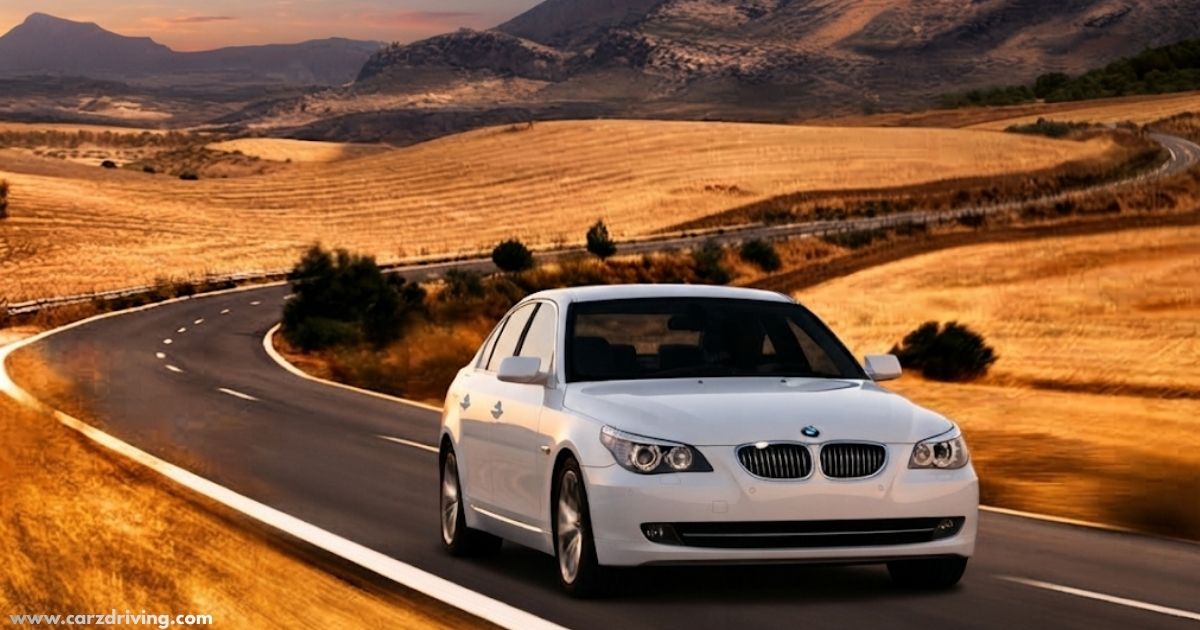
As the fifth generation of the 5-Series lineup, this car launched in Europe in 2003 and reached the U.S. market by 2004.
It marked a dramatic evolution in both design and onboard technology, stepping away from traditional styling cues toward a modern angular silhouette.
The lineup covered everything from the 525i and 528i through the 530i, 535i, 545i, and 550i, balancing performance with luxury across the range.
BMW used this generation to introduce the first-generation iDrive infotainment system, along with adaptive headlights and active steering, giving drivers new levels of car control and customization. These systems brought complex onboard electronics that later became a source of reliability challenges for some owners.
Engine Options & Trims
This lineup offered a genuinely wide spread of trims and engines, built for both daily drivers and performance-focused enthusiasts, with drivetrain and transmission options that varied by model.
The N52 engine, an inline-6, delivered strong efficiency and smooth power delivery, while later cars adopted the N53 in European markets, bringing direct injection for better fuel economy and responsiveness. The twin-turbocharged N54 engine stood out for its torque and its huge tuning potential, while those chasing V8 power could pick the N62 engine, a naturally aspirated V8 offering a refined powerful driving experience.
Transmission choices ranged from 6-speed manual to automatic, with later years adding 6-speed automatics and paddle shifters, though availability shifted slightly due to emissions-compliant engines and specific trim packages.
Own a BMW E60?
Whether you’re commuting or carving up back roads, this car deserves genuine expert care. Southside Euro offers specialized diagnostics, fluid services, and repairs built around every engine option, from the N52 inline-6 to the mighty S85 V10. They use dealer-level tools and OEM parts, treating each car with real precision and transparency, no guesswork involved.
That kind of performance care is what keeps these cars alive, so Book Your Service Today, or call (904) 240-1440, and with the right maintenance, your car can deliver the driving experience BMW intended well past 100K miles.
Conclusion
This E60 represents a genuine bold step in the evolution of the 5-Series, packed with advanced features, distinctive design, and a strong range of powerful engines that keep it a favorite among enthusiasts today.
Like any aging performance sedan, it rewards proper care and timely maintenance, letting you enjoy its full potential without any surprise breakdowns.
The engine alone puts this car among one of the greats, and a chassis flatters powertrain that somehow makes the gearbox feel like part of the fun rather than a flaw.
This whole experience is why I’m a proud member of this car M5 club, and don’t you dare tell me the SMG is bad, you just haven’t learned to drive properly yet. Give it the time it deserves and you’ll have a genuinely fantastic experience, even if things go wrong occasionally, because that’s just life.
FAQs of E60
What engine powers the BMW E60 M5?
The E60 M5 uses a naturally aspirated 5.0L V10 (S85 engine), delivering 507hp and a genuinely thrilling 8250rpm redline.
Is the BMW E60 M5 reliable?
It can be reliable with proper maintenance, though the S85 V10 is prone to rod bearing wear and the SMG transmission needs expert care.
How much does a BMW E60 M5 cost today?
Prices are surprisingly sensible, with examples starting under £20,000 and low-mileage cars reaching around £25,995 on PistonHeads.
What is the SMG gearbox like in the E60 M5?
The SMG gearbox feels jerky at first, but once mastered it becomes a genuinely satisfying, almost manual-like experience.
Why is the BMW E60 M5 considered a legend?
It’s the only M5 with a motorsport-derived V10, giving it an untamed, unforgettable character within the M5 heritage.