

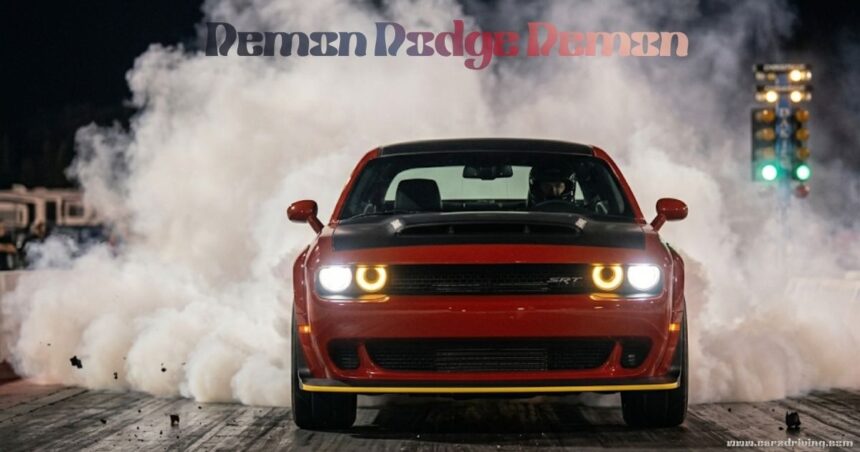
The Demon Dodge Demon didn’t just show up to the muscle car party it kicked the door down. When Dodge unleashed this unhinged ultra-muscle-car, it sent the 707bhp Hellcat straight into second place without breaking a sweat.
The 840bhp and 770lb ft of torque this beast carries made every other production car on the planet rethink its life choices, and the ability to pull a wheelie straight off the factory floor sealed its legendary status forever.
Tim Kuniskis, head of passenger car brands at FCA North America, kept the goal beautifully simple from day one hit 9s on the quarter mile in street trim with pump gas and pull the front wheels off the ground.
The engineers didn’t write a new rulebook; they fed the old one spine first into the shredder. These were drag racing nuts who brought aftermarket thinking inside American regulation boundaries, and the result carried a full factory warranty stamped right on the windscreen.
Demon Dodge Demon
I remember the first time I watched a Demon launch at a drag strip the violence was genuinely shocking. The smoke, the noise, the front end heaving skyward it hit differently than anything the Top Trumps card of any supercar could prepare you for.
From the 2017 model that got banned by the National Hot Rod Association for being too fast, to the imports appearing at UK events with full Demon Crate setups, to special editions like Jailbreak and Redeye keeping the Challenger and Charger lineup fresh since 2014 the Demon remains the crown jewel.
Even Pagani couldn’t match this level of factory madness, and Santa Pod crowds still lose their minds every single time one launches.
Highest Horsepower V8 Engine
The 6.2-litre supercharged HEMI V8 sitting under the Demon’s bonnet carries 25 major component upgrades over the Hellcat engine, and every single change served one purpose raw, brutal horsepower.
The supercharger grew from 2.4 litres to 2.7 litres, boost pressure climbed from 11.6psi to 14.5psi, and fresh pistons, rods, crankshaft, and conrods allowed the rev limit to push from 6200rpm all the way to 6500rpm.
New valvetrain and fuel injection systems meant this engine processed more air and fuel through its cylinders than any other production car at a rate not far off your bathroom tap, which no European marque would ever dare to brag about.
The numbers the Demon car put down 840bhp at 6300rpm and 770lb ft at 4500rpm came from combining the largest air induction volume of any production car, the biggest gasoline supercharger ever fitted to a street car, and the widest functional hood scoop available anywhere.
When you convert it properly, 850 metric horsepower means this monster muscle car packed the power of two seriously fast cars into one heavy but drag-tuned body. That’s more than twice the output of a Porsche Cayman GT4 and Porsche engineers would need a quiet sit-down after reading that sentence.
The result of pulling 90kg out of the standard car while pushing component changes through every corner of the engine meant the Demon car delivered acceleration figures that genuinely shocked the most powerful car world.
Even running without the 100 octane race fuel setup, the base tune still delivered 808bhp and 717lb ft, which tells you everything about the engineering confidence baked into this V8. No other production car in history carried this level of upgrades and still rolled out with a full manufacturer warranty sitting on the glass.
Fastest Production Car
The Demon car covers 0-60mph in 2.3 seconds flat, and with a roll-out factored in, that number drops further to 2.1 seconds numbers that made the entire production car world uncomfortable.
Reaching 30mph takes just 1 second, which honestly sounds satanic when you say it out loud, and for reference, that benchmark destroyed both the Bugatti Chiron at 2.4 seconds and the Tesla P100D with Ludicrous Plus mode activated at just over 2.3 seconds.
The craziest part? The Demon achieves all of this as a pure rear-wheel drive machine while both of those competitors rely on sophisticated all-wheel drive platforms to find their grip.
Traction is the real secret weapon here, and the Demon manages 0-30mph in 1.0 seconds while the quickest 4WD hardware on the planet manages that sprint roughly 50 per cent slower at around 1.5 seconds.
The Demon doesn’t spin its rear tyres off the line it simply hooks and pulls with a ferocity that feels more like a catapult releasing than wheels turning on tarmac.
When I spoke to people who had experienced proper drag strip launches in the Demon, every single one described the same sensation the complete absence of wheelspin where you absolutely expected it, replaced instead by something violent and apocalyptic that compressed the chest and shifted internal organs.
The 840bhp engine, the sticky drag radials, and the TransBrake system working together meant the Demon could pull 1.8g off the standstill a figure that caused absolute chaos when the acceleration times became public.
For genuine sticky drag strip conditions, the differentials and transmissions of normal cars simply couldn’t survive this level of abuse, which is exactly why Dodge engineered every single component specifically for this purpose. The Demon wasn’t accidentally fast every single platform decision pointed directly at rewriting the 0-60mph record books.
Fastest Quarter-Mile Production Car
The Demon trips the lights at the end of the strip in 9.65 seconds at 140mph, and that single number ended the quarter mile conversation for every other production car on the planet. For comparo purposes, the sharpest ultracars from McLaren, Porsche, and Ferrari can only manage around 9.8 seconds and the Bugatti Chiron hadn’t even posted a clean quarter mile time when Dodge set this benchmark.
Dodge set their record time back in November at the Gainesville track in Florida, practically at sea level where the air sat cool and dense conditions that suit a supercharged engine perfectly.
Professional drag racer Leah Pritchett set the official time, with Dodge’s chief test driver Jim Wilder posting a best just a hundredth behind at 9.666 seconds which personally feels like the more appropriate number for a car called the Demon.
When journalists got their turn at the Lucas Oil Raceway near Indianapolis, the altitude and 33 degrees centigrade ambient temperature told a different story, with the best effort coming in at 10.6 seconds at 133mph.
Working the launch, reading the revs, feeding the throttle correctly finding tenths on a drag strip turned out to be far more technique-dependent than anyone expected, and the Demon rewarded genuine skill with genuinely savage times.
It’s So Fast the NHRA Has Banned It
The NHRA the National Hot Rod Association took the rare step of officially banned the Demon from competing at sanctioned events, and the reason is beautifully simple: it was just too fast.
Any production car running under 10 seconds or pulling more than 135mph through the traps technically requires an NHRA certified cage fitted as standard, which the Demon doesn’t carry from the factory.
Show up at a sanctioned event and post a 10.01 seconds pass and you’re perfectly legal but the moment you dip into the nines or crack 135mph, you either weld a proper cage into the car or you take an early bath.
The 2017 Demon earned this distinction the hard way by actually running 9.65 seconds at 140mph making it the only street production car in history to land on the wrong side of that technicality through pure speed alone.
The NHRA sent it to the sidelines not because anything was unsafe by design, but because the rules simply weren’t written with the expectation that a wild factory muscle car would ever get this close to drag racing professional territory. That ban sits today as one of the greatest badges of honour any car manufacturer has ever accidentally collected.
Wheelie
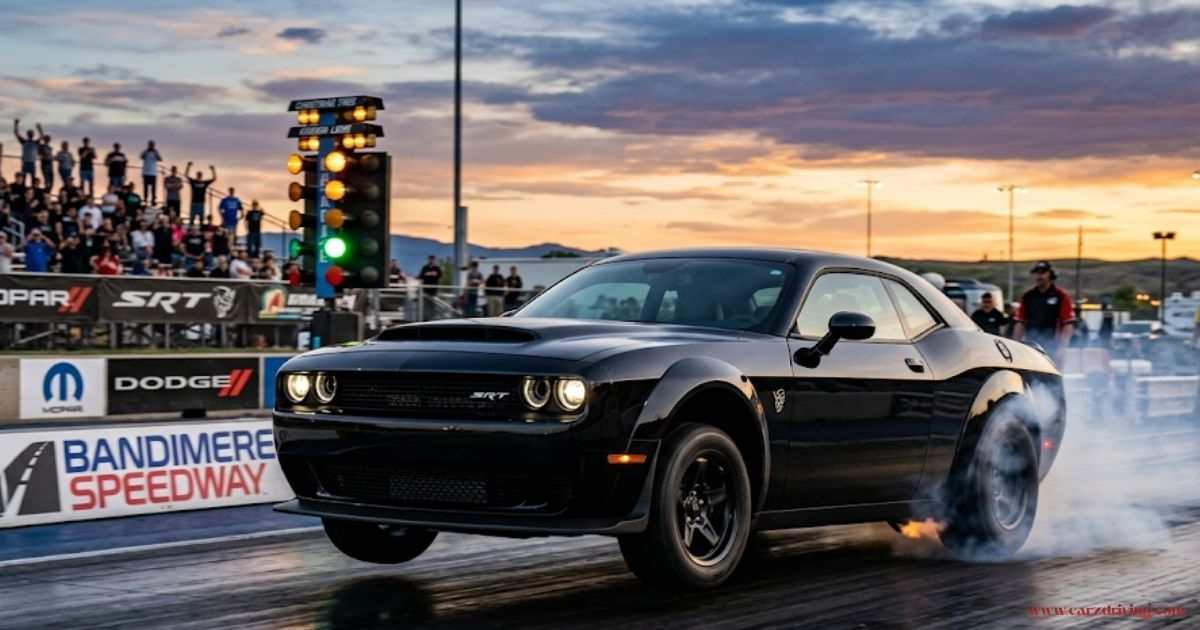
The Challenger SRT Demon became the first production car in history to lift its front wheels clean off the ground under power from a standing start an actual wheelie, the kind of thing reserved for bikes and purpose-built drag cars running on slick compounds.
The Guinness Book of World Records officially verified the longest wheelie from a standing start by a production car at 2.92 feet nearly a metre-long lift of those giant 315/40 R18 front tyres completely clear of the ground.
Watching that happen in real life, the front wheels simply heaving skyward with that kind of violent commitment, makes every other world first on this car feel slightly ordinary by comparison.
Dodge confirmed the wheelie could reach close to three feet of air under the front end during peak launches, which is the kind of launch behaviour that had the Guinness Book of World Records officials reaching for their measuring equipment and their vocabulary for disbelief.
The physics required to lift a production car off the ground under acceleration car this size, this heavy, this full of road equipment meant every single engineering decision about weight distribution, traction, and power delivery had to work perfectly in the same millisecond.
The 840bhp V8, the drag radials, and the TransBrake all working together created something the car world had genuinely never verified before.
More G-Force Under Acceleration Than Any Other Car
The Demon pulls 1.8g under acceleration a figure that means your cheeks physically press against the back of the headrest and your organs shift inside your body during a full-bore launch.
That level of g-force doesn’t happen without an extraordinary amount of shove working through the drivetrain and into those rear tyres, and the Physics of lifting the front wheels means all that energy redirects rearward in a single brutal instant.
When Dodge claimed 1.8g off the line, most people assumed the number was marketing until journalists actually experienced it firsthand and came back describing something closer to being punched than driven.
The weight transfer mechanics behind that number are genuinely impressivet he 58:42 distribution means 1125kg normally sits over those front wheels, and the Demon’s systems have to overcome all of that inertia to get those wheels into the air. Rear tyre grip improves by 11 per cent through the Drag mode suspension tune, which combined with the traction improvements from the drag radials creates the conditions for that 1.8g pull that compressed chest and shifted organs that every driver reported.
The 0-30mph run in 1.0 seconds means the Demon covers that distance roughly 50 per cent faster than the quickest 4WD systems available which at 1.5 seconds already felt violent and apocalyptic before the Demon redefined the entire category with a catapult-like blow to the guts.
The Demon Crate
Every Demon buyer received a coupon with their car, and that coupon unlocked the Demon Crate for exactly $1 a genuine wooden box packed with everything needed to turn a road-going Demon into a proper track Demon.
Inside that bespoke box sat a powertrain control module with high-octane engine calibration, a switch module with a dedicated high-octane button, a conical performance air filter, and a passenger mirror block-off plate alongside the famous front-runner drag wheels.
The Demon Crate also contained Demon-branded track tools, a hydraulic floor jack with its own carrying bag, a cordless impact wrench with charger, a torque wrench complete with extension and socket, a tyre pressure gauge, a fender cover, a tool bag, and a custom foam case sized to fit perfectly into the SRT Demon trunk to hold the front runner wheels and all track tools securely.
Beyond the physical contents, the Crate unlocked the ability to run 100 octane race fuel through the engine controller, which transformed the numbers the Demon could chase at a drag strip.
Without the Crate, buyers still had 808bhp and 717lb ft enough to pull those giant 315/40 R18 front tyres off the deck under a perfect launch but only the Crate unlocked the full 840bhp and the metre-long wheelie that the Guinness Book of World Records officially verified.
The VIN plate included for the dash added a layer of branded identity to the whole package, and the as-new Crate accessories sitting in unused condition with this particular car suggest its owner never quite found the right drag strip though there must be some 100 octane fuel lurking somewhere near Santa Pod.
Designed to Run on 100+ High-Octane Fuel
The Demon Crate’s powertrain controller gave owners a single button that switched the entire engine over to 100-octane race fuel mode no workshop visit, no recalibration, just fuel the tank, press the button, and the Demon measured the petrol’s octane rating automatically.
When the system confirmed a 100 octane reading, it resets all engine timing across every cylinder to extract maximum power from the higher calibration delivering the full 840bhp and 770lb ft in what Dodge called beast mode.
The system worked reliably regardless of weather conditions, which meant consistent performance across different climates and track environments without the driver needing to manage anything manually.
Running pump gas in street trim was always the everyday reality for most Demon owners, but the high-octane capability separated the production car from everything else available at the time. The ability to switch fuel modes at the press of a button and have the engine respond by completely remapping its own timing
represented a genuine world first in terms of accessible race fuel technology on a street-legal production car. The Demon’s calibration system effectively gave owners two completely different cars depending on which fuel they loaded into the tank.
Car with a TransBrake
The TransBrake system in the Demon solved a very specific drag racing problem how to hold the car perfectly still under power while building engine speed up to 2350rpm without overwhelming the brakes.
It worked through the steering wheel paddle shifters as the trigger, improving reaction time at the Christmas Tree lights and delivering far better launch consistency than a standard braking technique could ever achieve.
By locking the transmission output shaft during the standing start sequence, the system enabled quicker power delivery and generated up to 15 per cent more torque at launch than a conventional setup.
The electronically controlled system required the driver to pull both paddles to engage the TransBrake, then release one paddle, lift the foot off the brake, and finally release the remaining paddle to fire the car down the strip with the right foot managing revs throughout the entire sequence.
That preloads the driveline with torque, meaning full engine torque reaches the rear wheels within just 150 milliseconds of the driver lifting a finger off the final paddle.
When the Demon used TransBrake alongside Torque Reserve, boost at launch exceeded 8psi a number that explains everything about that 1.8g pull that defined the car’s character as the ultimate drag strip production car world first.
Car with a Torque Reserve
Torque reserve sounds like drag lingo invented specifically to make engineers sound cooler than they already are, but the system did something genuinely clever it built supercharger revs and energy in reserve without letting that torque overwhelm the brakes or break the rear wheels loose in spinning chaos before the launch even began.
The system activated automatically whenever the car entered launch mode with more than 950rpm showing on the clock, and it sat there holding potential energy like a coiled spring waiting for release.
Working in perfect harmony with the TransBrake, torque reserve created the conditions for a what-the-hell moment every single time, delivering quarter-mile times that felt genuinely impossible from a production car.
The numbers behind torque reserve deserve a moment of respect the system generated up to 120 per cent more engine torque than running without it, and when combined with the TransBrake preloading the driveline, full engine torque hit the rear wheels within 150 milliseconds of paddle release.
More than 8psi of boost sat loaded at the launch point, meaning the supercharger wasn’t spooling up it was already there, fully pressurised and ready to convert stored energy into that dog egg off a shovel departure that became the Demon’s signature move.
Without torque reserve and TransBrake working together as a system, the Demon would still have been extraordinarily fast but it wouldn’t have been this kind of world first production car that sent drag lingo into mainstream conversation.
It Doesn’t Have Rear Seats Either
Dodge shipped the Demon from the factory as a genuine single seater the front passenger seat, belt, and all associated hardware simply didn’t exist in the standard build, saving 58 pounds right there from the front end of the car.
The rear seat, restraints, and floor mats followed the same logic, disappearing for another 55 pounds of weight reduction that directly improved the car’s acceleration potential.
Both items came back as options, naturally the passenger seat for $1 and the rear seat for another $1 which means Dodge offered the most gloriously absurd option list in automotive history by letting buyers tick boxes to add mass back into a car specifically engineered to lose it.
That 26kg saving from eliminating the passenger seat and the 25kg recovered from removing the rear seating meant the Demon shed meaningful weight from exactly the right places high up and forward, which directly helped that 58:42 front-heavy distribution tip rearward under launch conditions.
The engineers who made the decision to remove standard equipment and sell it back for a dollar each clearly understood that saving weight on a drag car beats adding power every single time the numbers get close.
Driving alone in a car with no passenger seat and no rear seat as the factory-standard experience remains one of the most committed statements any production car manufacturer has ever made about what a car is actually built for.
Largest Functional Hood Scoop
The Air-Grabber system on the Demon covers 45.2 square inches of functional breathing area the largest hood scoop on any production car and every single square inch of that opening feeds directly into a sealed air box that connects straight to the engine.
The driver-side Air-Catcher system added a hollow headlamp and a dedicated inlet near the wheel liner to pull in even more cold air from outside the engine bay.
Combined, these two systems delivered an air-flow rate of 1150 cubic feet per minute 18 per cent greater than the Hellcat and the largest air induction volume of any production car on the road.
The engineering logic behind the Air-Grabber is beautifully direct to make horsepower, you need fuel, a big engine, and most importantly, enormous quantities of air forced through the supercharger at every moment of full throttle.
The natty device known as Air-Catcher feeding in from the driver-side meant the system never relied on a single source, giving the Demon redundancy in its air supply at the exact moments when everything else in the drivetrain was working at absolute capacity.
That largest functional hood scoop designation wasn’t just a marketing claim it represented a genuine engineering achievement that tied directly to every single horsepower number the Demon put on paper.
Liquid-to-Air Intercooler Chiller System
The Power Chiller system in the Demon solved the heat soak problem that destroys supercharged engine consistency run after run instead of a fridge sitting in the back like a Bentley, Dodge diverted the car’s existing air-conditioning refrigerant away from the SRT Demon interior and redirected it through a dedicated chiller unit mounted next to the low-temperature circuit coolant pump.
Charge air coolant first passed through a low-temperature radiator at the front of the car where ambient air knocked the temperature down, then entered the chiller unit for a second stage of cooling before flowing onward to the heat exchangers inside the supercharger.
The result was a liquid-to-air intercooler system that kept intake temperatures consistently low regardless of how wasteful the heat generated by repeated full-power runs became.
The After-Run Chiller addressed the problem that occurs after the engine shuts down following a hard strip pass normally heat builds and soaks into components during the cooling-down period, but the After-Run Chiller kept the engine cooling fan and low-temperature circuit coolant pump running after engine shut down to actively reduce supercharger temperature and charge air cooler temperatures simultaneously.
This meant the Demon could get back to the launch line quickly without waiting for natural cooling to catch up a genuine competitive advantage at any drag strip event where turnaround time between runs matters.
The entire system represented another genuine world first for a production car, combining boost management with thermal control in a way that no production car had ever attempted before.
Fitted with Drag Radials
The Demon rolled off the production line wearing Nitto NT05R drag radials genuine street-legal drag-racing tyres fitted to a production car for the first time in automotive history.
These 315/40R18 covers used a completely new compound and a specific sidewall construction designed to flex and load under launch forces, delivering a 15 per cent larger contact patch and more than twice the grip of the standard Challenger SRT Hellcat tyres. Stretching the car out by another 3.5 inches in track width, mounted on lightweight 11×18-inch wheels with open-end lug nuts, these bespoke tyres looked purposeful in a way that made every other production car tyre setup look slightly apologetic.
The same 315/40R18 Nitto drag radials ran both front and rear on the road configuration, and on damp roads they gripped surprisingly well though parking at the first sight of standing water remains the correct strategy.
By switching from the Hellcat’s 20-inch tyres to 18s with taller sidewalls, the ride quality improved noticeably drag radials are specifically designed to flex and runkle their sidewalls under load, generating a natural spring effect as they begin rotating that softened the overall character on public roads.
The traction these drag radials provided under full-bore launch conditions was the single biggest reason the Demon could pull 1.8g and lift its front wheels without tyres specifically engineered for this purpose, none of the other technology in the car would have mattered.
Skinny Front Wheels and Tyres Like a Proper Dragster
The Demon Crate included a set of narrow front-runner drag wheels stored in the boot alongside the jack and pump specifically so owners could swap the standard fronts for genuinely skinny front wheels at the track before heading to the strip.
Pulling the lightweight wide fronts off and replacing them with narrow runners shifted meaningful weight away from the front end and transferred it rearward, which directly improved the launch dynamics and gave the rear tyres even more of the traction advantage they needed.
The swap turned the Demon from a wide-bodied production car into something that looked like a proper dragster the visual contrast between those fatties out back and the tiny front-runner drag wheels up front is one of the most committed aesthetic statements in muscle car history.
Have Drag-Specific Suspension
Dodge tuned the Demon’s Bilstein adaptive suspension specifically for a long straight strip of tarmac rather than a twisting circuit the same focused approach VW used when dialling in the Golf Clubsport S for the Nurburgring, but pointed in an entirely different direction.
In Drag mode, the dampers and shocks work together to throw as much weight as possible rearward for maximum traction, with softer springs dropping 35 per cent at the front and 28 per cent at the rear, combined with softer, lightweight, hollow sway bars that reduce unsprung mass while allowing more body roll under the specific loading conditions of a standing-start launch.
The retuned Bilstein adaptive dampers also widened the tracks evident from those arch extensions and made a concerted effort to reduce weight at the front end specifically to help tip that 58:42 distribution rearward when it mattered most.
For drag racing, the Demon needed the rear firm enough to handle weight transfer without compression collapse, the front firm in compression to help those wheels lift off the deck, but genuinely soft in rebound so when the nose came back down after a wheelie, it did so with control rather than a crash.
The rebound automatically firmed up instantly if a driver backed out mid-run, giving immediate control back at the exact moment it was needed most.
The weight transfer improvements translated to 11 per cent better rear tyre grip confirmed across that 1125kg fighting against the 58:42 distribution and when you combine that with everything else the Demon did at launch, the setup stopped being a trick and started being genuinely clever engineering for both street and Sport mode use.
It’s Been on a Diet
The Demon arrived 200lbs that’s 90kg lighter than a standard Hellcat, and Dodge achieved that number through a ruthlessly logical list of cuts that prioritised acceleration above absolutely everything else.
The front passenger seat and belt alone accounted for 58 pounds, the rear seat, restraints, and floor mats contributed another 55 pounds, and stripping out 16 audio speakers, the amplifier, and all associated wiring recovered another 24 pounds from the total.
Removing the trunk deck cover, carpeting, and spare tyre cover added 20 pounds to the savings, the hollow sway bars saved 19 pounds, and eliminating mastic, body deadeners, insulators, and foam from the body structure recovered another 18 pounds that nobody launching at a drag strip would ever miss.
Switching to lightweight, aluminium four-piston brake calipers and smaller 360mm two-piece rotors saved 16 pounds, the move to lightweight wheels and open-end lug nuts recovered another 16 pounds, switching to a manual tilt telescope steering column saved 4 pounds, and finally removing the parking sensors and their module cut a last 2 pounds from the nose.
Dodge confirmed the total at 101kg in metric terms with the passenger seat deletion alone worth 26kg and the rear seat removal recovering another 25kg, while insulation, smaller brakes, lightweight wheels, parking sensors, and trim reduction accounted for the rest.
Every single pound and kilogram cut from this list contributed directly to that 2.3 seconds 0-60mph time, and the discipline required to strip a car this completely while keeping it road-legal, warranted, and genuinely comfortable remains one of the most impressive engineering achievements hiding behind all the headline horsepower numbers.
It Brakes Harder and Faster Than a Viper ACR
The Brembo brake package fitted to the Demon stops the car from 60mph to a complete standstill in just 97 feet that’s 29.6 metres which puts it ahead of the legendary Viper ACR in outright braking performance.
Tearing a hole in the atmosphere at the drag strip demands brakes capable of pulling the car back to earth with equal conviction, and these powerful Brembos delivered exactly that level of confidence.
For a production car built primarily around straight-line performance, the braking capability the Demon carried represented a serious engineering commitment to the complete package rather than just the headline acceleration numbers.
‘Eco’ Mode
Even in Eco mode yes, the Demon has Eco mode Dodge ran the car down the drag strip and posted an 11:59 quarter mile time that beats most serious supercars in their best driving modes.
That single number should make every production car manufacturer running around claiming performance credentials feel at least slightly uncomfortable about their marketing.
If the Demon in its most fuel-conscious strip setting runs 11:59, the Greenpeace calculation on fuel economy becomes a conversation for another day though 15ish MPG in real-world driving tells you everything you need to know about the commitment this engine demands in exchange for its performance.
It Won’t Take Einstein to Make It Go Faster
The Demon ships with Dodge’s full three-year/36,000 mile warranty and five-year/60,000 mile powertrain cover a commitment from the engineers that speaks to genuine confidence in everything they built, regardless of how much horsepower sits under the bonnet.
If you’re willing to invalidate that cover, the path to even more face-bending oomph starts with stickier slick tyres that allow the full 2350rpm to load up on the TransBrake without any slip, then a smaller supercharger pulley to pull more boost from the already-enlarged 2.7-litre case that replaced the original 2.4-litre unit.
Kuniskis himself reckoned a smaller pulley would yield another 150bhp without breaking a sweat, pulling the cats off for that theatrical exhaust note adds further gains, and loading the tank with genuinely high octane leaded fuel or running an EA5 tune pushes the entire package toward four-figure power territory that requires a quiet prayer before each launch.
The Demon proved its durability during development when a single test car completed 5,500 drag starts without changing a single component the tyres being the obvious exception while a Nissan GT-R typically demands its diffs get a rest after just three hard pulls.
During the development process, these engineers weren’t just building a fast car they were building a drag racer that happened to carry a road car warranty, and the difference between those two goals shows in every single component decision made throughout the programme.
Modified or standard, the Demon remains the benchmark that every serious drag racing production car gets measured against, and the engineering discipline required to build something this extreme while keeping it warranted and street-legal remains genuinely remarkable.
What’s It Like to Drive?
Climbing into an 840bhp supercharged V8 muscle car and pressing the SRT button for the first time is an experience that resets your internal calibration for what production car performance means the squeals, bellows, and snorts from that engine before the car even moves tell you that something fundamentally different is about to happen.
Nothing I had driven previously went off the line remotely like the Demon a Tesla at full chat feels violent, a 911 Turbo S feels properly serious, but the Demon is genuinely apocalyptic in a way that makes both of those feel like polite suggestions.
The bonnet rears up, you get shoved back, your chest compressed, your organs shifted, and the only natural response is a sharp intake of breath because your body genuinely interprets the experience as being punched rather than accelerated.
The absence of wheelspin is the detail that breaks your brain at 840bhp through rear-wheel drive, you expect carnage, but instead the Demon simply hooks and pulls like a catapult releasing, delivering that blow to the guts sensation through traction rather than drama.
The 0-30mph in 1.0 seconds figure means the Demon covers that distance while the quickest 4WD hardware available manages it 50 per cent slower at 1.5 seconds which already felt violent and apocalyptic before the Demon arrived.
The quarter mile in 9.65 seconds was set under optimal conditions, and even the journalists posting 10.6 second passes on a hot day at altitude came away understanding exactly why a McLaren 720S being faster in a straight line above quarter mile distances doesn’t diminish what
the Demon achieves this is a drag car, built to dominate its chosen distance, and Dodge warranted it specifically to operate as one through 5,500 drag starts without touching a single component.
How Does It Cope Away from the Strip?
Away from the drag strip, the Demon revealed a character that genuinely surprised everyone who experienced it those fat Nitto 315/40 R18 drag radials gripped damp roads with reassuring confidence, though standing water immediately moves this car into park-it territory.
Dodge did an exceptional job with throttle control, meaning the power metered out accurately enough to surge between traffic lights without drama, and the gearbox that hammers home under full load at the strip behaved smoothly and benignly on public roads.
The single most surprising thing about the Demon in road trim was the ride quality switching from the Hellcat’s 20-inch tyres to 18s with taller sidewalls improved comfort meaningfully, because drag radials are specifically engineered to flex and runkle their sidewalls under load, providing a natural spring effect the moment they start rotating.
Street mode lets the car roll around corners in a very muscle car way, but Sport mode transforms the character into something genuinely sporty by European standards well-controlled enough to hustle with confidence rather than simply point-and-squirt.
The adaptive suspension gave Dodge the freedom to run genuinely soft setup for street use and a completely different trick configuration for the strip, without compromising either experience.
The Hellcat comparison always surfaces when discussing the Demon on road the interior feels similar, the seats feel big and plush, and the everyday experience stays manageable but press that SRT button and the Demon reminds you immediately that this is an entirely different production car with an entirely different set of priorities.
The Drivetrain
The Demon used the same eight-speed auto transmission as the Hellcat, but Dodge modified virtually everything connected to it the torque converter was reworked, the prop shaft grew 20 per cent thicker, the rear diff gained 30 per cent more torque capacity, the gear sets were replaced entirely, and the half shafts increased in diameter throughout.
Every single drivetrain component upgrade pointed at the same goal surviving the repeated shock of 840bhp dumping through the system at a standing start without the diffs calling it quits the way a Nissan GT-R’s hardware famously did after just three hard pulls.
The modified transmission, upgraded rear-wheel drive drivetrain, and strengthened half shafts all worked together to make the Demon a production car that Dodge could genuinely warrant for drag racing use.
Inside the Demon
Inside, the Demon feels remarkably close to a standard Hellcat the seats are big and genuinely plush, the dashboard reads as familiar Challenger territory, and nothing immediately screams dedicated drag car until you press the SRT button and the screen fills with a completely different set of options.
From that screen, the driver could switch engine mode to 100 octane fuel calibration, engage line lock for controlled burnouts, set the exact rpm for launch control, adjust the suspension settings between street and strip configurations, and activate the trans brake system that made the whole drag racing package complete.
The combination of a genuinely comfortable interior wrapped around competition-level drag racing features and selectable settings was the final piece of the puzzle that made the Demon the most complete production car drag racer ever built.
Where Can I Buy One?
Dodge built exactly 3,300 Demons in total, priced at $84,995 each, and restricted sales to Dodge dealers that had sold at least one Hellcat within the previous 12 months a filter that kept the car in the hands of people who genuinely understood what they were selling.
Kuniskis estimated that roughly 1,400 of Dodge’s 2,450 nationwide dealers qualified, and within just ten days of going on sale, 70 per cent of all cars were already accounted for.
Dodge ran a genuinely clever system to deter speculators pay sticker price and your car gets built first, pay over sticker and your order moves to the back of the line tricky to enforce completely but a clear statement about who this limited production car was actually built for.
Specs
The Demon Dodge Demon runs a 6166cc supercharged V8 through an 8-speed auto transmission to the rear-wheel drive axle, producing 840bhp 851hp in metric at 6300rpm alongside 770lb ft of torque at 4500rpm.
The official 0-60mph figure stands at 2.3 seconds, the quarter mile falls in 9.65 seconds at 140mph, and the top speed sits at approximately 200mph with a weight of 1939kg.
Real-world MPG sits around 15, CO2 figures carry a Ha from every journalist who ever asked, and the complete drivetrain and engine performance package remains the benchmark against which every serious production car gets measured.
FAQs of Demon Dodge Demon
How fast does the Dodge Demon go from 0-60mph?
The Dodge Demon hits 0-60mph in just 2.3 seconds, making it the fastest rear-wheel drive production car ever built faster than even the Bugatti Chiron.
Why did the NHRA ban the Dodge Demon?
The NHRA banned the Demon because its 9.65-second quarter mile at 140mph was simply too fast for a street-legal production car without an NHRA certified cage.
How much horsepower does the Dodge Demon produce?
The Demon’s supercharged 6.2-litre HEMI V8 produces a ground-shaking 840bhp and 770lb ft of torque the highest horsepower ever put into a production muscle car.
Can the Dodge Demon really do a wheelie?
Yes, the Challenger SRT Demon is the only production car in history to lift its front wheels off the ground, pulling a Guinness World Record wheelie of 2.92 feet from a standing start.
What comes inside the Dodge Demon Crate?
The $1 Demon Crate packs drag wheels, a high-octane powertrain module, track tools, and everything needed to transform your street Demon into a full-blown drag strip weapon.