

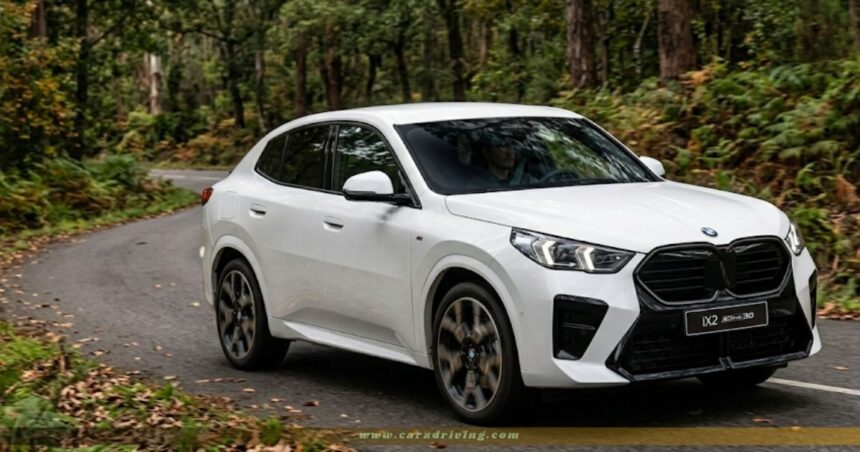
The BMW iX2 genuinely surprised me and I say that as someone who has spent years tracking the electric car market. When BMW quietly expanded its i all-electric range rapidly, most eyes were on the iX1. But the iX2 carved its own identity fast.
Built on the same UKL platform, this sporty, fastback body style sits 54mm longer, 64mm taller, and carries a 22mm longer wheelbase than the iX1 and those numbers actually translate into a noticeably different road presence.
BMW iX2
What makes the iX2 interesting is the tension it creates. It is more expensive and less spacious than the iX1, yet it pulls buyers who want something with sharper visual character.
If you are willing to accept that coupe-style roof as a design trade-off, then the iX2 rewards you with a genuinely upmarket feel, high quality cabin materials, generous standard equipment, and real storage space inside.
The ride can feel unsettled and bumpy on broken roads, but the electric motors stay consistently powerful and the car remains wonderfully easy to drive in most real-world conditions.
The iX2 targets a buyer who finds the iX1 too conventional and the larger EV options too bulky. It also competes as one of BMW’s stronger fleet sellers alongside the iX1, and BMW expects both ICE engines and EV versions to perform well commercially.
With a WLTP driving range of 267 miles on the xDrive30 and up to 283 miles on the eDrive20, the iX2 positions itself confidently as a premium smaller SUV for the modern EV buyer though calling it expensive is entirely fair at this price point.
Design & Powertrain
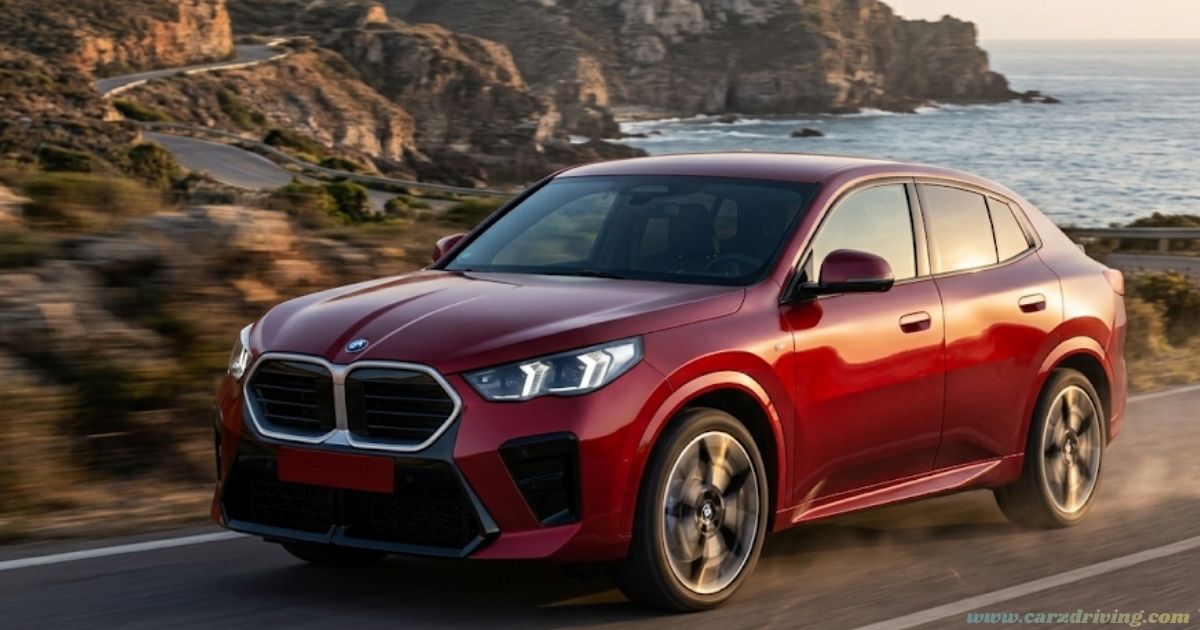
The iX2 takes the fastback approach to electric SUV design seriously. Its rear-end design draws clear inspiration from the X4, giving it a swept silhouette that stands apart from the more upright iX1.
The front receives deliberately individual styling choices to further differentiate the two cars, and the result is a vehicle that looks genuinely distinct on the road not just a rebadged sibling.
Under that sporty body lies a 66.5 kWh battery with a 64.8 kWh usable capacity, paired with two electric motors in xDrive30 trim delivering 190 hp and 247 Nm at both the front axle and rear axle simultaneously.
This configuration produces true all-wheel drive traction without the mechanical complexity of a traditional drivetrain. The balance between front axle and rear axle output is precise, and in everyday driving that symmetry makes itself felt through the car’s composed, planted character.
Outside, the iX2 is exclusively offered in M Sport equipment grade, which means every buyer receives shark nose detailing at the front, a gloss black rear spoiler, and 19in alloy wheels as part of the standard package.
There is no stripped-back base trim here every iX2 arrives looking genuinely dynamic, which I personally think suits the car’s character well. The visual drama of the gloss black elements against a strong paint colour genuinely elevates the iX2 above the more conservative appearance of the standard iX1.
BMW iX2 Models, Specs and Alternatives
Choosing between the two iX2 versions is simpler than it sounds. The eDrive20 sends 201hp purely to the front wheels in front-wheel drive configuration, completes the 0-62 sprint in 8.6 seconds, and delivers a longer-range 283 miles of WLTP distance making it the sensible, efficient pick for most buyers and the dominant fleet choice at £51,615.
The xDrive30 brings four-wheel drive, far stronger performance, and 313hp with 493Nm of torque, though its range drops slightly to 267 miles.
Both versions sit in strictly M Sport trim, which means your real decision comes down to performance versus range and efficiency nothing else.
The iX2 does not offer entry-level trim grades, and while that simplifies the buying process, it also keeps pricing firmly in expensive territory.
The range spans from just under £52,000 to around £57,000 before options, which places it in direct competition with some genuinely talented rivals like the Polestar 2, Audi Q4 e-tron, Volvo EC40, Mercedes EQA, Cupra Tavascan, and Ford Capri.
The iX2 occupies a niche space in the market it is sportier than the iX1 and more distinctive than the MINI Countryman it shares engineering with, yet it is arguably not decisively better than either of those alternatives in pure rational terms.
If maximum practicality drives your decision, the iX1 wins. But if style leads and you value the coupe-SUV character the iX2 delivers, then these alternatives become much less compelling. The electric coupe-SUV segment is growing fast, and the BMW iX2 holds its own comfortably within it.
Price and Model Range
The BMW iX2 range in the UK keeps things deliberately tight. The eDrive20 M Sport opens at £51,615 with its 204 hp front axle motor, a WLTP range of 272 to 283 miles, and a clean, well-equipped standard specification.
Step up to the xDrive30 M Sport and the price moves to £56,540, bringing the dual-motor all-wheel drive system and significantly stronger acceleration into the picture though for many everyday drivers, the eDrive20 honestly covers every practical need without compromise.
From a fleet perspective, the numbers tell their own story. The xDrive30 carries a P11D value of £57,390, with a residual value of 45% and projected depreciation of £31,340 over the ownership period.
Running fuel costs come to £4,075, while service, maintenance, and repair expenses add £2,193, bringing the cost per mile to 64.34p. The BIK rate sits at an attractive 2% with CO2 emissions of 0g/km, translating to monthly BIK payments of just £19 for 20% taxpayers or £38 for 40% taxpayers figures that make the xDrive30 genuinely compelling for business users.
Luggage capacity holds at 525 litres across both variants, and the battery size of 64.7kWh paired with 313hp in the xDrive30 represents strong value within the two variants on offer. All models come with the same rich standard specification, so neither version feels under-equipped at its price point.
From personal experience reviewing company car taxation across multiple EV models, the iX2’s BIK position is one of its strongest arguments for fleet decision-makers, and I think BMW has priced these two variants with that audience firmly in mind.
Driving Experience
Settling into the iX2 cabin for the first time feels immediately familiar in the best possible way the thick-rimmed M Sport steering wheel, the sweeping Curved Display dashboard, and the general ambiance are all instantly recognisable as BMW.
What changes is the power delivery. Unlike the rear-wheel drive bias of 3 Series models and above, the iX2 operates in front-wheel drive configuration on the eDrive20, while the xDrive30 uses a precise 50/50 power split and torque split across axles, producing handling that feels impressively neutral and thoroughly secure at all times.
The ride quality sits comfortably above average though I would stop short of calling it as indulgent as the iX3 and the overall experience remains consistently refined and quiet, as any good EV should be.
Performance in the xDrive30 is genuinely strong at 0-62 mph in 5.6 seconds, and the Boost paddle behind the steering wheel delivers a useful 10 seconds of peak acceleration when you need to close a gap on a motorway. That burst of extra power is not just a gimmick I used it several times during motorway testing and it responded cleanly every time.
The drive modes Personal, Sport, Efficient, Expressive, Relax, and Digital Art via BMW Digital Premium give the iX2 real character flexibility. Sport mode triggers the Hans Zimmer BMW IconicSounds Electric soundtrack, while Efficient mode activates the MAX RANGE function that BMW claims adds up to 25% more range.
The gear selector offers D or B positions, with B increasing brake regeneration meaningfully and high, medium, or low braking energy recovery settings are accessible directly through the touchscreen.
Despite some body roll in corners, the xDrive four-wheel drive system consistently delivers confidence and grip, even on the larger 20in wheels where the heavier battery makes the suspension work noticeably harder to smooth out road imperfections. The precise steering and genuinely unchanged practicality are the iX2’s biggest compliments.
Electric Motor, Drive & Performance
The iX2 gives buyers a clear performance choice between two well-defined characters. The front-wheel drive eDrive20 produces 201bhp, reaches 106mph, and completes 0-62mph in 8.6 seconds figures that feel more than adequate in normal day-to-day driving, and this version’s superior range and efficiency make it the rationally stronger pick for most people.
The four-wheel drive xDrive30 responds with 309bhp, a top speed of 112mph, and a sharp 0-62mph time of 5.6 seconds, though the added performance contributes less than you might expect to daily driving enjoyment.
In town, the iX2 delivers a smooth departure from a standstill, maintains an excellent view from the driver’s seat, and keeps things impressively quiet thanks to its well-insulated motors. That combination makes the car feel genuinely upmarket and relaxing even in dense traffic.
However, the suspension tuning leans hard, and at low speed on rough city streets the car never quite settles completely a minor frustration that disrupts the otherwise calm experience. The suspension does handle larger bumps and potholes with reasonable composure, and sticking with the standard 19-inch alloys rather than the optional 20-inch rims at £700 makes a measurable difference to comfort.
On the motorway, the iX2 genuinely excels reduced wind noise and road noise at higher speeds, combined with the naturally quiet motors, create a relaxing, composed long-distance character. B-roads present a different picture: the hard suspension struggles with twisty, uneven surfaces in a way that BMW’s own i4 handles far more elegantly.
The iX2 never becomes truly uncomfortable, but rivals clearly do a better job of absorbing bumps on those roads, and that honest limitation is worth acknowledging.
Range, Charging & Running Costs
The iX2 xDrive30 M Sport returns a WLTP figure of 259-267 miles, while real-world range lands closer to 220 miles in mixed driving a gap that is honest but not unusual for the segment.
Both models share the same 65kWh battery pack, with the eDrive20 achieving 272-283 miles and the xDrive30 dropping slightly to 259-267 miles due to its additional four-wheel drive hardware. During real UK testing, efficiency fell to 3.3 miles/kWh on routes that included motorway miles, where battery drain accelerates noticeably in any electric car.
Placed against the Mercedes EQA the iX2 matches up reasonably well on range, though the Volvo EC40 edges ahead. The Kia EV6 and Skoda Enyaq offer more versatile range at better value for money, and the iX2 simply cannot claim class leadership in this area something I think buyers deserve to know upfront.
The 64.8kWh battery across both the eDrive20 and xDrive30 supports DC rapid charging at up to 130kW, enabling a 10-80% charge in just 29 minutes at a compatible public charging station. That same 130kW capability matches what the Skoda offers, though it falls behind the faster Kia.
AC charging runs at up to 11kW on a standard three-phase supply, completing a full charge in 6.5 hours, while the optional 22kW three-phase upgrade cuts that to 3 hours 45 minutes. Perhaps most impressively, DC charging can add 75 miles of range in just 10 minutes — a genuinely useful real-world figure.
The Max Performance Charging software eliminates the old stepped curve charging behaviour, keeping rates smooth and times shorter. The Plug & Charge function removes the need for an app or card at compatible public charging stations, and the standard heat pump protects battery range effectively during cold weather cabin heating.
From an insurance standpoint, both iX2 models sit in group 38 comparable to the Volvo EC40, which spans group 34 to group 43 — so costs remain predictable for an electric car of this calibre.
Interior & Comfort
Walking into the iX2 interior after spending time in the iX1 reveals just how similar and yet subtly different these two cars feel. The textured trim panels add tactile interest, and the overall space feels almost as roomy as an SUV from the segment above, with a genuinely comfortable, multi-adjustable driving position that accommodates even the tallest drivers without compromise.
Rear legroom impresses, and despite the curvy roofline, rear headroom survives better than the sloping silhouette suggests a thoughtful engineering achievement.
The battery pack mounted beneath the floor prevents the 40:20:40 split/fold rear seat from sliding as it does in the ICE-powered X2, but the 525-litre boot remains a genuinely practical space, and the standard power tailgate makes access easy.
Materials throughout feel smart and genuinely premium wireless phone charging, USB-C connectors, and twin cupholders all contribute to the sense of considered design. The 10.25-inch digital cockpit and 10.7-inch touchscreen merge into a single curved display that looks sharp, bright, and colourful at all times, though the four shortcut buttons running beside the screen can be partially obscured by the steering wheel from certain seating positions.
Live services expand the 10.7-inch system’s usefulness further, and BMW adds video playback, games, Bluetooth games controller support, and app connectivity for parked entertainment. The centre armrest hides hidden storage beneath it, though the side-hinged lid opens toward the passenger seat in right-hand drive form a small but genuine frustration.
Standard heated sports seats, Alcantara upholstery, air conditioning, a leather multifunction steering wheel, 19-inch alloy wheels, powered folding mirrors, powered tailgate, and glossy exterior trim elements all come included.
Options worth considering include the Technology Pack for Adaptive LEDs and keyless entry, the Tech Plus Pack adding a head-up display and double glazing, the M Sport Pack Pro for a more cosmetic sportier appearance, the spring-loaded bar wireless phone-charging pad, M Sport buckets with integrated headrests for under £700, and the Harman Kardon surround sound system with 12 speakers for a notable jump in audio quality.
The iDrive system no longer includes a rotary dial all controls go through the touchscreen directly, including fan speed, temperature, heated seats, and the climate system alongside standard sat-nav, LED lights, cruise control, parking camera, and parking sensors.
Practicality & Boot Space
The iX2 presents an interesting practicality paradox it carries a higher number in the name than the iX1, yet it is genuinely smaller inside due to its distinctive sloping roof and the sloping roofline that defines its coupe character.
Rear headroom takes the biggest hit, and while younger passengers and kids cope easily, anyone approaching six-foot in height will notice the low ceiling immediately.
Legroom remains unaffected, so short trips in the rear are manageable for adults even with some slouching involved though fitting three adults across the back comfortably remains a stretch, and the BMW’s cabin feels narrower than the Audi Q4 e-tron’s in direct comparison.
The size comparison numbers tell the full story clearly. The iX2 measures 4,554mm long, 1,845mm wide, and 1,560mm tall, versus the iX1 at 4,500mm, 1,845mm, and 1,616mm that 56mm height reduction is exactly where the rear headroom loss comes from.
The Volvo C40 Recharge at 4,440mm by 1,910mm by 1,591mm and the Mercedes EQA at 4,463mm by 1,834mm by 1,615mm both sit taller, making rear space a stronger suit for those rivals.
Despite the passenger space compromise, the iX2 actually wins on boot space its 525 litres beats the iX1’s 490 litres by 35 litres, surpasses the Volvo EC40’s 413 litres comfortably, and leaves the Mercedes EQA’s disappointing 340 litres well behind.
Folding the rear seats flat opens up a total of 1,400 litres, which is a strong result for this segment. The under-floor cubby hole provides neat dedicated storage for charging cables, and the power tailgate makes loading straightforward though the prominent load lip does require lifting heavy items rather than sliding them in.
The ICE-powered sDrive 2.0i and M35i xDrive petrol variants offer 560 litres of boot space, giving combustion-engine buyers a further small advantage in this area.
Reliability & Safety
The iX2 benefits from having fewer moving parts than its combustion-powered X2 sibling, and that engineering simplicity translates directly into reliability confidence.
Build quality inside the car is genuinely high, and while the iX2 is still relatively early in its production life, there are no major issues visible that should concern prospective buyers at this stage.
BMW climbed to 14th place out of 32 brands in the 2024 Driver Power customer satisfaction survey, a meaningful jump from 21st the previous year. Owners rate the powertrain, ride, handling, and infotainment touchscreens positively the iDrive system in particular draws praise. The weakest category remains value-for-money, where BMW placed 28th, reflecting the premium pricing that runs across the range. Critically for used buyers, only 21.4% of BMW owners reported an issue in the first year a lower-than-average result that speaks well for the brand’s mechanical consistency.
Safety credentials are strong. The BMW X2 was crash-tested by Euro NCAP in 2022, earning a reassuring five-star rating across all categories.
Vulnerable road user protection scored 76%, adult occupant protection reached 85%, child occupant safety achieved 88%, and the car’s active safety systems topped the results at an impressive 92%.
Standard safety kit includes autonomous emergency braking, parking sensors, a reversing camera, a sound generator for low speed pedestrian awareness, and Isofix child-seat points everything a modern family-oriented electric car buyer should expect.
Conclusion
The BMW iX2 is a genuinely desirable and purposefully compact electric vehicle that makes a confident case for itself on design and driving character alone.
The 302 hp xDrive30 powertrain delivers a legitimately fun driving experience, the all-wheel drive system provides excellent grip in all conditions, and the 50/50 power distribution and torque distribution keep the handling balanced even if you do surrender the traditional BMW rear-wheel drive bias in the process.
The wide curved screen combining touchscreen and driver’s instrument display looks genuinely premium, though the removal of the iDrive rotary dial and physical shortcut buttons means every control now routes through the screen a trade-off that works better when stationary than when moving.
For buyers who love the iX1 in every way except its appearance, the iX2 is the natural answer. It carries the same platform strengths with a sharper, more expressive body and that matters to a real, identifiable group of buyers.
But honesty demands acknowledging the same drawbacks: slightly less spacious back seats, a higher purchase price, and a driving range that is decent rather than class-leading.
The premium positioning feels justified in terms of quality, but it does demand careful consideration when the iX1 exists at a lower price point with greater everyday practicality.
My honest take after extended time with the car is this the iX2 rewards drivers who prioritise presence and style alongside daily usability, and BMW has delivered those qualities effectively. The more expensive price tag stings slightly, but the overall package is coherent, well-executed, and genuinely enjoyable to live with day to day.