

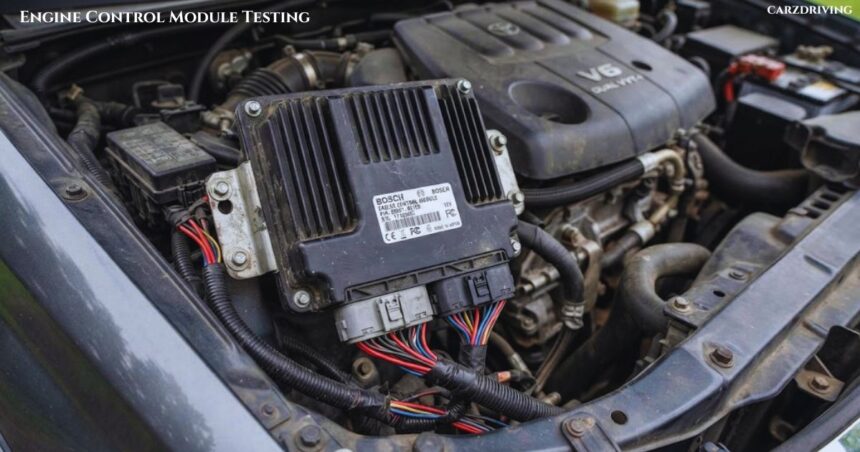
I have lost count of how many cars have rolled into the workshop for engine control module testing with an owner already convinced the ECU is dead. Most times, it isn’t. The real story is usually hiding somewhere between a fault code and a rushed guess, and that gap is exactly where proper testing earns its keep.
Signs of a Failing ECU
When the root of problems sits inside the module, the car tells you in small, annoying ways before it tells you in big ones. I have watched engine stalls happen at traffic lights for no clear reason, and I have seen a faulty sensor get blamed when the real culprit was a broken ground wire tucked behind the bulkhead.
Owners usually notice the engine warning light first, followed by the vehicle key refusing to respond, or the engine won’t start at all on a cold morning. Sometimes the fuel economy drops without warning, and the driver assumes it’s the fuel pump, when actually it traces back to a sensor fault feeding bad data into the system.
I always tell customers that gearbox faults and transmission shifting problems often show up alongside engine codes, which is a strong hint that more than one mechanical cause is at play. A short circuit hiding in the loom can trigger instrument cluster errors and even break communication between modules, so the dashboard starts flashing warnings that seem unrelated to each other.
Failed emissions tests with no obvious explanation, rough idling, and sudden power loss all point in the same direction, but none of them confirm anything on their own. This is why I never treat a single anomaly as proof; I treat it as a lead.
A suspected ECU fault is not the same thing as a confirmed ECU fault, and mixing the two up is how good modules end up in the bin. Mechanical problems, wiring issues, and genuine electronic failure can all produce identical symptoms, which is exactly why ECU troubleshooting tips always start with a structured diagnostic process rather than a swap. I follow this rule strictly: replacement only happens after evidence, never before it.
Non-start conditions, erratic engine performance, and repeated fault code resets that don’t clear are the moments I slow down the most, because rushing here is where assumptions creep in. The ECM, or Engine Control Module, runs so many complex engine systems together that one small fault can echo through the whole car, and that’s the pattern I’ve learned to respect after years of chasing these gremlins.
Engine Control Module Testing Methods
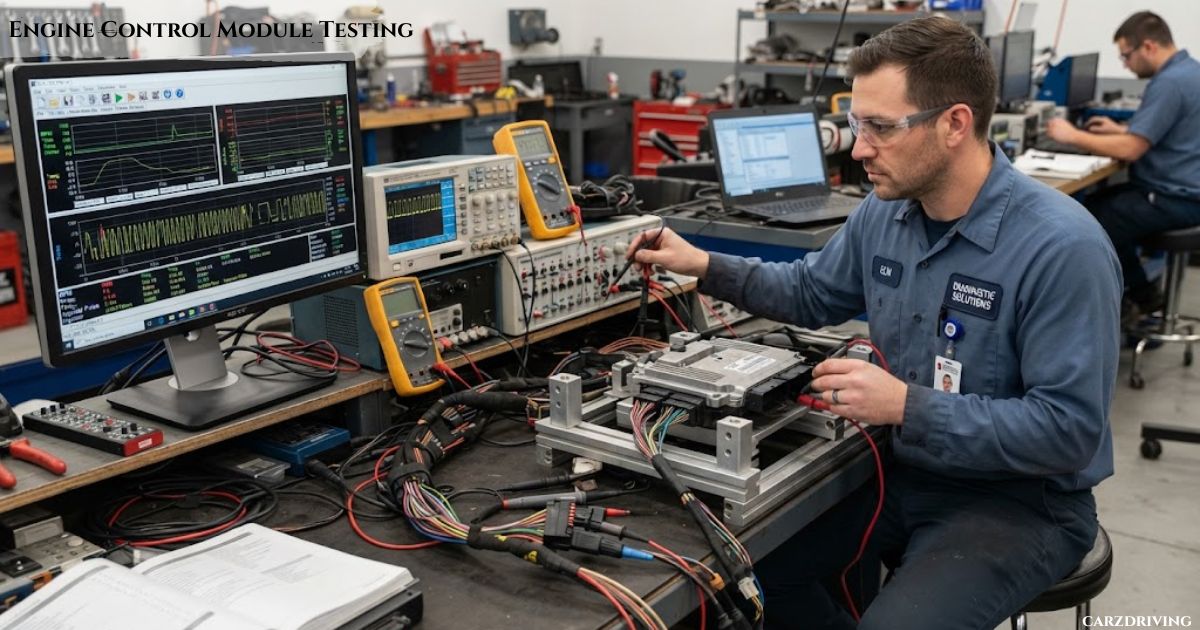
Once I suspect the module, the real work starts on the bench. I pull the correct pinout diagram for the exact model, because guessing pin numbers is how good units get condemned. I connect power leads and ground leads to the supply terminals, checking every reading against manufacturer specifications before touching anything else.
Ground continuity and the power supply pins get checked first, since a weak earth alone can make a perfectly good ECU act like it’s finished. I then apply sensor voltages through simulated input signals and watch the output responses on a multimeter or an oscilloscope, looking for a clean square wave on the CAN bus, since Controller Area Network traffic tells you a lot about the module’s health.
This whole setup, done away from the car, is what people mean by bench testing, and it remains the gold standard for accurate diagnosis because it removes the car’s own wiring from the equation entirely. In-vehicle testing has its place too I connect a diagnostic tool, pull live sensor feeds, and check both stored fault codes and pending fault codes while the engine runs, which is faster but less exact than working in a specialist environment.
A basic OBD2 port, present on cars since around 1994 and 1995, lets a scan tool or diagnostic trouble codes reader flag an error code starting with the letter P for powertrain issues, and any decent laptop-based tool can walk through engine parameters at the garage or even by the roadside.
This isn’t limited to the Engine Control Unit either I test BCM or Body Control Module, BSI or Built-in Systems Interface, PSA modules, Airbag ECU or SRS Module, TCM or Transmission Control Module, TCU or Gearbox Control Module, Mechatronic Units used in DSG and DCT Automatic Gearboxes, and even Hybrid and 48V system modules the same careful way, because input/output signal verification and CAN network communication checks confirm the module’s true health no matter what it controls.
Before any electrical work, I disconnect the negative battery terminal, then use a flashlight to look under the hood and in the footwell where most units for unrepairable, unnecessary replacement avoidance live. I check the wiring harness for burnt wires, bent wires, bent pins, loose pins, and weak pins, along with corroded wires and water damage, and I look for burn marks on the casing.
Many sealed units open with a screwdriver set, retaining screws, a flat head screwdriver, or a sharp blade and sharp knife, sometimes with pliers for stubborn clips, and once inside I examine the PC board for physical damage before deciding if it is repairable or genuinely faulty.
Reviewing published ECU repair success rates and understanding what a car diagnostic test actually reveals about voltage and resistance checks has shaped how much I trust each result, and confirming real power conditions with the right equipment, accuracy, and speed in mind is what separates a proper test from a lucky guess.
What an ECU Does in Modern Vehicles
I like to describe the ECU to customers as the brain of the vehicle, because that’s genuinely what it is. It runs fuel injection, ignition timing, emission controls, and transmission behaviour all at once, while also keeping an eye on safety systems like ABS and traction control.
Over the years, I’ve traced plenty of “dead module” complaints back to water ingress, voltage spikes, and heat damage, not to any fault inside the unit itself.
Component wear builds up slowly, and corroded connectors or damaged wiring harnesses often produce the exact same erratic behaviour an owner or a technician would blame on the module, which is precisely how misdiagnosis happens so often in this trade.
Interpreting ECU Test Results and Typical Findings
Reading the numbers correctly matters as much as taking them. A healthy main power supply should sit between 12V to 14.4V, and I flag anything below 11V or above 15V as an immediate concern. Ground continuity should stay less than 0.5 ohms, and once it climbs above 1 ohm, I know I’m chasing resistance problems, not module problems.
The O2 sensor input signal should keep cycling between 0.1V to 0.9V; a fixed voltage or no signal at all tells a different story entirely. On the CAN bus signal, I expect a clean square wave sitting around 2.5V to 3.5V, and a flat line or an erratic waveform usually means trouble in the wiring rather than the connectors themselves. Injector output should show a pulsed signal at idle; no pulse or constant voltage is a red flag every time.
Genuine faults sit outside these acceptable ranges with no external wiring or sensor issues to explain them away, while sensor-related false positives happen constantly and waste everyone’s money if missed. Intermittent failures are the trickiest of all, since a unit can pass every static bench test and still fail once heat and vibration get involved, often thanks to cracked solder joints or failing capacitors hiding inside.
A proper soak test under heat cycling conditions catches these when nothing else will. From what I’ve seen echoed in wider ECU pinout testing data, roughly 70% of units marked as replacement candidates turn out repairable once tested properly, and that single number has saved vehicle owners and fleets enormous savings over the years. Watching for signs your Mercedes ECU needs attention, or understanding how faulty electronics quietly drag down vehicle performance, gives any owner a much stronger footing once the repair decision arrives.
Repair, Remanufacturing, or Replacement: Next Steps After ECU Testing
Once testing confirms a specific component fault, I lean toward repair almost every time. A failed transistor, a blown capacitor, or a corroded connector pin counts as an isolated fault, and a skilled technician can usually restore full function at a fraction of the price of a new unit.
When the module carries multiple minor faults, or the original unit discarded has simply aged past a simple repair, remanufacturing becomes the smarter route the unit gets stripped down, inspected, rebuilt with new components, and tested to OEM, or Original Equipment Manufacturer, standards.
Replace only makes sense after catastrophic physical damage from fire or severe water immersion, and even then, I confirm it with a full test before spending anyone’s money.
Single identifiable component faults are almost always cost-effective to fix, remanufactured unit options offer reliability close to new at significantly lower cost, and treating replacement as a last resort rather than a first move has saved every customer I’ve worked with real cost.
I always ask any supplier offering rebuilt parts for evidence of testing procedures, because checking published ECU repair outcomes keeps expectations realistic and stops anyone from being pushed toward unnecessary expenditure.
Why Most ECU Failures are Misdiagnosed
The trade has a bad habit: when a component suspected of failure shows up, the fastest fix is usually to swap it and hope. With modules, I’ve found this replacement habit wastes more money than almost anything else in the workshop.
Most units that reach me labelled faulty were never properly tested a scan tool simply flagged code, someone jumped to a conclusion, and a replacement ordered followed with no real process of elimination behind it.
The technicians who get it right always verify power and verify ground before they even question the module, leaning on pinout diagrams and oscilloscopes rather than fault codes alone, because they understand that this work is never a single-step conclusion.
There’s an environmental case here too every unit thrown away for nothing adds to electronic waste, while remanufacturing and repair stretch the working life of components that took real resources to build in the first place. Following a disciplined process, testing before touch, is simply the responsible choice, and it happens to be the financially sensible one as well.
Why Bench Testing is Important
Too many garages still rely only on fault codes or trial-and-error part swapping, and I’ve watched that habit lead straight to unnecessary replacement parts, hefty dealer programming costs, painful immobiliser coding fees, hours of wasted labour, and flat-out incorrect diagnosis. A proper bench check gives a clear accurate answer instead, and that single difference protects both time and money.
How Bench Testing Saves You Money
Modules like ECUs, BCMs, TCMs, and Mechatronics carry serious price tags, so confirming the fault first helps avoid unnecessary parts purchases before anyone commits to buying. Replacing a module often drags in immobiliser programming or coding at the dealer, so a healthy module discovered through testing means skipping those costs entirely and helps prevent costly coding fees.
A bench check delivers rapid accurate diagnosis far faster than hours of on-car investigation, since bench testing confirms the real issue almost immediately. And when the unit genuinely is faulty, repair or cloning usually works out cheaper than buying new, which is exactly why I pinpoint the issue before ordering any part.
When Should You Test the ECU?
An engine light can turn on for dozens of reasons, so skipping engine control module testing and treating it as an automatic expensive mistake waiting to happen is a poor strategy.
A stalling engine or poor fuel economy might just as easily point to fuel system issues as to the module itself. Once several symptoms line up together, it’s time to test the ECU module properly, because replacing ECU without testing first is one of the costliest habits in this entire trade.
FAQs
How do I know if I need engine control module testing?
If your engine warning light stays on or the engine won’t start, it’s time for engine control module testing before you panic and pay for a replacement.
What is the difference between bench testing and in-vehicle testing?
Bench testing checks the ECU in a controlled setup using a pinout diagram, while in-vehicle testing uses a scan tool for quick, real-world answers.
Can a faulty ECU really be repaired instead of replaced?
Yes, many units are repairable proper engine control module testing often reveals a simple, fixable fault rather than total failure, saving real money.
What tools are needed for ECU testing?
A multimeter, oscilloscope, OBD2 scanner, and the correct pinout diagrams are the trusted tools behind accurate engine control module testing.
How much money can proper ECU testing actually save me?
Studies suggest up to 70% of ECUs marked for replacement are actually repairable, making engine control module testing a smart, honest first step.