

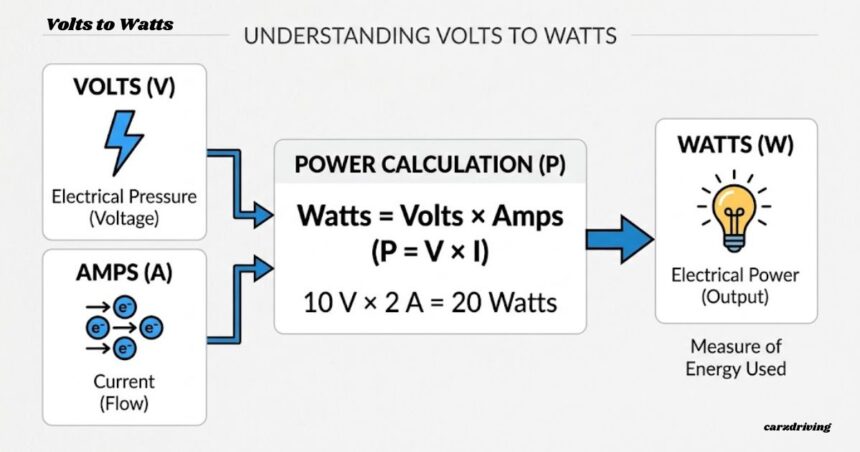
The first time a long outage hit my street, I started planning a backup battery and quickly learned that I could not do the math. That is when volts to watts stopped being a classroom idea and became one of my favorite electrical calculations for everyday applications. Whether you work as an electrical engineer or enjoy life as a DIY enthusiast, the same conversion helps you understand any device around you.
I use it when comparing a phone charger with a laptop brick, and again when sizing gear for solar power. Volts and watts are different units, because volts describe electrical pressure while watts describe total power. Once you see that relationship, you can read wattage labels, track power consumption, and keep energy consumption under control safely.
These two electrical properties never tell the whole story alone, so you always need one more value, and that value is amps. With voltage and amps in hand, you can measure the power that appliances, electrical devices, and whole electrical systems draw.
Understanding Volts, Amps, and Watts
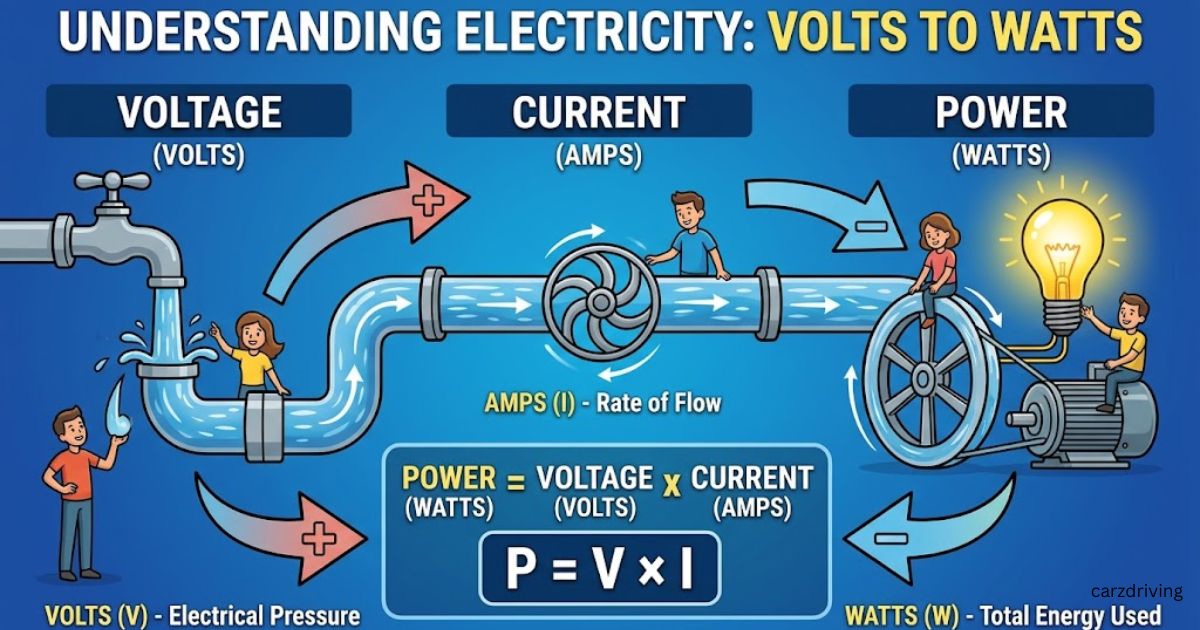
Think of electricity like a water hose. Voltage is the pressure, and scientists describe it as the electrical potential difference between two points. In the United States, household outlets give 120 volts, and in the UK they give 230 volts, while electric dryers and ranges often use 240-volt power.
Current is the flow of electric charge through a conductor, and we measure it in amps. A small charger pulls 1 amp, but a space heater can pull 12 amps from a 120V outlet. Voltage pushes electric charges along a wire, and too much current makes wires overheat and trip the breaker.
Watts show how fast a load uses energy, and that speed is the rate of power. A 10-watt LED bulb sips very little, while a 1,500-watt space heater gulps a lot, even on the same 120V outlet.
On paper, we write voltage as V and power as W. With fixed resistance, wattage is directly proportional to voltage, so higher voltage with the same current gives you more power. A typical incandescent light bulb uses 60 watts, a refrigerator may list 500 watts, and the wattage on the label tells you the real resistance story.
Electricians and engineers lean on these ideas when they design electrical circuits, pick a power supply for electronic devices, or lay out a circuit board. HVAC equipment and other appliances need the same care. A smart design delivers better efficiency, steady performance, and safe operation in any electrical system, while a sloppy circuit wastes energy consumption and ignores power factor.
How to Convert Volts to Watts
Here is my step-by-step guide to convert v to w. Read the voltage from the labels or the manufacturer’s specifications on the appliance. Next, multiply it by the current to get the basic formula, which is Watts = Volts × Amps. In short, W = V × A, and this DC formula works well for batteries, chargers, and electrical adapters.
Try 120V × 3A, which equals 360W. That is 3 amps at 120 volts. Likewise, 2 amps at 120V gives 240 watts, and 5 amps at 240V gives 1,200 watts. These quick sums give you solid household estimates for any device.
If you do not know the current, grab an ammeter and measure it. You can also use Ohm’s Law, where Resistance = Voltage / Current and Current = Voltage / Resistance, and you measure resistance in ohms. When you only know the resistance, the circuit follows V² ÷ Ohms.
AC needs one more step. The single-phase AC formula adds the power factor, so AC power equals volts times amps times that factor. Resistive devices like incandescent bulbs, heaters, and kettles sit near 1.0. A motor that draws 8 amps at 120 volts with 0.8 gives 768W, and power tools, compressors, and electronics behave the same way, because only part of the energy does useful work.
Power is the rate of energy transfer, so this math reveals power consumption, efficiency, and performance across electrical systems.
Practical Applications of V to W Conversion
When I picked a power station for my family, I started with a list of essential devices. A Wi-Fi router, phone chargers, LED lights, and a CPAP machine went on top, and I read each label for volts and amps. This list works well for medical devices, laptops, and cameras too, and it prepares you for outages and emergencies.
Next, I split every load into running watts and surge watts. A refrigerator has a steady running load, but the fridge compressor adds a startup surge, so a 700W fridge may need far more for a second. A coffee maker at 1,000W adds on top, so I always keep some headroom and plan for inverter losses.
Check three numbers on any portable power station wattage sheet: continuous output, surge output, and output rating. Strong surge capability matters for microwaves, power tools, and small appliances, and it matters more than raw battery capacity. Compact systems suit light use, while high-output systems handle heavy gear.
In solar power systems, panels make direct current, an inverter turns it into alternating current, and photovoltaic systems depend on that switch.
The same math reaches residential and industrial work, from household appliances like air conditioners and televisions to the automotive industry. Electric vehicles use an electric motor and battery packs, and engineers use v to w to set range. Electronics manufacturing follows industry standards and regulations to cut energy waste and boost efficiency and safety.
Good power management supports a sustainable future and a stable electrical grid. With better battery technology, you can judge capacity and duration, plus backup power, in both AC and DC. This lowers energy consumption and promotes renewable energy and solar power, with the right voltage and wattage for every portable power stations choice.
Conclusion
The key takeaways are simple. Wattage depends on voltage and current, so multiplying voltage by amps with Watts = Volts × Amps gets you close. For AC devices with motors or compressors, add the power factor to get a precise result.
You will check appliances and equipment, meet your backup power needs, and avoid overloaded circuits.
Electric potential difference is not the same as power consumed, and that is one of the most common misconceptions. Higher voltage does not always mean more energy consumption, because duration of usage, resistance losses, and the type of electrical load matter too, even though wattage stays proportional to voltage when resistance stays fixed.
Whether you study electrical systems, solar power systems, electric vehicles, or battery output, you make informed decisions about power usage, renewable energy, and a sustainable future.
Charts, Circuit Limits, and Common Mistakes
I started learning volts to watts with 12V gear, since cars, RVs, and marine batteries all run on it. Car outlets, power banks, compact DC devices, and solar panels use DC, so the math stays simple. A 12V phone charger at 2A makes 24W, a mini fridge at 5A makes 60W, an air pump at 10A makes 120W, and an LED light strip at 3A makes 36W. These numbers show battery drain fast, and in a 24V battery system, 20 amps gives 480W before inverter losses.
At residential outlets, 120V rules. A laptop charger at 0.8A uses 96W, a microwave at 10A uses 1,200W, and a space heater at 12.5A uses 1,500W. My 120V to watts chart runs from 1A at 120W up to 15A at 1,800W and 20A at 2,400W on a 120V circuit.
On 240V, electric dryers, ovens, welders, air compressors, and well pumps need dedicated circuits. My chart there shows 15A at 3,600W, 20A at 4,800W, 30A at 7,200W, and 50A at 12,000W.
No amps? Use Watts = Volts² ÷ Resistance. For the reverse, Volts = Watts ÷ Amps turns 240 watts and 2 amps into 120 volts, and this check helps when comparing adapters and battery systems.
Most homes use single-phase AC, but commercial and industrial sites use 3-phase power. The line-to-line formula uses √3, which is about 1.732, so a 208V system that draws 20 amps with a 0.9 power factor gives 6,484W. For line-to-neutral, you use 3 times the numbers instead. If you feel unsure, read the equipment documentation or call a qualified electrician, and remember that AC math always brings in power factor.
A 15-amp circuit has a theoretical maximum of 1,800W, and a 20-amp circuit reaches 2,400W. For a continuous load over three hours, the 80 percent rule, or 80%, drops those numbers to 1,440W and 1,920W, and a 30A line to 5,760W. Your breaker size, wiring, and outlet type set the real limit.
Running watts keep a device going, but surge watts hit when a motor or compressor starts. Refrigerators, sump pumps, air conditioners, and power tools can need two to three times their running level at startup.
A 100-watt light bulb over four hours uses 400 watt-hours, and I use watt-hours to guess my electricity bill. That math spots energy-saving moves, favors energy-efficient options, and cuts electricity costs. It also supports sustainability and energy conservation, and it shrinks your environmental impact and carbon footprint.
One of the biggest misconceptions says higher voltage gives brighter light output. A low-voltage LED light bulb can match a high-voltage incandescent bulb while using less, and duration of usage changes the total too. Wires also suffer power loss from resistive loss, which turns into heat over long distances of power transmission.
FAQs
How do I convert volts to watts?
Multiply volts by amps with the basic formula Watts = Volts × Amps, so 120V × 3A gives 360W.
Can I convert volts to watts without knowing the amps?
No, you need amps, resistance, or wattage too, because voltage alone cannot show your power consumption.
Does power factor matter when I convert volts to watts?
Yes, AC devices with a motor or compressor need the power factor, so 120V × 8A × 0.8 gives 768W.
How many watts can a 15-amp circuit handle safely?
A 15-amp circuit has a theoretical maximum of 1,800W, but the 80 percent rule keeps a continuous load near 1,440W.
What is the difference between running watts and surge watts?
Running watts keep a device going, while surge watts hit at startup, so you avoid tripped breakers by planning for both.