
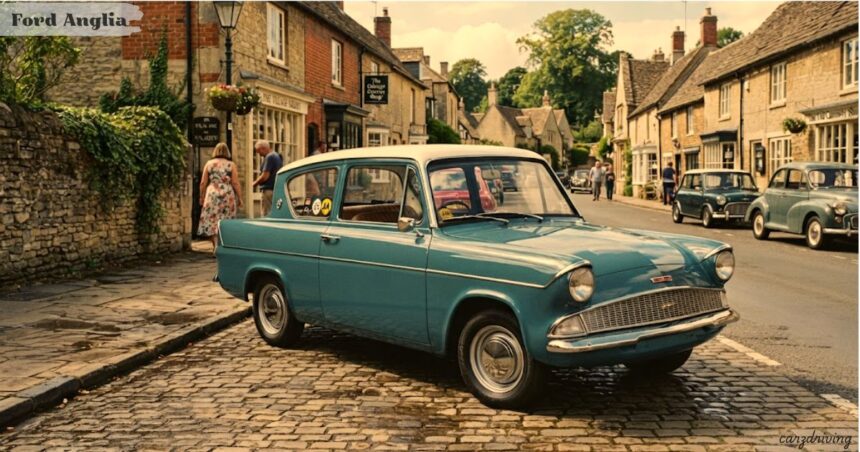
Ask any child today about the Ford Anglia, and they’ll probably call it the Harry Potter car before they ever use its real name. That nickname exists because J K Rowling borrowed a memory from her own life and turned this humble little runabout into a flying star, pulling it out of dusty classic cars shows and straight into the global spotlight.
Yet long before young people knew it from the big screen, the older generation already loved it as a dependable family car, and its true link to the Ford Escort carries a story worth telling.
The one I care about most is the 105E, a car that sold more than a million units between 1959 and 1967, and its tale actually starts much earlier. The Anglia name first appeared in 1939, worn by the E04A, then the smallest model in the whole Ford range. Built as a sit-up-and-beg budget car, it carried a 933cc side-valve engine and did its job without any fuss.
War got in the way for three years after 1942, when Ford’s factories switched over to the war manufacturing effort instead of building family cars. When peace returned, the E494A took over in 1948, and by then some 55,807 of the earlier model had already been made.
This successor was really just a makeover, wearing a new front end and a bigger 1172cc, 10hp engine, while still sitting firmly at the cheap end of the market.
At launch, it proudly wore the crown of Britain’s lowest-priced four-wheeled car, costing just £309 once you added the taxes, and it managed a top speed of 57mph, which felt brisk enough for its time.
More than 100,000 were sold before the 100E replaced it in 1953, though the older shape carried on as the Ford Popular for years afterwards. Every manufacturer eventually needs a new model, but often a so-called facelift is all a predecessor really gets not this time.
When Ford revealed the true 105E at the 1959 Earl’s Court Motor Show, the only thing it shared with its ancestor was the name, and its styling grabbed every eye in the room.
The reverse-rake rear window became an instant talking point, sitting behind a gently sloping bonnet and front wings that pushed the headlamps forward with sharp brightwork. Around the back, tail fins rose from the boot line, and the backward slant of the rear screen worked neatly with smart indicators.
Under the skin, the new over-square 997cc OHV engine joined a Kent family of engines that would power Fords for generations, mated to a four-speed gearbox offering four forward gears for the first time in a small British Ford.
Synchromesh made the shifts smooth, while a MacPherson strut front end and leaf-sprung rear axle gave confident handling right from launch. Buyers could pick a Standard or one of the Deluxe saloons, and by 1961 Ford had added estate and van derivatives to the family.
Things got properly exciting in 1962 with the Anglia Super, known internally as the 123E, which packed a punchier 1198cc Kent engine borrowed from the Consul Cortina.
This lift in performance pushed the top speed to 83mph and sharpened its drivability no end. Outside, two-tone paint with a chrome side flash and contrasting roof made it stand out, while inside, front seats with a padded dashboard top and full carpeting gave it real refined appeal.
Buyers loved having more choice to fit their budget, and this steady stream of innovation and charm kept the range fresh without losing its practicality.
That mix of ideas explains the car’s huge success, both at home in the UK and abroad. By November 1967, when the line finally closed, Ford had built an incredible 1,083,960 units, and that figure doesn’t even count the van variants.
Looking back after six decades, the debut of this car still reads like a bold example of a company willing to take a gamble. It paid off handsomely, turning the car into a genuine bestseller and, today, a beloved classic with a strong following among fans of classic Fords.
Cars from the 1960s rarely hold their values so well, but a full decade of rising interest has turned this once cheap and cheerful entry point into a proper classic that wins hearts and makes headlines.
The All-New Anglia
The motoring world moved fast through the 1950s, and cars built on pre-war designs simply couldn’t keep up anymore. Ford dropped the old upright stance in favour of a modern three-box design, launching the two-door Anglia 100E alongside a four-door version called the Prefect.
Under the bonnet sat a familiar 1172cc side-valve engine, keeping the same bore and stroke as before but fitted with larger bearings and inlet valves plus a fresh cooling system.
Ford even threw in a second windscreen wiper at no extra cost, though both were still vacuum-operated and had a habit of slowing down during overtaking or at high speeds. Even so, the improved engine now made 36bhp, enough to reach 70mph and hit 60mph in 29.4 seconds.
Unitary construction arrived for the first time, and the suspension grew up too, with McPherson struts at the front plus an anti-roll bar and semi-elliptic leaf springs at the back.
A facelift in 1957 gave the car a refreshed face, a larger rear window, larger tail lights, and shiny chrome bumpers. Sales stayed strong throughout, proving the shape still had life left in it. By the time the striking 105E took over, an impressive 345,841 examples had already rolled off the line.
Birth of the 105E
In 1959, the Anglia 105E joined a small group of British cars that shook up the motoring world overnight, standing shoulder to shoulder with the Mini and the Triumph Herald. Its angular styling, complete with transatlantic rear fins, a reverse-rake rear window, and hooded headlights, marked a radical step for Ford UK. Much of that fresh look came from a development centre in Birmingham, opened in the mid-1950s specifically to chase this kind of bold thinking.
That Americanized styling owed a lot to Elwood Engel, a visiting designer from Ford USA who left his mark on many of the car’s features.
Under the bonnet, the tired old side-valve unit made way for the sweet-revving Kent 997cc, an overhead valve straight-four with an oversquare cylinder bore. It drove through Ford’s first ever four-speed manual gearbox fitted to a production saloon, complete with synchromesh on the top three gears.
Gone too were the old vacuum wipers, swapped for electrical windscreen wipers, while drums handled the stopping and recirculatory ball steering took care of direction. Buyers chose between the basic Standard and the smarter Deluxe, the latter wearing a full-width chrome grille with pride.
The Standard at £589 skipped little extras like a glovebox lid, passenger sunvisor and carpets, but an extra £21 bought chrome side stripes, chrome rear lamp units, two-tone paintwork and opening rear quarter windows, though a heater stayed an optional extra.
Before any journalist got near it, Ford battered the car through 500,000 miles of punishing testing across the globe, from the Alaska Highway to remote tracks in Africa. Engineers checked cold starting, heater efficiency and roadholding in ice and snow conditions in Norway, then moved on to dust and suspension tests in East Africa, working at heights of 6,000ft and temperatures past 35C while dodging wild animals.
Drivers also pushed cars flat out across Germany on the Autobahns for high-speed testing, then took the fight to the Australian bush and the wilds of Canada.
More than 30 vehicles took part in these trials, and one unlucky group even got pulled over by German police on suspicion of smuggling drugs during a night test near the Ardennes by the Belgian border. Officers only relaxed once the car had been emptied of its cargo of 50lb bags of sand. It was, without question, the toughest testing regime any new Ford had ever faced.
First Impressions
On September 23 1959, Ford pulled out all the stops at Crystal Palace, launching the new car next to the updated Popular (really the old Anglia 100E) and the refreshed Prefect. Motor Sport magazine turned up to sample what Ford’s ad men proudly called the World’s Most Exciting Small Car.
Guests mingled in a gay lounge before lunch in a grand dining-hall, while outside in the sunshine rows of Ford commercial vehicles and historic vehicles stood on show, right back to the Model T.
There was even a comic sketch where a die-hard Volkswagen fan met the new car and realised his Beetle came up short on economy, speed, legroom and weight distribution. One journalist called the whole stunt a bit petty, aimed at a well-proven low-price design, and another odd moment saw 14 hefty lads climb out to show off the car’s body and boot capacity. Sadly, that particular launch video, a slice of pure retro cheese, seems lost to time.
Out on the Crystal Palace circuit, journalists reached about 55mph along the top straight, though the day wasn’t without a punctured tyre, a couple of minor prangs and one engine failure.
Even so, reviewers loved the new gearbox, praising how the oversquare engine answered a light throttle so willingly. Steering felt light with a touch of understeer, turning into body roll and then oversteer if pushed, all cushioned by that soft comfortable suspension.
The only real surprise was that reverse-raked rear window, which killed off the rear parcel shelf but let the boot swing open nice and wide. Over in America, Motor Life magazine said the high-revving engine felt almost radical, admiring its extremely oversquare dimensions and hollow three-bearing crankshaft.
Despite some doubts about the gear ratios, the magazine praised the transmission, while Sports Cars Illustrated magazine noted a warm female reaction and plenty of styling admiration wherever the car went, and that word America kept coming up in every glowing report.
MOTORSPORT SUCCESS
The car had barely reached showrooms before Formula Junior teams and other motorsport groups spotted the tuning potential hiding in that little engine. Keith Duckworth of Cosworth Engineering got hold of two units early on, and when Colin Chapman’s Lotus 18 entered Formula Junior racing in 1960 with a young Jim Clark driving, it ran the Cosworth III engine underneath.
The car also thrived on the rally circuit, entering the RAC International Rally of Great Britain and becoming a regular at the Monte Carlo Rally.
It even won the 1966 British Saloon Car Championship, the forerunner of today’s BTCC, driven by John Fitzpatrick. That high-revving engine proved its durability again and again, and nobody showed this off better than twin brothers Tony Brookes and Michael Brookes.
These twin brothers, both 24-year-olds in October 1962, captured six International Class G World Records at the Montlhéry Autodrome near Paris in a 105E fitted with the humble £13 Ford Performance Kit.
Averaging an incredible 83.47mph, the record run spanned 4 5 6 7 days and nights and covered distances of 9,300 miles and 12,400 miles, needing nothing more than routine tyre changes. Meanwhile, brothers Mike Young and John Young built race cars under the name Superspeed Conversions, working from a garage in Ilford, East London.
They tuned 1000cc, 1300cc and 1650cc engines for various championships, and in 1965 created six less extreme road-going versions of their fastest cars.
Ford supplied these cars in bright Monaco Red with black trim, and Superspeed fitted each one with a tuned engine, a close ratio gearbox, plus suspension and brakes borrowed from a Lotus Cortina. Extra touches included Bullet Wing Mirrors and an upgraded works rally dash straight from Ford. Only one of these, surely the ultimate road-legal Anglia, is known to survive today.
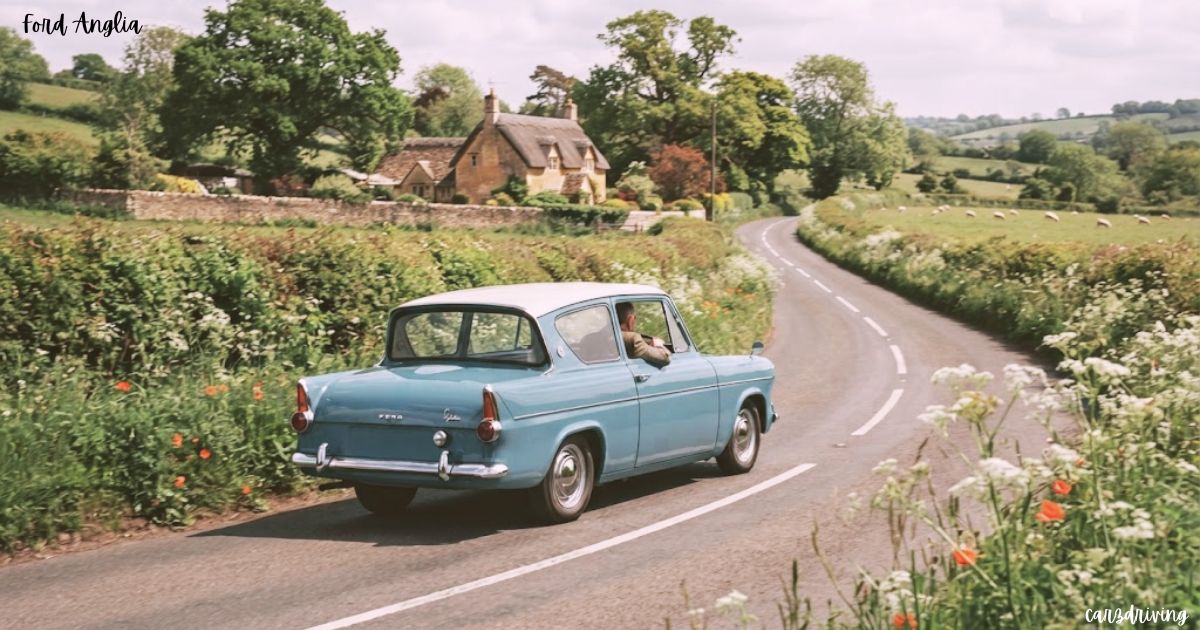
Anglia 105E Values
Prices for these cars swing wildly depending on condition, and rough restoration projects can still be picked up for around £1500-£2500, though expect plenty of rust and missing parts. Sound, roadworthy examples typically sit between £6000-£9000, giving a solid base for running restoration work or regular classic use.
At the top end, top-tier cars, whether low-mileage originals or well-restored examples, fetch £12,000-£16,000, with the very best nudging £20,000, and the 1200 Super often commands a small premium thanks to rising values across the board.
Bodywork
Like most monocoque saloons from the 1960s, this car can suffer serious corrosion if left unchecked, so always check for structural deterioration as well as rust on the outer panels. On the shell, both inner sills and outer sills rot easily, along with all four jacking points and the hidden central sill section.
The rear leaf springs mounting points can rust right through too, as can the rear crossmember and boot floor, and it’s common to find holes in the floorpans, especially near the front corners and outer edges.
The A-pillars rot from the base upward, which can eventually affect the door hinge mounting points, and under the bonnet you’ll often spot old repairs to the flitch panels and inner wings near the front struts. Trapped mud and salt cause corrosion from behind here, so check any work done around the strut tops carefully.
Luckily, reproduction panels are available from Ex-Pressed Steel Panels (steelpanels.co.uk), though a full boot floor £475, plus VAT, and pieces like rear spring hangers £180, outer sills £193 and an A-pillar outer skin panel £155 can all add up fast.
Front wings rot too, usually around the headlamp area and the rear edge of wing in line with the A-pillar, and genuine old-stock Ford wings are almost impossible to find, though new wings £1100 are available with an eight months lead time.
Doors rust through the middle trim line where the outer skin meets the internal panel, while the rear wheelarches and lower rear quarter panels are other known trouble spots, though repair sections exist for both. The rear valance rusts too, and a replacement runs to around £280.
Engine and Transmission
The 997cc Kent engine generally holds up better than the 1198cc engine, which has a reputation for premature bearing wear, though both suffer fatigue over time. Watch for a rumbling bottom end, heavy oil consumption and blue exhaust smoke, plus a camshaft chain rattle and core plugs corrosion, since both units are prone to oil leaks.
A professional engine rebuild costs around £2000, though Newford Parts sells exchange units if originality matters less to you than getting back on the road.
There are also plenty of upgrade options, including a popular swap to the 1500cc Kent engine from the Cortina, a favourite trick back in the 1970s and 1980s that still has fans today, though any real power gains mean the brakes and suspension upgrades should follow too.
This proves the engine’s durability, since it takes tuning so well. Gearboxes paired with both units are tough overall, but worn synchromesh, especially in second gear and first gear, brings noticeable crunching.
A whining noise points to internal wear, and jumping out of second gear usually means worn selector rods. Oil often escapes from the input shaft or around the diff nose bearing, where the built-in seal tends to perish with age. A properly leak-free underside almost always signals a recent restoration.
Interior
The cabin stays simple throughout the range: Standard and Deluxe models came with hard-wearing rubber flooring, while the Super treated owners to proper carpet.
Every version used vinyl upholstery, though the patterns and colours changed over the years, and early cars often wore eye-catching two-tone trim. The Super’s front seats offer more padding and support than the Deluxe, though even these can wear thin, showing worn vinyl or poking springs.
If your interior has seen better days, Aldridge Trimming sells seat covers £480 a pair in single colour or two-tone colour schemes, along with fresh door cards and rear side panels. They also stock full carpet sets and accurate headlining kits for that factory-fresh feel.
Check the screen seals too, since perished rubber lets in water ingress, and a musty smell or soft patches in the flooring often point to hidden rot underneath.
Suspension, steering & brakes
With MacPherson struts and coil springs up front, and leaf springs plus lever-arm dampers at the back, the 105E suspension layout is typical for a Ford of this era. Parts availability is good, and it’s worth joining the Anglia 105E Owners’ Club for its excellent spares scheme. Watch out for leaking dampers, tired rear leaf springs and worn front struts, which show up as vague handling or bouncy handling on the road.
Also check the strut top mounts in the engine bay, since perished rubber here can compromise the whole mount. Newford Parts sells rebuilt front struts £175, or you can fit original-spec inserts £125 instead, while new rear dampers come from Small Ford Spares (smallfordspares.co.uk) for £151, with reconditioned units £77 as a cheaper option.
If the steering feels vague, with imprecise steering or a shimmy at speed, a worn idler joint on the drag link is usually to blame.
The Owners’ Club supplies a remanufactured drag link with a modified idler joint built in, and most steering components can be sourced through the club or independent suppliers. The steering box itself is simple enough for any home mechanic to tackle at home.
Braking couldn’t be simpler either, with an all-drum braking system and non-servo brakes, plus affordable parts like brake shoes £60, master cylinders £90 and wheel cylinders £20.
Verdict
Blending glamorous Americana-esque styling with simple mechanicals, a good range of trim levels and body styles, plus handy compact dimensions, this car makes for a genuinely appealing classic and one of the best 60s classic choices out there.
It might no longer be a bargain, but values keep climbing, and it still keeps heads turning wherever it goes, all while opening the door to a huge, friendly Ford community one I’ve enjoyed being part of at more than a few weekend meets myself.
Ford Anglia 105E Timeline
In 1959, the fourth-generation Ford Anglia 105E arrived with bold transatlantic styling, replacing the older 100E. By 1961, Thames 307E vans joined the family, and the following year, 1962, saw Tony Brooks and Michael Brooks average over 83mph at the Montlhéry Autodrome in France, breaking six world endurance records, the same year the Anglia Super 123E arrived with its bigger 1198cc engine.
In 1965, the Anglia Torino 105 appeared, developed by Ford’s Italian subsidiary with Michelotti-styled bodywork, and sold across Italy, Belgium, Luxembourg and the Netherlands. Production ends in 1967, by which point over one million 105E examples had rolled off the line.
FAQs
What made the Ford Anglia famous besides being a classic car?
The Ford Anglia became a household name after starring as the Harry Potter car, winning hearts across the global spotlight.
How many Anglia 105E units were made?
Ford built an incredible 1,083,960 units of the 105E between 1959 and 1967, making it a true bestseller.
What engine powered the Ford Anglia 105E?
The 105E used the all-new over-square 997cc OHV engine, the first of the legendary Kent family.
How much is a Ford Anglia 105E worth today?
Prices range from £1500-£2500 for restoration projects up to £20,000 for top-tier cars, reflecting rising values.
Is the Ford Anglia a good classic car to own?
Yes its simple mechanicals, compact dimensions, and warm Ford community make it a genuinely beloved classic and proper classic choice.