

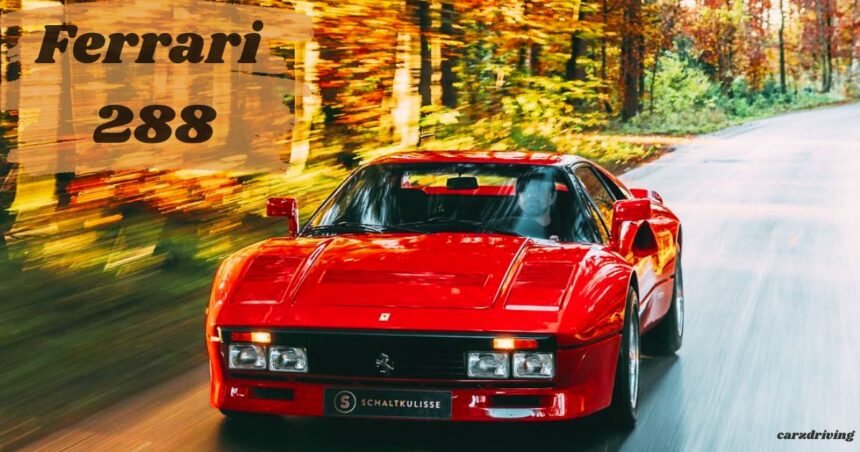
The Ferrari 288 GTO is one of the most legendary models in automotive history, and it arrived in 1984. Many fans call it the starting gun for every hypercar that followed, and the TG crowd likes to point out that hypercars show up once a decade. Each decade or so, we look back at this fast car to see where the whole story began.
The name looks confusing at first, so here is the simple version. The 288 comes from the 2.8-liter engine displacement and the eight-cylinder layout, and the GTO stands for Gran Turismo Omologato, which means grand touring homologation.
Ferrari built it as a grand touring car with cutting-edge technology from motorsports, mainly from the Group B rally scene.
On the surface, the car looks like an elongated 308 GTB, but it feels like far more than that. It has a primal force about it, with swoopy front wings, big NACA ducts, and a sublime stance. That stance looks beautiful in a way most hypercars never manage.
Origins and Group B Homologation
So when does a supercar turn hyper? In my view, the GTO is the moment Ferrari jumped to the next level. Maranello first planned it for rallying, and the Group B rules let manufacturers build high-performance road cars with minimal production requirements.
Then the FIA banned those events because they were too dangerous, but Ferrari kept building the car anyway. Ferrari never went racing with it, yet the GTO still earned legendary status through its raw power, technical innovation, and exclusivity. Its reputation grew fast in the 1980s, and it still shapes how we see the brand.
Enzo Ferrari gave the project to Nicola Materazzi, whom people called Mr Turbo. Materazzi had already helped Scuderia Ferrari find the right technical path in the early 1980s, so Enzo trusted him. Leonardo Fioravanti, the star designer at Pininfarina, said the brief was simply to build a racing car from the 308 GTB.
Dr Harvey Postlethwaite, a recent F1 hire, pushed the car far beyond that brief. He used composites and Kevlar to cover a high tensile steel frame chassis. That mix kept the weight low and the body strong.
The 288 in the name points to the engine, a 2.8-litre V8 with 395bhp. Engineers mounted it longitudinally instead of transversely, as in the 308, so it could fit the twin IHI turbos and Behr intercoolers. The team developed it alongside the Lancia LC2 Group C racer, which was a very cool car.
Ferrari also stretched the wheelbase by 110mm and had the track widened. Those changes turned the car from a steroidal 308 into its own machine, and it is actually shorter overall.
It still keeps the curvaceous front wings, pronounced hips, air vents, and pop up headlights that make it so beautiful, and its competition aggression shows in every line.
The rules asked for far fewer cars, but Ferrari built 272 units. That limited production makes the car a rare gem and an exclusive collector’s car. Its groundbreaking engineering and performance potential helped define the Ferrari name.
Performance, Driving Experience and Speed
Even though the car dates from 1984, anyone who drives the 288 GTO today gets a lesson in analogue motoring. After 40 years, it still gives a full-bodied thrill to people who want one. It feels less intimidating than the F40, even with the same awkward dogleg first gear.
The car does not lunge forward with the same exhilaration and sense of impending doom as its famous successor, but it has an addictive turbo whooshiness.
It feels beautifully damped, and its suppleness hints at a wider bandwidth than you expect. Once you pull 4,000rpm and the turbos are spooled up, the car feels scintillatingly alive.
The top speed is 189mph, or 304 km/h, which made it the world’s fastest production car until the Porsche 959 arrived.
Sources also list 4.9 seconds for 0 to 60 mph, and that acceleration placed it among the fastest road cars of its time. It also set Ferrari up as a leader in high-performance vehicles and lifted its standing in the automotive world.
The twin-turbocharged engine, manual transmission, lightweight construction, and advanced suspension system work well together. The car stays agile through corners, holds a line on straightaways, and handles high-speed turns with ease. It also feels at home on winding roads and tracks, thanks to strong braking systems.
Aggression Meets Elegance
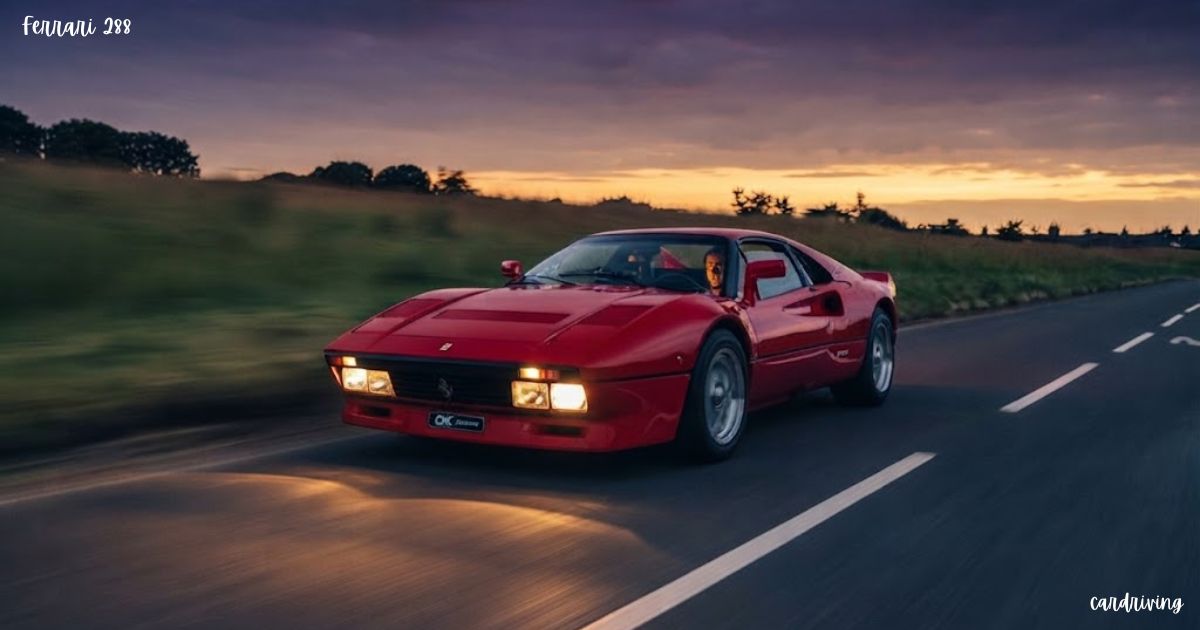
Pininfarina, Ferrari’s long-time design partner, drew a body that feels both aggressive and refined. The car started from the Ferrari 308 GTB, but the team re-engineered it so heavily that the aesthetic looks new. The flared wheel arches, NACA ducts, and elongated rear end set it apart from other Ferraris of its time.
Up front, a low-profile aerodynamic nose with pop-up headlights gives the front fascia a classic ’80s look. Ducts on the hood and fender improve airflow, cut drag, and help the components cool during hard driving. Every duct has a job to do.
Wide fenders cover larger wheels and give the car a muscular stance and strong road presence. Ferrari also focused on weight reduction, using Kevlar, aluminum, and fiberglass to bring the car down to 1,160 kg, or 2,557 lbs, which gives it real agility. The classic colour choice was Rosso Corsa red, paired with a minimalist black interior, and that mix gives the car an unforgettable look.
Engineering and Technical Innovations
Ferrari packed groundbreaking engineering into the car and wanted a powertrain that mixed speed with longevity. The 2.8-liter twin-turbocharged V8 helped make it one of the fastest cars of its era, and some writers call it a first for the company. I would check that claim, though, because Ferrari built a turbo road car before this one, and the brand mostly used naturally aspirated engines.
Sources list the power output as 395bhp @ 7000rpm or 400 horsepower, along with 366 lb-ft of torque. The twin IHI turbochargers and intercoolers deliver intense power delivery, especially at high RPMs. The 2,855cc V8 feels raw and gives a visceral driving experience.
A 5-speed manual transmission lets the driver use the whole powerband. Independent suspension with coil springs, telescopic shock absorbers, and anti-roll bars gives sharp handling and steady stability at high speeds. Ventilated disc brakes stop the car whenever the driver asks.
Ferrari used exotic materials like Kevlar for the body panels, and many sources mention an aluminum chassis, while others describe a steel frame, so treat that detail with care. Either way, the mix was very advanced for the mid-1980s. It kept the weight low without hurting rigidity.
The Evoluzione
In 1986, Ferrari built the 288 GTO Evoluzione for Group B racing. The team gave it an aerodynamic overhaul with a large rear wing, wide bodywork, and carbon fiber panels. Every change aimed at one goal, which was speed.
Its engine made 650 horsepower and could reach 225 mph, or 362 km/h. Ferrari made only five units, and the FIA canceled Group B before the car could race. Still, the Evoluzione points straight toward the F40, and its experimental engineering added a strong link to the supercar lineage and showed real performance excellence.
What It Got Wrong
The 288 GTO still shows its 1970s roots, and it lacks the rigidity and intensity of the cars that followed. It idles like a four cylinder car, as many flat plane crank Ferrari V8s do, and it buzzes, vibrates, and sounds very mechanical. Anyone raised on EVs might panic, though a heavy clutch and unassisted steering are a bigger test.
The cockpit feels tight for taller drivers, because the engine presses against the Kevlar and Nomex bulkhead. The driving position is idiosyncratic, and the interior feels very 1980s. None of this is truly wrong, but a fair review needs something to complain about.
Legacy and How History Has Judged It
The rules for homologation asked for 200 cars, yet Ferrari built 272. That makes the car the rarest link in the hypercar bloodline, and the name alone gives it top level status in collectors’ circles. Buyers treat it as a sought-after collector’s piece with timeless appeal.
The 288 GTO became an instant collector’s item and a collector’s icon. Its rarity and iconic status mean it can appreciate in value, and it often sells at auctions for millions of dollars. Collectors have revered it for decades.
The 288 GTO led straight to the F40, the most iconic model of the late 1980s. The F40 borrowed the same ideas of turbocharging, lightweight design, and high performance. Both cars show how Ferrari shaped turbocharged engines and a twin-turbocharged V8 tradition.
The car’s enduring influence reaches far beyond its life as a homologation special, even though Ferrari never raced it in Group B.
It set a new standard for sports cars, with aggressive styling, lightweight materials, and technological advancements. It also proved that racing technology could fit into road-legal cars, and later high-performance street-legal supercars followed the same path.
The 288 GTO helped set Ferrari’s trajectory, and it links the past with future aspirations. It shows the brand’s dominance in motorsports and its relentless pursuit of excellence, and it proves the celebrated maker was ready to take a risk. Few cars carry that story so clearly.
It marked a pivotal moment in the company’s evolution, when innovation mattered more than safe choices. The car pushes the boundaries of performance with speed, beauty, and desirability, and its elegant yet aggressive design still wins over enthusiasts. Its performance still impresses people today.
Today, the 288 GTO is an icon that runs on passion, and its storied history keeps buyers loyal. It holds a strong place in the market, and it inspired generations of supercars.
Ferrari 288 GTO Price and Specs
Prices tell a big story: the ferrari 288 car cost £73,000 in 1984, and today it can reach up to £3.5m. The Specs list a 2,855cc V8 with 395bhp @ 7000rpm and 366 lb-ft. Weight sits at 1160kg (dry), and 0-62mph takes 4.8 secs, with a top speed of 189mph.
To me, the 288 GTO stands out because it feels complete, with beauty, speed, and history in one package. It asks a lot from the driver, and it gives a laot back. Few cars from that era do the same.
FAQs
What is the Ferrari 288 GTO?
It is a legendary 1984 hypercar that Ferrari built as a Group B homologation special with a twin-turbo V8.
Why is it called the 288 GTO?
The 288 comes from the 2.8-liter eight-cylinder engine, and GTO stands for Gran Turismo Omologato.
How many Ferrari 288 GTO cars did Ferrari build?
Ferrari built 272 units even though homologation needed only 200, so it is the rarest car in the hypercar bloodline.
How fast is the Ferrari 288 GTO?
It reaches 189mph and covers 0-62mph in about 4.8 secs, which made it the world’s fastest production car until the Porsche 959 arrived.
How much does a Ferrari 288 GTO cost today?
It cost £73,000 in 1984, and today this collector’s icon sells for up to £3.5m at auctions.