
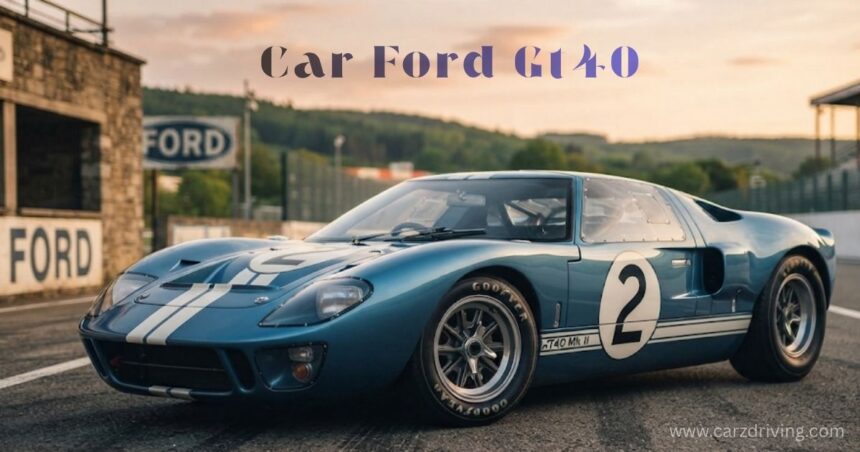
Every great legend starts with a wound to someone’s pride, and the Car Ford GT40 is no different. The story begins when Henry Ford II tried to buy Ferrari at the last minute, only to be turned away by Enzo Ferrari himself.
That single rejection lit the fuse for one of the fiercest feuds in automotive racing history, a battle now remembered simply as Ford vs Ferrari. Ford answered with Project GT40, a plan built to regain pride and beat Ferrari at its own game, on its own turf: Le Mans.
To make it happen, Ford set up Ford Advanced Vehicles, known as FAV, based in England, and pulled together some of the sharpest minds in the business.
Car Ford Gt40
Eric Broadley of Lola Cars brought his chassis knowledge, John Wyer came in as the motorsport engineer who could actually run a race team, and the Ford Motor Company supplied the muscle and the money.
Soon after, American veteran racer Carroll Shelby, an American designer with a nose for speed, joined the effort, along with driver Ken Miles, whose skill would later carry the car onto the world stage.
These were the humble beginnings of the Mk1, born in the mid-60s in Berkshire, and the whole saga was dramatic enough that it eventually became the subject of a Hollywood film, with the GT40 itself as the true star of the deal. From design to development, this was a project driven by one thing: pride.
Origins & Development History
The first real car to come out of this effort was the GT40 Mk1, developed from the earlier Lola Mk6 GT and powered by a 289 cubic-inch, 4.7L Ford V8 engine paired with a Colotti 4-speed gearbox.
Early outings were rough. At the Nürburgring 1000km in 1964, the car suffered reliability issues that ended in retirement, and things were no better at Le Mans 1964, where all three GT40s entered were struck by mechanical failures, proving that a fast car does not always make a finished endurance racer.
By 1965, Alan Mann Racing stepped in and built lightweight aluminum GT40s, known as AM GT-1 and AM GT-2, which became the lightest GT40s ever built.
These cars used an aluminium upper-superstructure built from Elektron, a magnesium alloy, along with a crossover fuel system and a reworked suspension featuring anti-squat, anti-drive, adjustable roll centres, and adjustable castor, all wrapped around the same small-block 289, 4.7-litre V8.
It was Alan Mann’s own cars that finally delivered a real victory at the 24 Hours of Le Mans in 1966, following strong showings at the Daytona 2000km and the 1965 Le Mans 24 Hours, where drivers such as Ken Miles, Lloyd Ruby, Innes Ireland, and Sir John Whitmore pushed hard despite ongoing engine failures and gearbox failures.
At the 12 Hours of Sebring, Frank Gardner brought a car home in seventh position after fighting clutch problems, while Graham Hill and Sir Jackie Stewart even qualified third on the grid before a valve failure ended their run, a reminder of how closely this project was tied to the wider world of Formula 1.
Ford refused to give up, and the answer to these setbacks was the J-Car, which grew into the Mk II GT40 and the road-eating 7.0-litre Mk IIs built with help from Shelby American.
The Mk2 carried a huge 427 cubic-inch, 7.0L engine producing 485 horsepower, matched to a purpose-built Kar-Kraft T-44 gearbox, with new air intakes and cooling systems fitted to stop the overheating that had plagued earlier cars.
The results came fast: a dominant win at the 1966 Daytona 24 Hours, followed by another strong result at the 1966 Sebring 12 Hours, where Ford finally looked like a real Ferrari challenger.
Ford sent no fewer than eight GT40s to Le Mans that year, riding on momentum from the success of the Mustang road-car range, and fielded two Mk2s carrying race numbers #7, driven by Brian Muir, and #8, which crossed the cheque flag with Dick Thompson at the wheel before being disqualified over a driving incident during qualifying.
Denny Hulme in Car #1 was told by Ford’s race organisers to slow for a staged formation finish, producing the famous 1-2-3 victory, though technical rules around race finishes later meant Bruce McLaren and Chris Amon in Car #2 were awarded the official win.
That result finally broke Ferrari’s dominance, and Ford backed it up with another 1-2-3 finish at the 1967 Daytona 24 Hours. The final chapter of the racing story belongs to the GT40 Mk4, which triumphed at the 1967 Le Mans, with the Mk4 GT40s proving to be the fastest cars Ford ever built for the job.
Behind it all sat Lola Cars, based in Slough since 1963, which had served as the premier chassis supplier for a car built around the Ford 289ci V8 engine in a mid-engine racer layout, using an aluminium monocoque as a stressed member with a distinctive Kamm-tail and a guillotine door design, all shaped under the guidance of Roy Lunn and later refined by JW Automotive Engineering. This was Henry II’s dream made real by a team of Brits determined to end Ferrari’s winning streak, and once Le Mans ’66 was won, the GT40 kept winning for the next three consecutive races.
What makes the original GT40 so special?
I recently spoke with Andrew Smith, who has spent over 10 years among Ferrari specialists and private collections, and he pointed me toward chassis 1029, a car once campaigned by Scuderia Bear under owner Bill McKelvy. This particular GT40 raced at Sebring and Le Mans in 1966, and survived an accident during qualifying without losing its original tub, which was later carefully restored.
Today it appears at events like the Goodwood Revival, the Le Mans Classic, and the Tour Auto in France, a demanding Tour de France-style five-day rally covering roughly 3,000km across 11 special stages on both closed roads and full circuits.
Andrew ran the car in 2017 and again in 2018, and remembers a gearbox issue that struck right on the last special stage, a tense moment for any driver competing in the pre-66 category and pre-73 category.
Even with that setback, finishing the event at all felt like a genuine achievement. The car wears a striking livery, finished in silver with a bold Tricolore stripe and the number plate 1 MUF, and Andrew still talks about tearing down the Mulsanne straight at four in the morning, the road pitch black except for the glow of the digital speedo reading 300km/h. It is, by any measure, a truly special car.
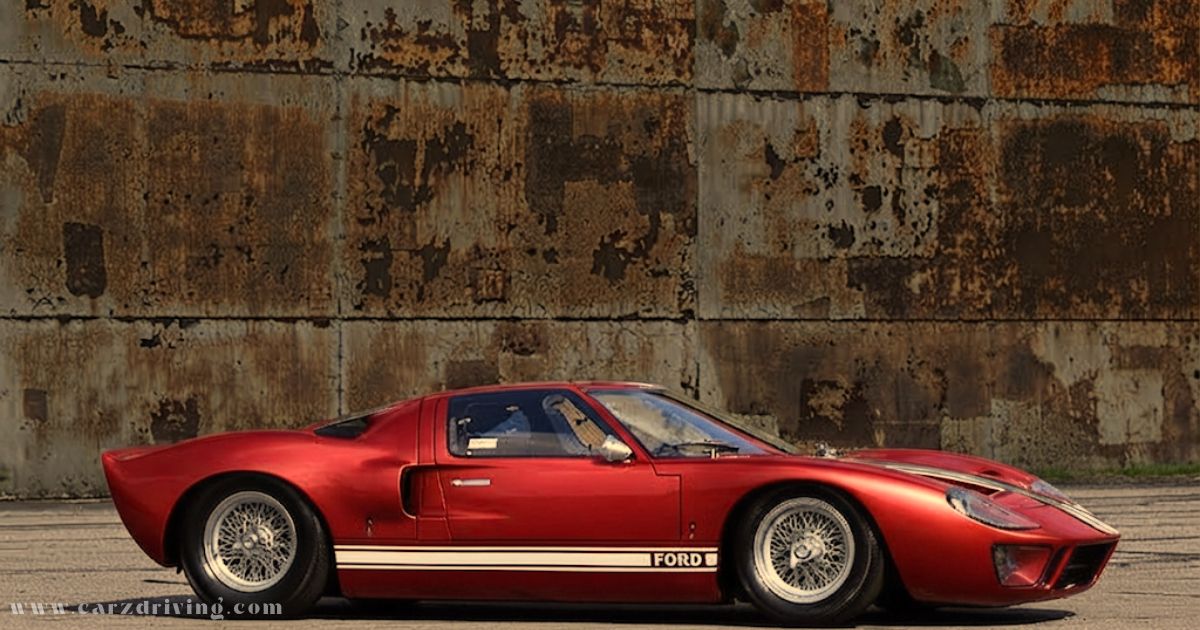
What is it like to drive?
Driving a GT40 is nothing like driving a modern machine, and behind the wheel it feels every bit the pure race car it was built to be, especially on something like the Tour Auto, where every special stage demands full concentration.
It is a big car with a very low chassis, and it can feel like a real handful until you learn to trust the robust chassis and the strength of the tub underneath you, particularly over rough speed bumps and undulations in the road.
Power comes from the 289 V8, producing somewhere between 400bhp and 450bhp, sent through a five-speed gearbox that lets the car accelerate hard down a straight; I still remember flying down the Hangar straight at Silverstone in fifth gear and feeling the whole car come alive.
It is a tough car and a genuinely heavy one, the kind that needs to be taken by the scruff of the neck rather than driven gently, but that is exactly what makes it so rewarding.
The low seating position, the angle of the steering wheel, the placement of the gear lever, and the awkward step over the sill all add to the drama, and the cabin itself is noisy and hot. Even so, it remains surprisingly usable; I have covered 100 miles in one sitting with nothing more than a pair of ear defenders for comfort.
Standing barely 40 inches tall, the GT40 is rightly called iconic, so admired that countless replicated cars exist today, much like the Cobra, and its race car design, penned by Eric Broadley of Lola, still stands as one of the all-time best design achievements in motorsport.
Have you ever owned a 2005 Ford GT?
Yes, and the 2005 Ford GT, with its thunderous V8, remains one of my favourite cars to have owned. It is a modern interpretation of the GT40, a proper modern-day update that captures the spirit of the original without simply copying it.
In terms of bang for buck and value for money, few cars come close, and it delivers a genuine sense of occasion every time you turn the key. Friends who have driven it have always raved about it, and I can only agree that it is, quite simply, a great car.
What attracted you to the new Ford GT?
The new Ford GT pulled me in through its deep roots in racing and its clever crossover into road cars, built to satisfy strict homologation rules while still chasing glory at Le Mans.
There is a bit of sandbagging that goes on in qualifying before the real race begins, and the car’s carbon tub houses a tight cockpit shaped almost entirely around aero efficiency, with room for just two people.
Compared with rivals like the 458 and the 488, this feels less like a soft road car and more like a race car wearing a softer version of its hardcore version, with barely any storage space beyond a small fuel tank. I remember Clarkson praising it too, and it is easy to see why: the car feels genuinely exclusive.
Ford built only 80 cars for 2018, sending just 12 UK cars into the country, with further batches following in 2019 and 2020, though emissions problems made later cars even harder to secure. That scarcity makes it rare and special, and I still enjoy watching the Tour Auto video and its coverage of the special stage, filmed over roughly six months of work.
Tell us about the spec
Choosing a specification for one of these cars and car ford gt40 is an experience in itself. Ford now let buyers explore options using CGI and VR headsets right inside a dealership booth, rather than relying only on traditional car showrooms and dealerships across the UK.
Everything from the interior trim to the lights is handled with real precision, thanks to Multimatic in Canada, who also manage ongoing service work, alongside the option of ordering online.
Buyers can choose from four interior options and five exterior options, along with different caliper choices and a sports exhaust setup, letting each owner truly personalise their car right down to the stripe.
My own preference leans toward Liquid Grey paintwork paired with a Light Speed interior, finished with blue Alcantara and leather seats, plus red calipers, red spinners, blue calipers, protective vinyl, and PPF for the paintwork.
It is easy to see the influence of cars like chassis 1029 here, since this is very much a modern interpretation of that racing heritage, echoing liveries such as the F12 TDFS and paying tribute through liveries inspired by the Tour de France, including a lovely 0585 homage.
FAQs of Car Ford Gt40
What is the Ford GT40?
The Ford GT40 is a legendary race car built by Ford Motor Company to beat Ferrari at Le Mans.
Why was the GT40 built?
Ford built the GT40 after Henry Ford II was rejected in his attempt to buy Ferrari, sparking the famous Ford vs Ferrari rivalry.
Did the Ford GT40 win Le Mans?
Yes, the GT40 Mk II delivered a historic 1-2-3 victory at the 24 Hours of Le Mans in 1966, ending Ferrari’s dominance.
Who designed the Ford GT40?
The GT40 was shaped by Eric Broadley of Lola Cars, with Carroll Shelby and driver Ken Miles driving its development on track.
What engine powers the Ford GT40?
The GT40 ran on a powerful Ford V8 engine, ranging from the 289 cubic-inch small-block to the mighty 427 cubic-inch Mk2.