

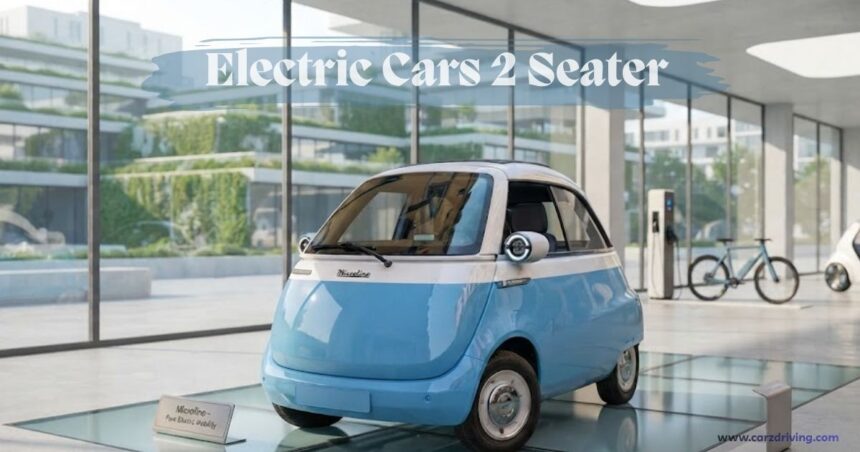
Every sports coupe or convertible in the electric cars 2 seater category shares certain qualities that separate it from the crowd.
Combine those traits with the usual EV essentials, and you get better efficiency than gas-powered models, quick acceleration backed by instant torque, and futuristic styling that turns heads on the road.
Add in stronger safety and richer comfort features than most modern speedsters, and you’ve basically got the full list.
Electric Cars 2 Seater
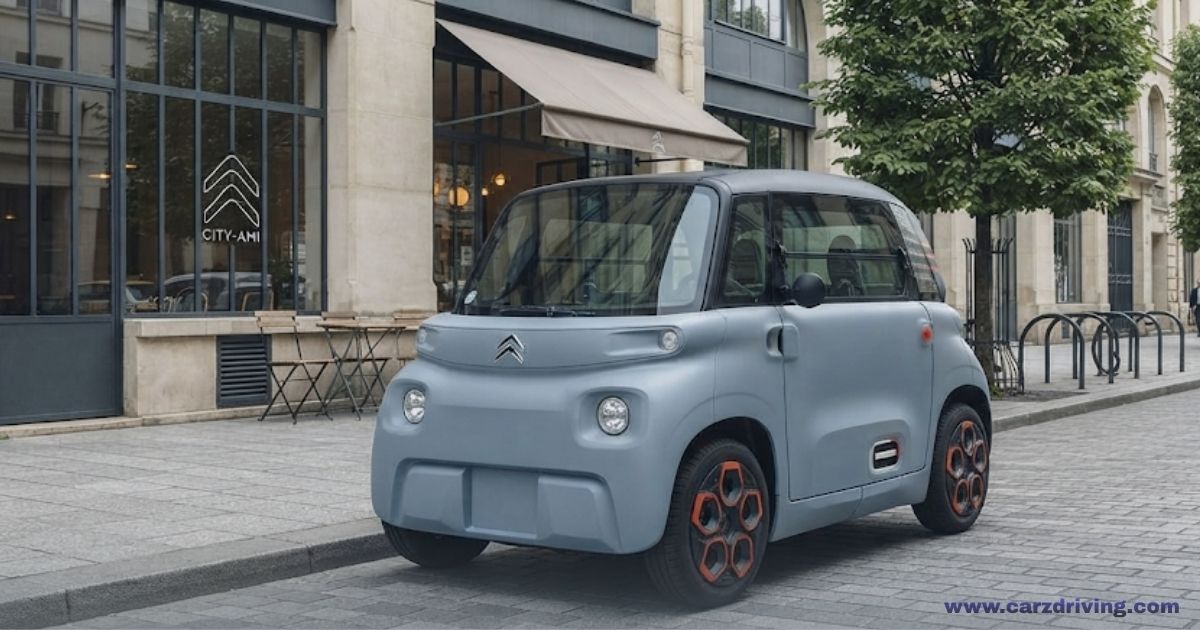
Citroën AMI One
My first ride in a Citroën AMI One happened on the streets of Coventry, and I still remember how tiny the little car felt next to normal traffic on busy roads.
Citroën unveiled this quadracycle at the Geneva Motor Show in 2020, and because of its small footprint at 2.41m long and 1.39m high, it fits perfectly into narrow city lanes built for urban motoring.
In France a 14-year-old can legally drive one, while here a 16-year-old could technically take the wheel, though nobody should mistake this machine for fast; its top speed sits around 28mph, safely under the 30mph limit that felt a bit vulnerable on faster stretches.
The 5.5kWh battery carries the car 43 miles on a single charge and needs only two hours charge time from a regular three-pin socket, which makes daily zipping around town with two aboard genuinely practical.
Buyers on the continent can pick one up through a subscription service or purchase it outright for 6000 euros, and UK availability currently remains TBC. Even so, I’d call the AMI One a cheap, utilitarian, clean way of making affordable electric motoring available to the masses.
Renault Twizy
The Renault Twizy felt ahead of its time when it launched back in 2012, and it became an immediate success, becoming the biggest selling plug-in car of that year with 9015 units sold, a small number by today’s standards but huge for a brand new idea.
As a daily commuter, the Twizy manages 50mph and travels 62 miles on a full charge, which takes about 3.5 hours from a three-pin outlet.
Priced from under £12k, or accessible through a car sharing scheme, this little Renault remains one of the most original urban EVs on sale, and honestly, I’d still call it the best today among small electric runabouts.
Smart EQ ForTwo
smart turned into an EV-only brand early on, and that decision made sense for a company already known for urban-orientated small cars.
Both of its models offer room for two, which earns the EQ ForTwo its spot on this list; at 2.69m long, it packs a 17.6kWh battery good for 80 miles, with an 80hp motor pushing it to 81mph, so it truly drives like a normal car, and you can even order it as a cabriolet.
The price is where things get tricky. Starting around £15k, the EQ ForTwo feels expensive for such a tiny car with short range, even though it comes with decent kit as standard.
Its bigger brother, the ForFour, shares plenty of the same hardware, but that biggest issue of cost stays the same across the range.
Microlino
Fans of the classic BMW Isetta bubble car will love the Microlino, built by Swiss firm Micro. Company research found that the average city dweller carries only 1.2 people and drives less than 20 miles per day, so the Microlino answers that need with two seats and flexible battery options.
The bigger pack delivers 125 miles, enough for six days of typical driving, while the smaller battery still manages 78 miles.
Micro already has a strong record in electric mobility solutions, having built electric scooters and three-wheeled mopeds long before this car came along, so the Microlino feels like a logical step forward. Once it clears type approval, it should reach sale for around £10,500.
E.GO Life
Coming from Germany, the e.GO Life represents mainland Europe’s take on the two-seater urban EV, and it has already sold in small numbers.
Buyers can choose between the 20 form, 40 form, and 60 form, fitted with 14.5kWh, 17.5kWh, and 23.5kWh batteries respectively, giving a driving range starting at 62 miles and climbing to 90 miles, with the highest spec version reaching 88mph.
Prices run from £13,790 up to £17,260, which puts it firmly in the same bracket as its rivals.
The road hasn’t been smooth, though. e.GO faced insolvency before a Dutch investment group stepped in during the autumn, rescuing it after a genuinely bumpy start. Thankfully, production, sales, and servicing are all running again now.
Toyota C+ Pod
Toyota’s C+ Pod stands out as the brand’s first pure EV, and it shows that Toyota still treats electrification as something of a curio rather than a core mission. Sold only in Japan, this mobility option targets short urban journeys, and its first customers will mainly be government bodies.
Measuring 2.5m long, 1.3m wide, and 1.5m tall, it looks a lot like the AMI One, but a 12bhp motor pushes it to 37mph.
The 9.06kWh battery pack gives a solid 93 miles of range with two on board, which feels generous for such a small runabout.
Uniti One
Designed in Sweden and engineered in the UK, the Uniti One breaks from the two-seat trend by offering three seats, yet it still plays the role of a city-dweller’s dream vehicle that can occasionally reach the suburbs.
A 67bhp motor pairs with a 12kWh standard battery for 93 miles range, while an optional 24kWh battery stretches that to 186 miles, thanks to remarkable efficiency of just 8kWh/100km and a light 600kg dry weight.
Charging feels genuinely quick too: 50kW charging adds 62 miles in only 10 minutes, and the 7kW onboard charger takes it from 20-80 per cent in just over two hours.
At a starting price of £15,100, the Uniti One offered real value, though the company has stayed rather quiet lately.
MeV Bee
Built in the UK, the MeV Bee short for Manchester Electric Vehicles launched with a clear goal: create a viable, small EV priced like a used VW Golf, somewhere between £8000 and £10,000, opening up zero emissions motoring to more drivers.
Engineers relied on recyclable materials and clever building techniques to keep both cost and weight down, resulting in something pleasantly light.
Sadly, news has gone quiet since launch, but in principle, this remains a genuinely good idea worth revisiting.
Lotus Evija
Nobody can really crown a best 2-seater electric car, but among the four options sold in the United States, the Lotus Evija stands out first. Lotus, a British sports car brand that has built lightweight two-seaters for decades, felt it only natural for this automaker to enter the EV world with a highly-competitive coupe.
Priced at $2,100,000 and built as a Coupe with Electric power, 4 Single Speed Planetary gearing, and Four-Wheel Drive, torque sits at 1,253 lb-ft while horsepower stays TBC and Fuel Economy is not yet listed; 0-60 happens in under <3.0 seconds.
Cars in this niche segment are rarely attainable, and the Evija is harder still because of its limited production run of just 150 units.
Four Electric Motors produce a staggering 2,011 bhp, which the brand calls the most powerful production car ever built, and that brake horsepower combines with all-wheel drive and strong traction to hit 60 mph from a standstill in under three seconds even quicker than the Rimac Nevera, and noticeably lighter yet more powerful.
Lotus cares about speed, but handling matters just as much, so electro-hydraulic steering delivers the stable, accurate experience that drivers expect from this EV brand. As for range, the Evija manages about 195 miles, or, as Lotus likes to put it, roughly 15 laps around the Nürburgring.
Pininfarina Battista
Remember that electric toy car that looked just like a real-life car model? Owning the Automobili Pininfarina Battista brings back that same joy you felt unwrapping presents on Christmas Day, except this insane electric hypercar costs roughly $2 million before any options, and those options alone can add hundreds of thousands of dollars.
Built as a 2023 Coupe priced at $2,200,000, running Electric power through a Single-speed Automatic and All-Wheel Drive layout with 1,900 hp and 1696 lb-ft of torque, hitting 60 mph in 1.8 seconds, the Battista sits in a class of its own within the Supercar world, thanks partly to its luxurious interior, a rare touch among hypercars that usually chase pure speed and handling alone.
Four Electric Motors work in conjunction to deliver 1,877 hp, or 1,877 horsepower if you prefer, launching the car to 60 mph in 1.79 seconds through raw power.
Reading that huge figure is one thing, but actually riding through the sprint is something else entirely, especially once the car reaches 217 miles per hour and the thrill truly kicks in.
Surrounded by an opulent interior, a minimalist dashboard, and a driver-focused layout, complete with quilted leather seats and brushed aluminum accents, the cabin ties the whole experience together.
Pininfarina B95
The second two-seater electric car from Automobili Pininfarina is the B95, a 2025 Convertible priced at $5,000,000, running Quad-Motor Electric power and matching the Battista’s 1,877 hp with four motors, sprinting to 60 mph in <2 sec and firmly earning its place among the Supercar elite on this list.
Its shape echoes the Ferrari Monza SP2, missing a windshield and showing off high rear wheel arches among other exterior features, though calling it a Ferrari would be inaccurate; instead it delivers an all-electric open-roof experience that starts well past $5 million.
Four Electric Motors and no roof make the B95 a genuinely spectacular showpiece, the kind of car you’d expect to see parked at Pebble Beach rather than driven daily, since so many buyers treat these cars as investments instead of true driving machines.
Even so, it still reaches 186 mph like a proper hypercar, and the driver sits behind a carbon fiber dashboard trimmed with houndstooth-pattern backrest upholstery against tan leather, plus other comfort features, all while offering about 300 miles of range in its calmest drive mode.
Rimac Nevera
Rimac shocked everyone with the record-shattering Nevera, and this two-seat electric car doesn’t just impress by EV standards it counts among the most impressive vehicles ever built anywhere.
Built as a 2023 Coupe priced at $2,400,000, running Electric power through a single-speed direct drive and All-Wheel Drive setup, with 1,914 hp and 1740 lb-ft of torque, Fuel Economy TBC, and a 1.74 Seconds sprint to 60, this true electric hypercar gave the automaker more than enough power, all-wheel-drive grip, and monocoque construction to crush records straight out of the factory.
It holds the fastest-ever 0-249-0 mph sprint, completed in a mere 29.93 seconds, beating the previous record holder by over a second, and that 1.74-second 0-60 mph launch makes it the fastest production car ever recorded.
Four Electric Motors work in tandem, combined for 1,914 horsepower, proving that strong acceleration doesn’t always mean weak top-end speed; the Nevera keeps pushing against aerodynamics all the way to a top speed of 258 miles per hour, beating many professional drag racers with its 8.25-second quarter-mile on the track.
Despite all that, it stays surprisingly drivable on the street. Sure, it’s still a hypercar, so don’t expect it to feel as comfortable as everyday electric vehicles, but double-wishbone suspension and electronically controlled dampers keep it genuinely livable once dialed into Comfort mode.
What To Consider When Buying Electric Cars With Two Seats
As the charging network grows across the country, more people gain access to electric cars, so owning an EV sports car no longer feels unrealistic.
Weighing the pros and cons helps: on the plus side, you get ludicrous acceleration figures, nimble handling, and generous comforts built into that higher price tag, along with better efficiency than old ICE hypercars.
On the downside, most stay expensive, offer lower overall range than mainstream EVs, and honestly feel a little less exciting to drive than traditional gas-powered EVs.
Birò
Available in the UK electric cars 2 seater, the Birò claims the title of the first 100% electric, 4-wheeled personal commuter with a removable battery, and it treats safety as a top priority by making a steel tubed frame the backbone of the whole design;
that steel tubing shapes a cabin that stays strong and resistant, while disk brakes all around handle the job of stopping without drama.
Being zero emissions, this electric motor produces no noise pollution and zero petrol consumption. I used to commute in an SUV that took 40 minutes each way, but the same trip now takes about 7 minutes in a Birò.
That’s the real power of freedom. Driving vision feels wide open thanks to transparent surfaces offering nearly 345-degree vision, plus real comfort packed into an ultra-compact space through a supportive headrest and armrest.
As a 2 seater city car, it gives protection against tough weather conditions, and on sunny days you can open the roof and windscreen, or even remove the side doors, letting cool air and light flow through as you move around the city for daily mobility.
Recharge your energy with ease, because the Re-move system relies on a lithium battery system you can pull out right after parking; the battery unit comes free for real convenience, letting you charge batteries at the office or home with total ease.
This setup makes for genuinely fast charge and long range driving, all while staying quiet on the way.
Top speed reaches 25 mph, and the Lithium Maxi Battery delivers 62 miles on its 44.4 V non-removable battery, while the Lithium Re-Move pack manages 34 miles instead. A fixed battery needs a charging time of 3-6 hours on 110v, and the removable pack takes just 2-4 hours.
For sales questions or to book a test drive, several re-seller dealerships cover major city areas; simply fill in the form for enquiries, and someone will get back to you shortly.
FAQs of Electric Cars 2 Seater
What is the fastest electric cars 2 seater?
The Rimac Nevera holds the crown, sprinting to 60 mph in just 1.74 seconds with a top speed of 258 miles per hour.
Which electric cars 2 seater is best for city driving?
The Citroën AMI One and Birò shine here, offering a small footprint, zero emissions, and effortless zipping through narrow city streets.
How much does a 2 seater electric car cost?
Prices swing wildly, from the affordable Microlino at £10,500 to the jaw-dropping Pininfarina B95 at $5 million.
What is the range of a 2 seater electric car?
Range varies by model, with the Renault Twizy managing 62 miles and the Lotus Evija stretching to 195 miles on a charge.
Are 2 seater electric cars practical for daily commuting?
Yes models like the smart EQ ForTwo and MeV Bee bring genuine convenience, low cost, and clean, everyday commuter freedom.