

Strut replacement sounds like a dull repair until a worn strut turns your Charlotte commute into a bouncy, nervous drive. Your shocks and struts work hard whenever you cross a patched street, hit a pothole, or merge onto I-77. This guide walks you through the clearest warning signs, so you can act before small problems grow into expensive repairs.
What Do Struts Actually Do in My Car?
Struts absorb road impacts, hold your tire contact steady, and give your suspension system a firm backbone. Each one packs a shock absorber, a coil spring, and a mounting plate into one unit. Struts also provide vehicle weight support, so they carry real load every mile.
The spring takes bumps and dips and weight shifts first, then the strut tries to control spring movement and dampen spring movement before the next hit arrives. That job keeps body motion small and your vehicle control steady. When a strut fades, your spring response turns bouncy and the whole car feels loose.
How Are Shocks and Struts Different?
In the shocks vs. struts question, the short answer is simple: a strut works as a structural component, while a shock works as a standalone component. A shock bolts between the frame and the axle and relies on separate springs. A strut carries load and also shapes your steering geometry, which is why it adds structural support.
Many cars use struts up front and either struts or shocks in the back. Check your owner’s manual to confirm your suspension type, or look behind a front wheel for a spring wrapped around a thick cylinder. Trucks and some SUVs add a leaf spring or an overload spring, which changes how they carry weight.
Which Other Parts Can Fake Bad-Strut Symptoms?
Several neighboring suspension components can copy strut symptoms, including bushings, ball joints, control arms, and sway-bar components, which all sit near the strut. Worn strut mounts and tired steering components also cause clunks and wander. A proper diagnosis sorts the suspects before anyone orders parts.
Even your tires can mislead you. Low tire pressure, poor tire inflation, a damaged tire condition, or a skipped tire rotation history can all create odd wear, and a failing wheel bearing can add a hum you might blame on the wrong part. Check these basics first, since they cost little and narrow the search.
Why Does My Car Keep Bouncing After Bumps?
Excessive bouncing is the classic sign, and you will feel the car keep rocking after one dip. A healthy strut settles the body in one or two motions. A tired one lets the car float and ruins your ride quality.
Charlotte’s patched streets, uneven roads, speed bumps, and shifting road conditions make this easy to notice. You may also feel a floating sensation on the highway, and your ride comfort slips away so slowly that you stop noticing. Plenty of drivers only catch it after riding in a friend’s newer car.
What Does a Clunking Noise Mean?
A clunking noise over bumps usually points to a worn strut, a loose mount, or tired internal valving. Some drivers hear knocking over bumps instead, especially at a railroad crossing. Either way, book a check soon, because the noise rarely fades on its own.
When the strut wears out, parts can slap together in metal-on-metal contact. That harsh noise over bumps gets louder as the damage grows. A quiet cabin after the repair tells you the fix worked.
Why Does My Car Dive When I Brake?
Nose-diving when braking means your front struts can no longer hold the car level. The nose drops, and weight transfer shoves too much load toward the front wheels. That shift gives you a longer stopping distance when traffic stops short.
Worn struts also cause rear squat during acceleration, where the back sinks and the front lifts. Both problems trigger a loss of traction at the front tires, so you may see increased stopping distances and reduced braking performance. Hard stops in stop-and-go traffic on Independence Boulevard show the problem fast.
What Do My Tires Reveal About Worn Struts?
Uneven tire wear is one of the easiest signs to catch with your own eyes. Worn struts let a tire hop as it rolls, which carves cupped tire wear into the tread. Run your hand across the rubber, and you may feel a scalloped wear pattern like small waves.
Failing struts keep producing irregular wear patterns, and premature tire wear follows. That wear cuts tire life and adds road hum. Check your alignment too, since a bad one can imitate the same patterns.
Does a Wet Strut Always Mean a Leak?
Not always. Fluid leakage matters when you see a wet streak or an oil film running down the unit, because that points to a leaking seal. A light, dusty film can look scary and still mean little, so judge the amount, not just the sight.
Look for wet or oily residue along the shock body and judge how much has escaped. Once the hydraulic fluid drains, damping performance drops quickly. Compare the leak with how the car rides, since damping capability tells the real story, and a failed seal never heals itself.
Why Does My Steering Feel Strange?
Pulling to one side or wandering steering can point to a bad strut, bad alignment, or a tire problem. Many drivers also notice changes in steering response, like a delayed turn-in. Because several causes overlap, you need an inspection instead of a guess.
Worn struts bring reduced steering response, poor handling, and an unstable ride in crosswinds. You may also feel swaying during turns, unpredictable handling during lane changes, and vibration through the wheel. Take steering concerns seriously, because they affect every emergency move you make.
What Other Warning Signs Should I Watch For?
A rough ride that keeps getting worse is a red flag, and deteriorating ride quality rarely fixes itself. Check your ride height too, because sagging springs make one corner sit low. These changes build through gradual wear, so they sneak up on you.
Walk around the parked car and spot worn components, loose components, or damaged components. Check again after a pothole impact or curb impact, since one hard hit can start the damage. Write down what you find so your mechanic gets the full story.
How Do I Do a Bounce Test at Home?
Push down hard on one corner of your parked car, then let go and count the bounces. If the body bounces more than twice, that strut has likely worn out. This bounce test takes about 30 seconds, costs nothing, and needs no tools.
Repeat it at all four corners and compare. Follow up with a short road test on a quiet street, then finish with a visual inspection using a flashlight. Jot down a symptom review so you can describe each noise and when it happens.
When Should I Book a Professional Inspection?
Book a professional inspection as soon as two or more signs appear together. A qualified technician can run a suspension inspection and measure what you can only guess. Many shops also offer a comprehensive inspection that covers the entire front end.
Good shops use diagnostic tools and advanced diagnostics to find the root cause. Ask for a related components inspection so nothing hides behind the obvious symptom.
What Should I Tell the Mechanic Before the Visit?
Tell your mechanic what you feel, where you feel it, and when it happens. Mention your speed, the road surface, and whether the sound comes from the front or the back. Specific notes save time and help the technician zero in fast.
Bring your service records and any recent parts receipts. Say if you hit a nasty hole last month or started hauling extra weight. Small details like these often explain a symptom that looks mysterious at first.
How Many Miles Should Struts Last?
Most cars need new struts between 50,000 to 100,000 miles, though the exact number depends on the vehicle and the road. Treat 50,000 as your first checkup, not a deadline. This mileage interval gives you a range, not a promise, so watch the symptoms too.
Every car has its own inspection interval and replacement interval, so check your service records. Your struts’ service life also depends on how and where you drive. Rough city streets can push you toward the early end of that range.
What Shortens Strut Life Around Charlotte?
Rough roads, construction zones, and patched pavement wear struts faster than smooth highway miles, because each jolt travels through the springs and dampers. Every hit adds to your impact cycles, and the count climbs quickly. Charlotte’s steady building boom gives drivers plenty of all three on daily routes.
High temperatures and heat also hurt, since thin hydraulic fluid damps less effectively, and Charlotte summers often reach the 90s °F. Heavy cargo, towing a trailer, and any extra load push the rear harder. Aggressive braking, a rough driving style, and tough driving conditions wear parts even faster.
Can I Make My Struts Last Longer?
Yes, a few habits help you stretch strut life. Slow down for rough patches, avoid curbs, and clear junk out of your trunk. Smoother driving costs you nothing and spares every moving part.
Rotate your wheels on the schedule your manual gives and keep your pressure right. Those habits spread wear evenly and make strut trouble easier to spot. A quick look under the car at each oil change adds one more layer of protection.
How Long Does the Job Take?
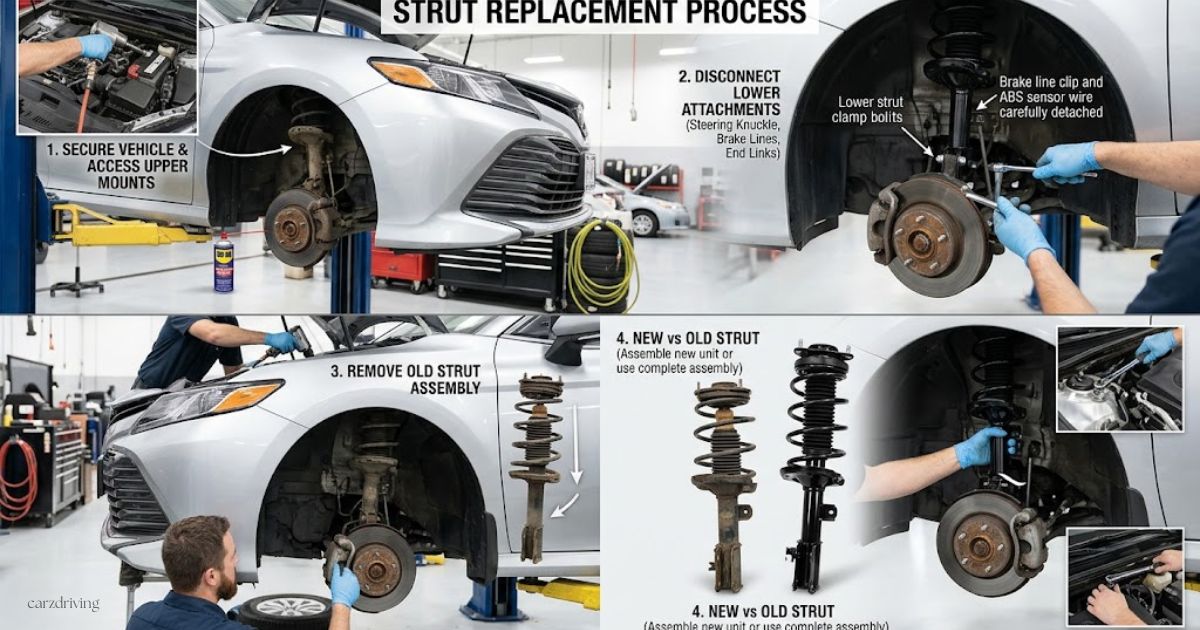
Most shops need about two to three hours per axle, and some quote 2 to 4 hours depending on the car and its age. Your vehicle make and model sets the clock for the whole job. A complex suspension design adds time because parts sit in tight spaces.
The installation time also depends on rust and bolt condition. Technicians compress coil spring tension with a special tool, and that spring compression step demands care. They remove and reinstall each part in order.
Should I Buy Complete Strut Assemblies?
A complete strut assembly works well for most drivers because it bundles the strut, spring, and mounting hardware. A quick strut arrives as a pre-assembled unit, which saves labor. Either route beats mounting a new strut on a tired spring.
Pick quality parts or premium parts, and look for OE-equivalent parts. Lower-grade parts may ride fine at first but wear out much sooner. Ask for a repair warranty in writing before you approve the job.
Do I Have to Replace Struts in Pairs?
Yes, you should replace in pairs, meaning both struts on the same axle pair. Pick both fronts or both rears, never one corner alone. A single new strut next to an old one makes the car pull and handle oddly.
If your front struts are bad but the rear shocks feel fine, leave the back alone. Balanced handling needs matching units on each front axle or rear axle. Matching pairs also keep stability and cornering predictable.
Why Does My Car Need an Alignment After Strut Replacement?
Yes, you do, and you should not skip it. New struts change your suspension geometry slightly, and that suspension geometry change shifts your wheel alignment angles. Ask for an alignment check right after the repair, on the same visit, before you drive away happy.
Skip it and you risk uneven wear, pulling, and weaker handling. An alignment adjustment brings the angles back in line and protects your new parts. If you still have alignment concerns after the job, go back and ask the shop to recheck.
How Much Should I Expect to Pay For New Struts, And Is It Worth It?
Strut Replacement prices vary by vehicle and parts, so ask for a written estimate before work starts. A detailed estimate lists parts, labor, and alignment, and clear pricing means no hidden fees. Compare at least two shops before you decide, and ask what each quote includes.
Yes, it is worth it, because delays cause secondary damage and push your repair cost higher. Request professional installation, solid workmanship, and post-repair testing so you know the car works as intended. Ask about repair options too, since some cars need only one axle done.