

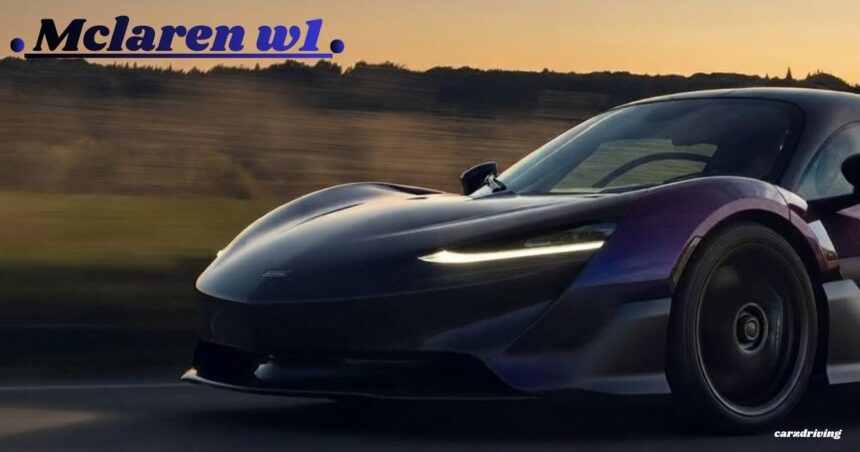
I still remember the first time I heard about the McLaren W1 running laps at Mugello, and honestly, the number 205mph stuck in my head for days. This isn’t just any track it holds FIA grade one status, has hosted an actual F1 race back in 2020, and even welcomes MotoGP. Ferrari owns the place, so there’s a quiet rivalry sitting in the background every time a McLaren shows up there.
Behind the wheel, McLaren Automotive’s chief development driver Dani Marcos pushed the car hard enough that the GPS correlation suggested speeds close to F1-adjacent territory, even after accounting for some rounding.
McLaren driver coach Charlie Hollings rode along too, and his experience training actual F1 drivers tells you everything about how seriously this car is treated. The track itself throws blind crests, elevation changes, and a brutal turn one off the main straight right at you, which is exactly the kind of challenge the W1 was built to eat up.
Out on track, you notice the total absence of inertia almost immediately the car just wants to turn-in. Through corner exits it squirms slightly before gathering momentum with a kind of mechanical ferocity that no EV can fake. In dynamic mode, the W1 rotates naturally under load, and with variable drift control offering 15 levels of ESP intervention, drivers can dial in exactly how much drift they want without things going sideways unexpectedly.
The numbers back up the feeling: 62mph disappears in a hurry, 124mph arrives in 5.8 seconds, and 186mph takes less than 12.7 seconds a full three tenths quicker than the F80 and three seconds faster than the McLaren Senna around Nardò.
The hydraulic steering carries a reworked torsion bar for extra feel, a clear step up from the 750S benchmark, while the front end talks through your forearms and the rear wheels talk through your shoulders. That’s 1258bhp running through the back axle alone, yet it never feels knife-edgy like the 765LT it’s more approachable, more analogue, despite all the hi-tech underneath.
Braking is its own story. The McLaren Carbon Ceramic-Racing+ setup uses 390mm discs with a ceramic layer, six-piston calipers up front and four-piston calipers at the rear, plus F1-style cooling ducts to keep temperatures in check.
Stopping from 124mph takes just 100 metres, and from 62mph it’s 29 metres numbers that make the maximum braking feel genuinely bulletproof. Around the chicane, taking more kerb, hitting 193mph near the crest, the stability under braking is honestly breathtaking.
Away from Mugello, the roads nearby the Raticosa pass and Futa pass are steeped in Mille Miglia history, full of unpredictable camber changes and blind corners. The W1 somehow stays composed and absorbent here, letting you brake deep with confidence.
Even at high speed through tunnels on the autostrada, with exhaust wailing and the cabin humming with proper NVH, holding a conversation stays easy the engine note isn’t the most musical against the F80 sonically, but it’s close.
On the road, Comfort mode makes the W1 as easy to live with as a McLaren Artura, and the suppleness shames plenty of saloons. Chief engineer Andy Beale describes it as a car that will “breathe with the road,” and product manager Heather Rhodes insists it’s meant to be “equally good on road”.
I’ve sat through passenger laps in a Ferrari 488 GT2 before, and even that didn’t prepare me for how approachable this much grip, clarity, and body control could feel across 20-minute sessions. The aero does real work in fast corners, and compliance over rough terrain never disappears. It’s the kind of car that turns high performance into something you can actually use, not just admire from a TG-style highlight reel.
Mclaren W1 Interior
Stepping inside the W1 feels dramatic before you even sit down, thanks to the gullwing doors replacing McLaren’s usual setup. The cushions attach straight to the carbon tub, which saves weight and makes you feel properly wired into the chassis. A small lever moves the pedal box, while the steering wheel and instrument panel adjust electrically adjustable.
The sprung pedal box pushes back until it’s comfortable, and the brake pedal sits just past vertical under full load tiny details that show up everywhere here. Visibility stays strong despite how low you sit, helped by the thinnest A-pillars McLaren has built and big mirrors; there’s no rear glass, just a mirror-camera setup instead.
Behind the driver and passenger, there’s room for luggage space, and the fixed seat structure shared in spirit with the Ferrari F80 passenger seat, the Aston Martin Valhalla, and the Morgan Super 3 trades seatback angle adjustment for lighter weight and better rigidity.
The optional InnoKnit trim sweeps across the sills and cockpit like fabric, offering a sustainable, technical-feeling option instead of leather or Alcantara.
A cantilevered door fin blade frees up interior space, and the carbon fibre sun visors measure just 3mm thick. The window panel built into the door roof section is a small but clever touch, and the flat topped, flat bottomed round wheel carries just two buttons one for the Boost function, one for the aero adjust button.
Rocker switches on the instrument binnacle handle drive modes, and that same binnacle acts as a flow diverter, sending air where it’s needed the air con genuinely works well. The high-res touchscreen, an 8in touchscreen sitting between driver and passenger, avoids any screen envy given everything else the car offers.
Apple CarPlay works alongside USB-C and USB-A ports, plus cup holders and central storage space, because even a hypercar needs somewhere for your keys. Fold the head-rests down and you get 118-litre storage space enough for weekend bags, though not much more.
There’s a seat squab gap for the optional five-point harness, and with standard three-point inertia belts, an insert covers the hole so you don’t lose pens, wine gums, or microphones down there.
The ticket window, a byproduct of aero requirements, is the only real compromise the last car I remember with anything similar was the DeLorean, and the W1 handles it far better. Squabs sit in the car’s own spaces, and a section of the carbonfibre box under your thighs even houses the subwoofers. It’s a cabin that rewards attention to detail more than flashy infotainment ever could.

Design & Styling
The W1’s chief engineer Andy Beale walked me around an unclothed W1 in the garages at Mugello circuit, just 70 miles from Maranello close enough to Ferrari that people will read into it either way. At the front, an aluminium crash structure carries the bodywork and several cooling radiators, while the suspension and steering rack bolt directly to the carbonfibre tub.
That tub uses pre-preg carbonfibre, laid up through a labour-intensive process rather than the usual resin injection-moulded, dry lay-up method McLaren normally uses for high volume production. With only 399 units ever planned, that trade-off makes sense. Torsional rigidity comes in at 44kNm/degree, and the tub weight, including metal inserts, comes to just 70kg.
Double wishbones sit front and rear, paired with coil springs and adaptive dampers no 48V system, no linked hydraulics, no inverters, because Andy Beale was clear that all of that adds weight nobody wants. Pushrods at the front keep the damper units lower, dropping the scuttle and the driver without hurting visibility, and the same pushrods cut unsprung mass while clearing space to cool the brakes.
The ride height system offers Comfort mode and Sport mode with different damper stiffness, but leaves the coil spring rate untouched until Race mode engages the heave bars. A telescopic bar connects through torsion rods up front; in high ride height it slides freely, but locked in Race mode, it stiffens the spring rate considerably.
The rear uses a transverse heave bar with drop links that only lock rigid in Race mode, working around the suspension forces created by the engine and transmission layout.
Because of brake cooling needs, McLaren skipped its usual dihedral-opening doors the hinges would sit in high airflow zones and used gullwing doors instead. A movable front splitter and active rear spoiler move the rear wing 300mm back at full extension, feeding the diffuser; this configuration isn’t road-legal, so it’s geofenced to circuits or static display only. Overall downforce caps at 1000kg, bleeding off naturally at higher speed.
Measuring 4635mm length and 2191mm width across the mirrors (2074mm with them folded, barely wider than body width), the W1 wears its proportions with purpose rather than excess.
Engines & Performance
Heather Rhodes, the W1 product manager, insists the engine is properly new, and the specs back her up. Designated MHP-8, it’s a 4.0-litre, oversquare engine with a flat-plane-crank V8 layout — 92mm bore, 75mm stroke, 3988cc total built from aluminium with spray plasma-coated bores instead of sleeves, letting engineers cut cylinder spacing and shave 40mm off the block shorter design.
Turbocharged to make 916bhp on its own, it skips electric turbos entirely because they’d add 30kg in the wrong place. A radial-flux electric motor mounted beside the eight-speed gearbox adds 342bhp, bringing peak power to 1258bhp. In everyday driving, the motor handles torque-fill; push harder and it works across the rev range up to the 9200rpm rev limit.
A 1.384kWh battery normally keeps some charge in reserve for torque filling and reverse, but the Boost button unlocks everything at once, and Sprint mode lets you drain the battery fully for one committed lap. At the back, a straightforward hydraulic limited-slip differential manages power through rear tyres, while 390mm discs with six-piston front calipers and four-piston rear calipers handle stopping duties.
Wheel sizes run 9.5Jx19in fronts and 12.0Jx20in rears, wrapped in Pirelli P Zero rubber, stickier Trofeo tyres, or even winter tyres — 265/35 R19 front, 335/30 R20 rear. The numbers speak for themselves: 60mph in 2.7 seconds, 124mph in 5.8 seconds, 186mph in 12.7 seconds, and an electronically limited 217mph top speed, capped because faster would need a different tyre structure.
Despite that, the car stays rear-driven and genuinely usable even in hot and sticky conditions on a high-speed circuit, the power never feels like it’s fighting you.
The engine note carries a bwoap tone that’s more interesting than older McLaren V8s, and the gearshift picks tall gears smoothly in auto mode, or snaps cleanly through the paddles when you take over yourself.
MPG & Running Costs
All 399 allocated cars sold quickly, which says a lot about how future residual values might hold up despite the £2 million list price, taxes included.
Buyers didn’t stop there either the average option spend reached £600,000, with some hitting the peak option spend of £900,000, almost entirely on bespoke personalisation since there aren’t really mechanical option changes to buy. Every McLaren dealer can handle servicing, which keeps ownership simpler than you’d expect for a car at this level.
Verdict
The W1 blends tremendous performance with real approachability, something not every hypercar manages. Its steering, brakes, and ride all feel exceptional, and the high-quality cabin backs that up with straightforwardness of feedback and natural agility built in from the start.
Against rivals like the Aston Martin Valhalla and Ferrari F80, the W1 carves its own identity the Valhalla feels willingly silly and less serious, while the F80 leans into being a precise, fast, aero-heavy race car. None of that makes the W1 less enjoyable; if anything, the engineering cost and wide car dimensions feel justified once you’ve spent real time behind the wheel.
Whether it’s the mammoth power, the time spent in the pit lane, or simply how naturally it handles, the W1 earns its spot among genuine greats even without a single definitive answer on which hypercar in this trio is truly “best.”
Technical Specs
Priced at £2,000,000, the Mclaren W1 pairs a V8 engine 3988cc, twin-turbocharged petrol plus an electric motor with an 8-speed dual clutch automatic transmission running rwd. Combined power reaches 1258bhp (916bhp at 9200rpm from the engine, 342bhp from the motor), while torque hits 988lb ft between 4500-5000rpm (664lb ft engine, 324lb ft motor).
Claimed weight sits at 1399kg dry, with 0-62mph dispatched in 2.7 seconds and a top speed of 217mph. CO2 comes in at 310g/km, and the W1’s natural rivals the Aston Martin Valhalla and Ferrari F80 sit right alongside it in this rarified corner of the hypercar world.
FAQs
How fast is the McLaren W1?
The McLaren W1 hits 60mph in 2.7 seconds and reaches a thrilling 217mph top speed, powered by 1258bhp.
What engine powers the McLaren W1?
It runs a 4.0-litre, twin-turbocharged flat-plane-crank V8 paired with a radial-flux electric motor for 916bhp plus 342bhp combined.
How much does the McLaren W1 cost?
The McLaren W1 carries a £2 million list price, with buyers often adding bespoke personalisation worth hundreds of thousands more.
Is the McLaren W1 rear-wheel drive?
Yes, the W1 stays exclusively rear-driven, giving it uncorrupted steering and a genuinely agile, linear feedback feel.
How many McLaren W1 units were made?
Only 399 units of this hypercar were ever built, and every single one sold out almost instantly.