

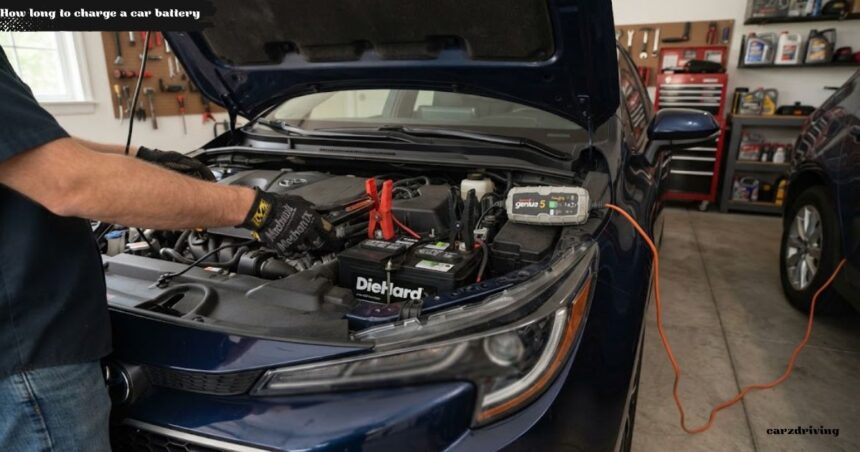
Anyone who has turned the key on a cold morning and heard nothing but a click knows the sinking feeling of a dead cell, and immediately starts wondering how long to charge a car battery before it’ll start again.
Over the years of running chargers on everything from small runabouts to old classics, I’ve learned that the answer to “how long will this take” is never one single number it depends on the battery, the charger, and even the weather outside. Below is a full, practical walk-through of everything that affects charging time.
How Long to Charge a Car Battery?
As a ballpark figure, most car batteries need somewhere between one hour and a full day to reach a full charge, and the exact number depends heavily on the size of the battery and the battery type you own.
A standard 12V, 60Ah battery that is deeply discharged can take about 24 hours on a slow A2 trickle charger, while the same flat car battery hooked up to a 10A unit often gets a useful charge back in three to four hours.
The general rule of thumb is that a discharged battery sitting at a low charge will need roughly 5-6 hours on a mid-range unit, though the charger output, charger type, and the mode of charging you choose all shift that number up or down.
Jump Starting Vs Charging the Battery
A jump start is not the same thing as a proper recharge, and knowing the difference matters when you’re dealing with a failing battery out on the road.
To jump start a car, connect jump leads from a second battery or a booster car, matching positive terminal to positive terminal and negative terminal to negative terminal, then run the engine so the alternator sends power back into the flat cells; this gets you moving quickly in emergencies, but simply letting the vehicle tick over afterwards risks overworking the alternator without giving a genuine boost charge.
If the battery is only partially discharged, the engine and alternator can often top it up on their own, though one that no longer manages to hold a charge properly really needs a mains charger applied straight to the battery terminals rather than relying on driving alone to start the car.
Types Of Battery Chargers
Chargers come in a few distinct families, and picking the right one protects your battery lifespan instead of shortening it through careless overuse. A plug-in, conventional charger sometimes called a linear charger pushes a fixed current into the battery cells at a low power output,
such as 0.8 amps or 4 amps, which suits everyday drivers who just want a quick burst overnight rather than getting stranded in an emergency; leave it on a wall socket for around 12 hours and it delivers a slow continuous charge, but because it has no controller built in to stop the process, you must manually unplug it to avoid an overcharge and possible damage.
A trickle charger runs at even low current and suits stored vehicles or anything laid-up over winter, keeping cells topped up without long-term damage.
By contrast, a multi-stage charger also sold as a range multi-stage charger or modern smart charger uses a built-in controller to monitor amperage and charging rate automatically, shifting from high current for extra charging speed to a gentle maintenance mode once the vehicle is nearly full, which is exactly why classic car owners reach for a boost charger with full power settings when reviving a truly dead battery, all while protecting overall battery health.
Charging While Driving
Driving the car is one of the most natural ways of replenishing a drained battery, because the engine turns mechanical energy into electrical energy through the alternator while you’re on the move.
A steady 20-30 minute drive along motorways or A-roads, rather than just idling in traffic, gives an adequate charge and better alternator performance, since higher engine speed pushes more current back in over that duration; a quick half an hour trip is roughly the initial charge time needed before longer short trips start helping the car usage cycle instead of draining it further.
That said, running the radio, lights, air conditioning, a heated rear window, and other electrical items or electronic instruments all at once means a low battery in a car with a faulty battery or a poor condition of the battery may never reach a full recharge over long periods, so being in good working order matters just as much as the driving itself.
What Causes a Battery to Go Flat?
Several everyday habits and conditions cause a flat battery, and knowing them helps you avoid repeat trouble. Lights left on overnight, a fault in the electrical system, or ordinary battery drain from accessories are common culprits, while corrosion on the terminals and simple wear and tear slowly weaken the cells until an old battery can no longer hold its charge.
Sometimes even a fairly new battery can battery fail early because of a faulty battery straight from the factory, and in that case no amount of charging will inject new life into it replacement is the only fix once cold weather exposes the weakness.
How Long Does It Take to Charge a Car Battery with A 12 Volt Charger?
A standard 12 volt charger typically brings ordinary car batteries to a full charge within about 12 hours, though this shifts with the unit’s output. Interestingly, this differs a lot from an electric vehicle, where a rapid charger delivering around 48 amps can push the pack to 80% in as little as 30 minutes, showing just how far apart charging technology sits between a regular 12V battery and an EV pack.
Can A Completely Dead Battery Be Recharged?
Yes in most cases a dead battery can completely recharge with either a jump start, a push start on manual cars, or a dedicated charger left connected for several hours. Once revived, letting the engine idle for a short while with all electrical items switched off helps confirm the battery is back in good working order before you trust it again.
Is It OK To Charge a Car Battery While Still Connected?
Modern chargers make it perfectly safe to leave the terminals connected while recharging at home, provided the car is garaged in a safe place away from sparks or damp. This convenience largely negates the need to disconnect the electric cables every time, though it’s still worth checking your manufacturer’s advice for your specific vehicle.
Charging A Car Battery 4 Things to Remember
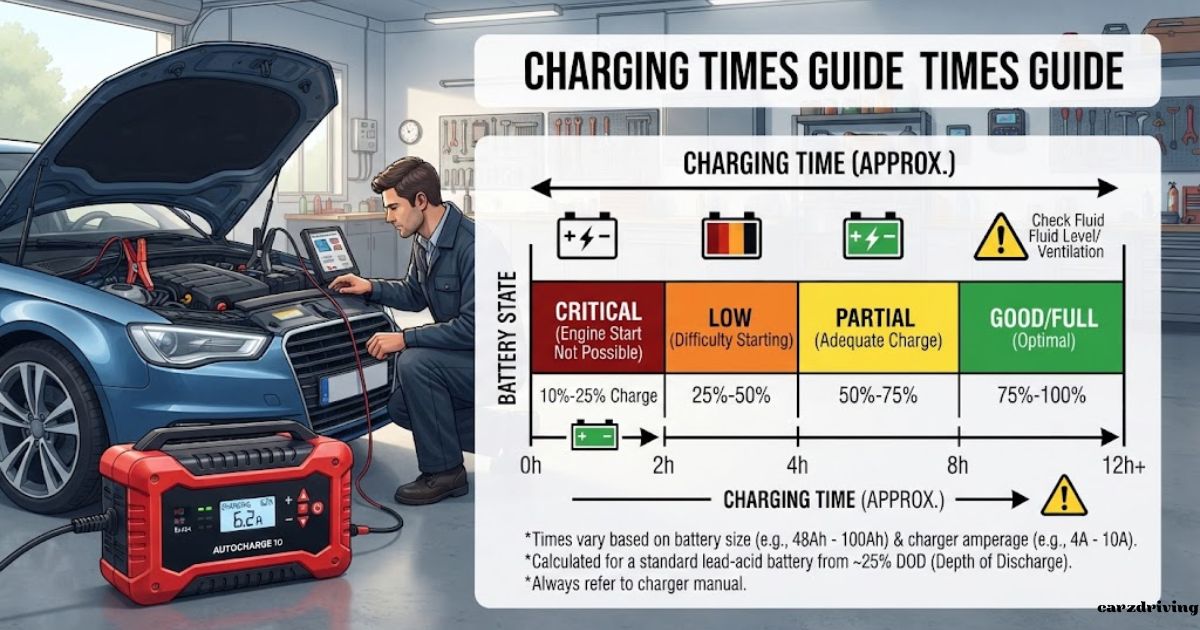
Before you plug in, keep four simple points in mind. First, a regular car battery generally needs 10-24 hours on a gentle setting for long term performance and long life, whereas a stronger boost battery setting at 4-8 amperes can rapidly finish the job in 2-4 hours. Second, don’t rush things just to start the engine sooner pushing current in too fast risks damage, and recharging slowly is almost always kinder to the cells over time.
Key Factors That Affect Car Battery Charging Time
Charging time depends on several factors working together. Battery capacity, measured in amp-hours or expressed as an Ah rating such as 40Ah or 80Ah, is the biggest one: small batteries in compact city cars charge quicker, while SUVs and vans carrying more electrical systems, headlights, and accessories need larger cells that take longer per hour on charge.
The charging rate you pick matters too gentle trickle chargers at 2A, standard domestic chargers at 4-6A, faster smart chargers at 8-10A, and heavy-duty workshop units at 20A+ all give very different charger outputs, with lower amps being gentler and better for maintenance on classic cars, while higher amps work faster but add stress if the battery is overused.
A new healthy battery with full capacity in good Ah condition charges quickly and efficiently, whereas an older battery struggling to hold a charge, or already showing sulphation, may never hold a charge permanently even after a full cycle, meaning replacement is the sensible
move rather than sitting dead for days or weeks. Much like a fuel tank needs fuel or an engine needs electricity, petrol cars and diesel cars both drop in voltage the same way when going flat, and a discharged battery left unattended only gets worse.
Temperature and environment change charging efficiency too: cold conditions slow the chemical reactions inside the cells, extending charging time and making it harder for the battery to keep holds charge well, while hot conditions and hot weather raise the risk of heat buildup and overheating, which can cause real damage to the amp rating over time.
A smart charger will monitor the whole process and adjust the charging rate automatically to protect the battery whatever the cold weather or heat throws at it.
Simple Way to Estimate Your Car Battery Charge Time
For a rough estimate, use this simple formula: divide Battery Ah by Charger amps, then multiply by a 1.2 factor to allow for energy losses, since no charger is truly 100% efficient.
As a rule of thumb, a near-empty 60 Ah battery on a 5A smart charger works out to roughly 14 hours, and once you run it through the charging time formula properly, the real-world charging time for a typical UK car lands closer to 14.4 hours a handy way to optimise the charge before you even start.
Using A Mains Car Battery Charger
A mains-powered charger plugged in at home is generally the safest option for safe home use, and it hands you full control over the whole process. Good car battery chargers, including trusted names like Battery2U, are reliable enough to revive weak batteries through reconditioning and desulphation modes without damaging electrical systems, and many smart chargers will automatically cut off or slip into maintenance mode, preventing overcharging and enabling a safe long-term connection to extend battery life whether you drive small city cars, larger SUVs, or vans.
How To Safely Charge Your Car Battery at Home
Follow a few basic safety steps before you connect the charger. Park on a level surface, apply the handbrake, turn the engine off, and take the keys out; keep the area clear of open flames and sparks, and make sure there’s decent ventilation around whichever battery type you’re working with.
Check the voltage, usually 12V on most modern cars, then attach the red clamp to the positive terminal and the black clamp to the negative terminal, or to a metal earth point on the vehicle chassis if the manual says so, matching red and black terminals correctly before you switch on the charger in the correct mode.
What To Look for During Charge
While the battery charges, keep an eye on the indicator lights or display on smart chargers to track progress. If you notice a strong smell, or the case feels battery hot to the touch, stop charging at once and call a professional; otherwise the unit should slide into maintenance mode by itself once charging complete appears.
How To Tell When Your Car Battery Is Fully Charged
The clearest way to confirm a 12V lead-acid battery is full is with a digital multimeter: check the battery voltage at rest, a few hours after being disconnected, and look for a reading around 12.6-12.8V.
For simple DIY testing without a multimeter, most visual signs work well enough a green light or a steady display on the smart charger though anything odd should always be treated as a possible safety issue.
When Charging Isn’t Enough: Signs You Need a New Battery
Sometimes no amount of charging will fix things. Slow cranking, dashboard warning lights, or charging warning lights that won’t clear even after a full charge all point to a cell that can’t be revived. Watch for visible damage such as swelling or leaking on the case, or needing a frequent recharge just to manage one jump-start all clear signs it’s time to replace the battery instead of fighting it further.
When To Stop Trying to Revive a Battery
Most car batteries last between four years and six years under typical UK driving conditions, and once genuine physical deterioration sets in, repeated attempts at charging become pointless. If a battery fails to hold a charge and keeps causing breakdowns or extra alternator stress, it’s both safer and more economical to simply replace it.
Roundup
How long to charge a car battery? In short, getting a decent charge back into your car depends on several factors, from battery size to weather conditions, and can take anywhere from three hours to a full day.
Keeping your vehicle reliable sometimes just means knowing when charging will do the job and when replacement is the smarter call and if you need help fast, a new battery can be delivered quickly once you get in touch.
FAQs
How long does it take to charge a car battery?
A flat car battery usually needs 1 to 24 hours to reach a full charge, depending on the charger type and battery size.
Can I speed up charging with a smart charger?
Yes a smart charger at 10A can bring most car batteries back in just three to four hours.
Will driving my car charge a dead battery?
A steady 20-30 minute drive on the motorway helps the alternator give an adequate charge, but it won’t fully recharge a deeply discharged battery.
Is it safe to leave my car battery charging overnight?
Yes, as long as you use a smart charger with automatic cut off, it’s completely safe and prevents overcharging.
How do I know when my car battery is fully charged?
Check for a green light or steady display on the charger, or test the battery voltage with a multimeter don’t let a flat battery catch you off guard again.